
ADVERTISEMENTREMOVE AD

Assam's Barak Valley to See Bipolar Fight as BJP-Cong Muscle Out Other Parties

BJP is banking on delimitation, CAA and development pegs in Barak Valley, but internal discontent remains a worry.

Published
story-hero-img
i
Aa
Aa
Small
Aa
Medium
Aa
Large

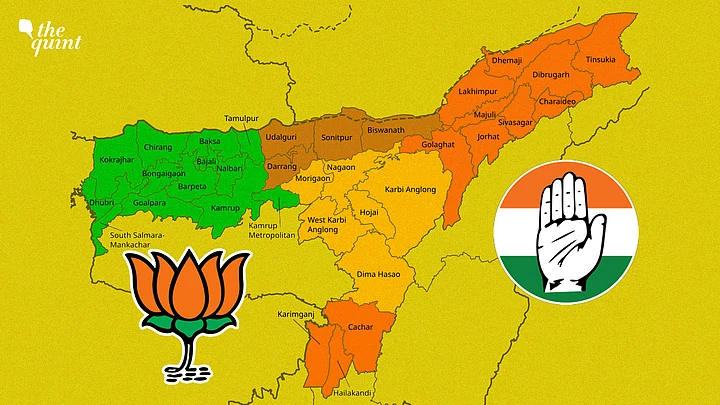
Assam's Barak Valley is quite distinct from the rest of the state in terms of religion and language. The demography of the valley is almost equally divided between Hindus and Muslims. Linguistically, the Bengali language, with over 80 percent speakers, remains dominant. Following delimitation, the region has also seen a change in the Assembly seats. This time, the seats are down to 13 from the previous 15. Along with seats, politics has also changed over the last 15 years in the valley.

In the 2016 elections, the Bharatiya Janata Party (BJP), which had drawn a blank in the region in the 2011 elections, dominated by securing eight seats, while Baddruddin Ajmal’s All India United Democratic Front (AIUDF) gained three seats, emerging as the second-largest party with four seats, largely supported by Bengali Muslims.

The Congress, which dominated the valley in the 2016 elections, experienced a sharp decline of 10 seats, falling from 13 to three.

ADVERTISEMENTREMOVE AD

Winds of Change

The situation has since changed in the valley with the Congress and the AIUDF uniting to prevent the division of anti-BJP votes, primarily the Bengali Muslim votes. This strategy paid well with the Congress-AIUDF combine winning nine seats—the AIUDF securing five, and the Congress four—while restricting the BJP to six seats.

This time, political equations changed again with the Congress refusing to ally with the AIUDF. After the 2021 elections, the Congress started distancing from the AIUDF and targeted the latter for being in a tacit alliance with the BJP.

This campaign has worked well, with Muslims moving largely to the Congress and abandoning the AIUDF’s “lock and key” (party’s election symbol) in the 2024 Lok Sabha elections. The polls saw the Congress’s Rakibul Hussain defeating Ajmal by a landslide margin of over 10 lakh votes from his bastion Dhubri.  

Barak: A BJP Bastion 

For the BJP, Barak Valley is significant. In the 1991 elections, when the party first opened its account in the state, securing 10 seats, nine came from the valley.

This time, the saffron party’s aim is to improve its tally. To achieve this, it is banking on Hindu polarisation by highlighting the Citizenship Amendment Act (CAA), as a chunk of Hindu Bengalis of the valley came from erstwhile East Pakistan (now Bangladesh).

Importantly, following the delimitation, the demography has changed with Hindus becoming dominant in 10 seats of the valley. In the last Lok Sabha elections, the National Democratic Alliance (NDA) led in these 10 seats, mostly with large margins—highlighting its dominance in the valley, facilitated by delimitation.

Apart from this, the party is banking on a development and infrastructure push in the valley. Prime Minister Narendra Modi himself was there in Silchar on 14 March to inaugurate and lay foundation stones for various development projects worth Rs 23,550 crore.

It has to be said that the long-delayed arrival of broad gauge-railway to the valley was completed only after the BJP came to power in 2014. The new route directly connects the valley with the rest of the country. This has, undoubtedly, changed the scenario of the region once isolated.

As far as the candidates go, the saffron party has given preference to experience. It has nominated both the state ministers—Krishnendu Paul from Patharkandi and Kaushik Roy from Lakhipur. It has also nominated former Silchar MP Rajdeep Roy, who wasn’t given a ticket in the last Lok Sabha elections, from the Silchar Assembly constituency. It fielded sitting Congress MLA Kamalakya Dey Purkayastha from Katigorah. 

However, internal discontent remains a worry for the saffron party. Rajdeep’s nomination hasn’t gone well with a section of saffron’s grassroots.

This time the saffron party denied tickets to Mihir Kanti Shome (Udharbond), Dipayan Chakraborty (Silchar), and Nihar Ranjan Das (Dholai). Although the saffron party has been able to dissuade them from rebelling against the party, concerns of silent rebellion by their supporters do remain. 

The Karimganj North seat also remains a concern as in the last Lok Sabha elections the BJP had a lead of only 6,902 votes. This time it has nominated Subrata Bhattacharjee, former party district president of Karimganj district, now called Sribhumi. In the last election, the seat was won by the Congress’s Kamalakya Dey, who is now the BJP’s candidate from Katigorah.

ADVERTISEMENTREMOVE AD

BJP Banks on AGP in Muslim-dominated Seats

In the last Lok Sabha elections, Congress had a lead in three Muslim-majority seats—Sonai, Algapur-Katlicherra, and Karimganj South. Aware of its least chances, the BJP has left these three seats to its ally Assam Gana Parishad (AGP). 

In Sonai and Algapur-Katlicherra, the AGP has given tickets to two AIUDF sitting MLAs, Karim Uddin Barbhuiya and Jakir Hussain, respectively. Only in Karimganj South, the party gave ticket to Ikbal Hussain, a grassroots leader. 

From the candidate list, it becomes clear that the AGP’s influence among Muslims is limited in the valley. So, it has to select candidates from the AIUDF to get Muslim votes. This strategy, however, is unlikely to help the AGP win any seat, with a majority of Muslims unlikely to vote for a BJP ally, although the former sees a chance in the Sonai seat due to internal dissent within the Congress.

ADVERTISEMENTREMOVE AD

Old Timers, New Faces & Turncoats in Congress List

The challenge for the Congress, while being hopeful to retain Muslim votes, is to get back its lost base among the Bengali Hindus. To counter the BJP’s polarisation, the party has been focusing on price rise, unemployment, and the reduction of two Assembly seats in the valley, alleging it as a step-motherly attitude of the state government. 

In terms of ticket distribution, the grand old party followed a mixed strategy: old timers, new faces, turncoats, and social balancing.

It has given tickets to leaders like Abhijit Paul in Silchar and Ajit Singh in Udharbond. In Borkhola, it fielded Dr Amit Kumar Kalwar, a medical practitioner who recently joined the party.

However, the party's list also contains turncoats. In the Patharkandi seat, it gave the ticket to Kartik Sena Sinha, who got elected from the seat on a BJP ticket in 2006. In Katigorah, Congress placed its faith in Amar Chand Jain, who was also a BJP MLA. In Lakhipur, it nominated Dr M Shanti Kumar, who earlier contested elections on a TMC ticket. In the Sonai seat, it gave a ticket to Aminul Haque Laskar, who earlier was an MLA from the BJP. 

In terms of social balancing, the Congress has given tickets to two small linguistic communities in the valley. Kartik Sena belongs to the Bishnupriya Manipuri community while Shanti Kumar belongs to the Meitei Manipuri community.

Like the BJP, the grand old party is hit by internal dissent. The party’s social engineering in Lakhipur isn’t liked by several local leaders, who had demanded for a change of the candidate given the small percentage of Meitei community in the seat. Also, they alleged that the candidate isn’t a local.

On the other hand, Cachar District party president Sajal Acharjee had written a letter to state party president Gaurav Gogoi to reconsider Aminul Haque’s candidacy to safeguard the seat from possible setback. 

ADVERTISEMENTREMOVE AD

AIUDF, TMC Remain Impactful in Some Seats

In the last elections, the AIUDF contested five seats in alliance with the Congress and won all the seats. Within five years, two of the MLAs left the party and got tickets from the AGP.

The other three have also faced suspensions from the party. As a result, this time the party has been contesting only on four seats, an acceptance of how the party lost its strong influence in the valley.

The four seats where the party is contesting are Karimganj North, Karimganj South, Sonai and Ram Krishna Nagar (SC). While the party has opted for Muslim candidates in Karimganj North, Karimganj South, and Sonai, while in Ram Krishna Nagar, it has nominated a Hindu candidate. 

Apart from defections of prominent leaders and MLAs, another major reason for the AIUDF’s erosion of base is due to the Congress recovering its lost base among the Muslims in the valley. In the last few years, the grand old party has been campaigning to portray the AIUDF as a “B-team of BJP”—and it seems this strategy of Congress has clicked among a large section of Muslims. With the AIUDF and the Congress sharing the same Muslim support base, the weakening of AIUDF has increased Congress prospects in the Muslim areas. 

This time, only in Karimganj North, AIUDF, according to the Lok Sabha 2024 elections, is going to be acting as a vote cutter and hurting Congress’s prospects. In other seats, AIUDF is unlikely to be a major factor. 

On the other hand, the Trinamool Congress has announced candidates for only five seats—Udharbond, Katigorah, Sonai, Karimganj North, and Karimganj South. The party’s state unit is led by Sushmita Dev, a former Congress MP from Silchar. Despite this, the party wasn't able to field any candidate in five Assembly constituencies, including Silchar Assembly seat, falling under the Silchar Lok Sabha seat.

This shows Sushmita’s limited influence in the valley, including the Silchar area, and limiting TMC as a minor player in the valley. Only in Karimganj South, it can act as a major vote-cutter due to its candidate Aziz Ahmed Khan, a former AIUDF MLA.

ADVERTISEMENTREMOVE AD

It can thus be said that the BJP has a lead in the valley, banking on delimitation, identity politics, and development. However, anti-incumbency and internal dissent may hurt its prospects in a few seats.

On the other hand, while the Congress banks on unemployment, price rise, and the alleged step-motherly treatment of Barak Valley, its failure to counter the BJP’s identity politics is likely to hurt its prospects in many Hindu-dominated seats.

One thing is clear: driven by identity politics, Barak Valley is politically polarised this time between the BJP and the Congress, leaving little space for other players like the AIUDF and the TMC.

(Sagarneel Sinha is a political commentator and tweets @SagarneelSinha. This is an opinion piece and the views expressed above are the author’s own. The Quint neither endorses nor is responsible for them.)

Speaking truth to power requires allies like you.
Become a Member
Monthly
6-Monthly
Annual
Check Member Benefits
×
×