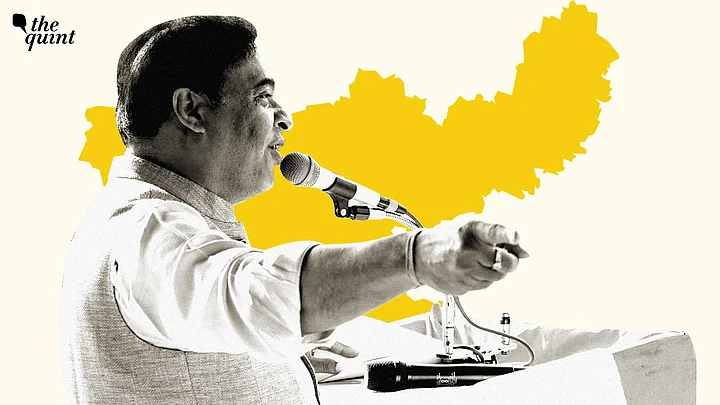
On 24 January, Assam Chief Minister Himanta Biswa Sarma made a statement that brought unusual clarity to how power is being exercised in the state. Speaking to the media amid mounting concern over the ongoing Special Intensive Revision (SIR) of electoral rolls, Sarma stated that notices were being issued only to “Miyas”—a term used for Bengali-speaking Muslims in Assam and widely regarded as pejorative—and that this was deliberate.
Speaking to reporters, he said,
“Which Hindu has got notice? Which Assamese Muslim has got notice? Notices have been served to Miyas… else they will walk over our heads.”
He went on to add, with unusual candour, “We are giving them trouble… to keep them under pressure.”
Targeted Scrutiny
What appeared as procedural confusion begins to look different when the Chief Minister himself describes pressure as intent, not error.
These were not off-the-cuff remarks or a rhetorical slip. They were repeated, explained, and defended. The Chief Minister also linked the issuance of notices to eviction drives and action by the border police, saying this was meant to signal that, in his words, “the people of Assam are resisting them.”
What is striking is not merely the language, but the premise it reveals: that pressure, disturbance, and targeted inconvenience are legitimate tools of governance when directed at a named community.
For weeks now, Assam has been in the midst of a tense voter list revision ahead of Assembly elections expected later this year. As widely reported by The Quint and many other media outlets, the claims-and-objections process has been marked by confusion and anxiety. Reports have documented allegations of bulk objections being filed using Form 7, of individuals being summoned to hearings on the claim that they were “dead” or had “shifted”, and of district administrations suspending proceedings following complaints of unauthorised or irregular access to electoral databases.
Opposition parties have filed police complaints alleging attempts to tamper with electoral rolls, including unauthorised access to official systems. Minority communities, particularly Bengali-origin Muslims, have spoken of panic, humiliation, and a fear of being erased from the rolls.
A Constitutional Line Crossed
Until now, these developments could be—and often were—described as administrative lapses, procedural misuse, or overzealous verification. The Chief Minister’s own statements collapse that explanation. When the head of an elected government openly acknowledges that notices are meant to “keep” one community “under pressure”, the issue is no longer bureaucratic error. It is declared intent.
This is where the constitutional question begins.
A Chief Minister does not speak merely as a party leader or campaigner. He is a constitutional functionary. Upon assuming office, every Chief Minister swears to bear true faith and allegiance to the Constitution of India, and to discharge the duties of office without fear or favour, affection or ill-will. That oath is not a formality. It is a moral and constitutional boundary that restrains how power may be exercised.
Publicly announcing that state machinery will be used to disturb or pressure a particular community sits uneasily—if at all—with that oath. It transforms neutral administrative processes into instruments of selective scrutiny. It signals that the State does not stand equally behind all citizens, but watches some with suspicion while leaving others untouched.
Sorting Citizens
By naming “Miyas” as the only group under scrutiny, the Assam Chief Minister redraws the boundaries of belonging—turning citizenship into something some must constantly prove.
Sarma’s remarks are also revealing in how belonging is classified. By insisting that neither Hindus nor “Assamese Muslims” have received notices, the Chief Minister performs a form of official sorting. Some citizens are implicitly legitimate; others must repeatedly prove themselves.
This classification has not been confined to a single statement. In a separate interaction with the media, the Chief Minister went further, openly framing the exclusion of “Miya” voters as both intent and outcome. Responding to allegations of “vote chori”, Sarma said,
“What is vote chori? We just want to steal some Miyan votes.”
He added that, “Going by the rules, Miyans should not be able to vote here—they should vote in Bangladesh.”
Sarma claimed that arrangements had already been made to prevent them from voting in Assam, describing the present measures as preliminary. “When the SIR comes to Assam,” he said, “five to six lakh Miyan votes will have to be deleted.” Addressing political criticism, he added, “The Congress can abuse me if they want. My job is to trouble the Miyans.”
In Assam, this carries a particular historical weight. The state has lived through decades of citizenship verification—from “D-voters” to Foreigners’ Tribunals to the National Register of Citizens (NRC). In such a context, signals from the top are not abstract. They shape how officials act, how discretion is exercised, and whose presence is treated as provisional.
When intimidation is articulated from the highest political office, it does not remain rhetorical. Police officers, election staff, and local administrators do not operate in isolation. They receive cues—explicit or implicit—about whom the law should inconvenience and whom it should spare. What might otherwise be defended as discretion begins to resemble policy.
This pattern is not confined to Assam, but it is unusually explicit here. According to India Hate Lab’s 2025 report, India recorded 1,318 in-person hate speech events in a single year. Assam accounts for 32 of these.
Notably, 16 of them are attributed to Chief Minister Sarma himself. The importance of this data lies not in moral condemnation, but in constitutional diagnosis. When hate speech becomes frequent, public, and politically rewarded, the risk is that state inaction, or tacit endorsement, begins to harden into a mode of governance.
Oath Versus Office
In a recent article for Bar & Bench, I argued that hate speech should be understood as a constitutional event. It reshapes the conditions under which equal citizenship is lived. Harm does not begin with physical violence; it begins when fear is normalised and public space narrows. Sarma’s remarks fit this pattern precisely. They are not warnings against unlawful conduct issued through legal process. They are announcements of unequal treatment.
Indian constitutional law is not indifferent to such developments. Article 14 guarantees equal protection of the laws. Article 21 has been interpreted to include the right to live with dignity and the State’s duty to prevent foreseeable harm.
In a constitutional democracy, no one is “illegal” by declaration or description. Citizenship is determined through law, evidence, and adjudication—by competent tribunals, not televised assertions or collective suspicion. When eviction, electoral revision, and policing are framed as tools to discipline identity, citizenship itself becomes conditional.
The oath that a Chief Minister swears is not to a party, nor to a community, but to the Constitution of India. To govern in defiance of its equal protection is to reduce that oath to rhetoric—and to erode the very idea of citizenship it exists to protect.
This is neither about Assam nor only about one community. It is about what happens when intimidation is openly justified, absorbed administratively, and defended politically. Democracies do not always erode through emergency proclamations or suspended rights. Sometimes, they erode when constitutional oaths are recited in the morning—and repudiated by evening speeches.
(Sahil Hussain Choudhury is a lawyer and Constitutional Law Researcher based in New Delhi. His X handle is @SahiHChoudhury and his Instagram handle is voxjuris_ & Linkden. This is an opinion article and the views expressed above are the author’s own. The Quint neither endorses nor is responsible for them.)