
ADVERTISEMENTREMOVE AD

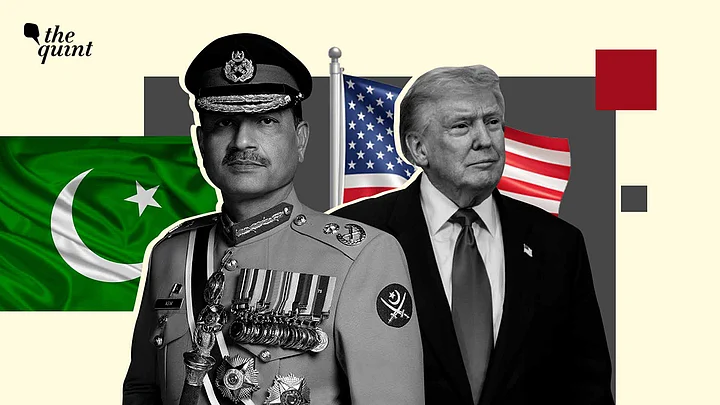
Trump & Asim Munir: A Geopolitical Situationship

Asim Munir’s mediation style and Trump’s deal-making instincts appear to speak a similar dialect.

Published
story-hero-img
i
Aa
Aa
Small
Aa
Medium
Aa
Large

It almost sounds like a love story—except instead of handwritten notes exchanged between gushy teenagers, it involves a dour Field Marshal and a patently abrasive American President. The other protagonist in this cross-continental “romance” is Donald Trump—perhaps the last person one would expect to be penning hosannas or sonnets for anyone other than himself. Yet, that is precisely the tone he strikes when he refers to his “favourite Field Marshal,” alongside Pakistan’s Prime Minister, as “great people,” “extraordinary men,” and part of a “kind and competent leadership.”

Reciprocally, the usually unsmiling Field Marshal Asim Munir—who carries the emotional expressiveness of a sealed security dossier—is suddenly all diplomatic smiles and carefully calibrated warmth in the presence of Trump.

Like his ideological template General Zia-ul-Haq, Munir is a Hafeez-e-Quran (one who has memorised the Quran) and is not known for theatrical flourish or conversational exuberance. His public persona is more institutional than intimate, more briefing note than banter, more command post than conversation.

Even the United States’ number-two man, Vice President JD Vance, could not resist adding a touch of teasing ambiguity to the narrative. In a remark that was half light-hearted and half revealing, he noted: “An Indian and a Pakistani are the two most important people in my life.”

The “Indian” being his wife, and the “Pakistani” not the President, not the Prime Minister, and not even a rotating cricket captain—but the Five-Star Field Marshal of Pakistan’s ever-elusive “establishment,” believed to operate somewhere between Rawalpindi GHQ and a cloud of strategic ambiguity.

ADVERTISEMENTREMOVE AD

In Munir, Vestiges of Pakistan's Past

Field Marshal Asim Munir has, in recent times, been moving with unusual urgency across Washington, Riyadh, Dubai, Beijing, and even Tehran, attempting to stitch together some of the world’s most incompatible conversations, like a hyperactive diplomatic tailor trying to fit garments onto a mannequin never designed for a single cut.

There is a distinct déjà vu here, reminiscent of General Yahya Khan’s shuttle diplomacy in the early 1970s between China and the United States, when he attempted to bring adversaries into dialogue that struggled even to agree on the shape of the negotiating table.

In the grand theatre of geopolitics, Munir’s mediation style and Trump’s deal-making instincts appear to speak a similar dialect—one where diplomacy is fundamentally transactional, and success is measured by who walks out believing they secured the better bargain. In such brokerage ecosystems, the broker invariably takes his ‘cut’ (financial, diplomatic, personal, or otherwise) and often emerges stronger within a system as constrained and resource-strapped as contemporary Pakistan. It is a space where symbolism often travels faster than substance, and where carefully staged optics can temporarily outpace structural reality.

Ironically, both the austere (and often described as ideologically rigid) Zia-ul-Haq and Asim Munir have courted the United States with striking consistency.

Serendipitously, both trace familial roots to Jalandhar—Zia himself and Munir’s father—making them, in a sense, products of migration histories shaped by partition and its attendant instincts of caution, adaptability, and survival.

Serendipitously, both trace familial roots to Jalandhar—Zia himself and Munir’s father—making them, in a sense, products of migration histories shaped by partition and its attendant instincts of caution, adaptability, and survival.

While Zia famously eliminated his civilian patron, Zulfiqar Ali Bhutto, sending him from political marginalisation to the gallows, Field Marshal Munir operates in a different ecosystem, one where the civilian government is widely viewed as fragile, fragmented, and constrained. In such a landscape, even Washington appears to understand instinctively whom to engage, whom to praise, and whom to politely overlook.

Thus, if geopolitics ever held casting calls, Asim Munir would be the perennial supporting character who appears in every Washington script—always referenced, rarely defined, and consistently described in unusually warm diplomatic tones.

Constitutional Validity Barely a Constraint

The question of constitutional constraint naturally arises: is there any institutional mechanism capable of checkmating such consolidation of influence?

In practical terms, the answer appears increasingly uncertain, given the prevailing civil-military balance.

As Zia-ul-Haq once remarked with characteristic bluntness: “What is a constitution? It is a booklet with twelve or ten pages. I can tear them away and say that tomorrow we shall live under a different system. Today, the people will follow wherever I lead.”

Thus, while Donald Trump and JD Vance may appear ideologically distant from Asim Munir, both sides ultimately operate within a framework where strategic utility outweighs ideological alignment. It is a dynamic not unfamiliar to history: Zia-ul-Haq managed a similar equilibrium with Ronald Reagan, the Hollywood-trained storyteller turned Cold War president, during an era defined by shared interests and mutual convenience rather than genuine affinity.

In the end, there is no authentic “romance” between Trump, JD Vance, and Field Marshal Asim Munir—only a long-running geopolitical situationship. Trust issues are publicly aired, accusations of “double standards” occasionally surface, and yet the phone keeps ringing, because inconveniently, each side still needs the other.

It is a logic that would sit comfortably in the world of The Art of the Deal (ghost-written book attributed to Donald Trump), where relationships are measured less in sentiment and more in leverage and transactions.

And perhaps that is the final irony: even a religiously austere military leader must navigate the transactional grammar of global power, just as Washington must periodically rediscover the utility of engagement.

In such a world, there is no love, only mutual necessity, carefully wrapped in better PR, and sustained by the uncomfortable reality that in geopolitics, absence is rarely an option and indifference is even less affordable.

(Bhopinder Singh is a Former Lt Governor of Andaman & Nicobar Islands and Puducherry. This is an opinion piece and the views expressed above are the author’s own. The Quint neither endorses nor is responsible for the same.)

Speaking truth to power requires allies like you.
Become a Member
Monthly
6-Monthly
Annual
Check Member Benefits
×
×