
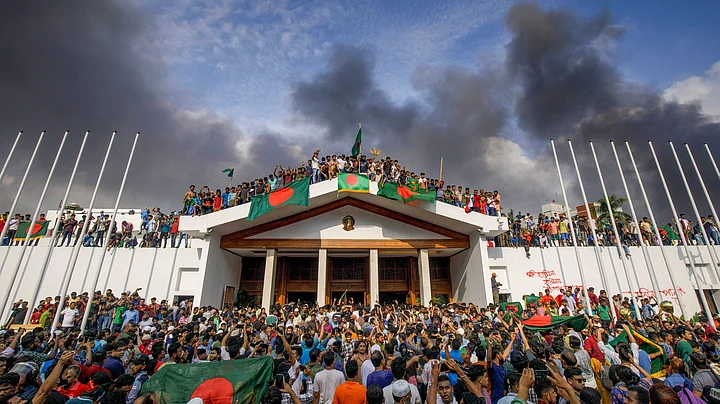
Dr Muhammad Yunus became the Chief Advisor of the interim government of Bangladesh after former Prime Minister Sheikh Hasina resigned and fled the country.
The other advisors are:
Dr Salahuddin Ahmed (an advocate of IMF’s Good Governance)
Dr Asif Nazrul (former member of the ‘Ekattorer Ghatak Dalal Nirmul Committee’, although that ended with controversies and a critique of Indian Expansionism in water politics, border killing etc)
Adilur Rahman Khan (the founder of ‘Odhikar’ that published an annual list of deaths along the Bangladesh–India border)
Hassan Ariff
Tauhid Hossain
Syeda Rizwana Hasan
Md Nahid Islam (students’ representative)
Asif Mahmud Sajib Bhuiyan (students’ representative)
Brig Gen (Retd) M Sakhawat Hossain
Supradip Chakma (former bureaucrat of the fascist Awami League)
Farida Akhtar
Bidhan Ranjan Roy
Dr AFM Khalid Hossain (the only advisor who was a politician; former vice-president of Hefazat-e-Islam Bangladesh, a party that proposed a 13-point program that included gender segregation and that has a previous history of spreading extremist views against other Hindus, Ahmadi Muslims, seculars and atheists)
Nurjahan Begum
Sharmin Murshid
Farooqui Azam
If the advisors are selected on the basis of being ‘civil society’ representatives, then some questions arise:
What was their role in the student-mass uprising?
Did any of them have any roadmap for the transition from an interim government to a democratic Bangladesh?
If it was a student-led mass uprising, where is the participation of the masses in the selection of advisors or policies of the interim government except for some of the ‘coordinators’ of the movement?
Why aren’t there representatives from all social classes in the interim government?
The members of the University Teachers’ Network were present in the movement since the beginning and they even proposed an outline for transition to a democratic Bangladesh free of discrimination on 4 August 2024, but none of their members were called for a roadmap.