
ADVERTISEMENTREMOVE AD

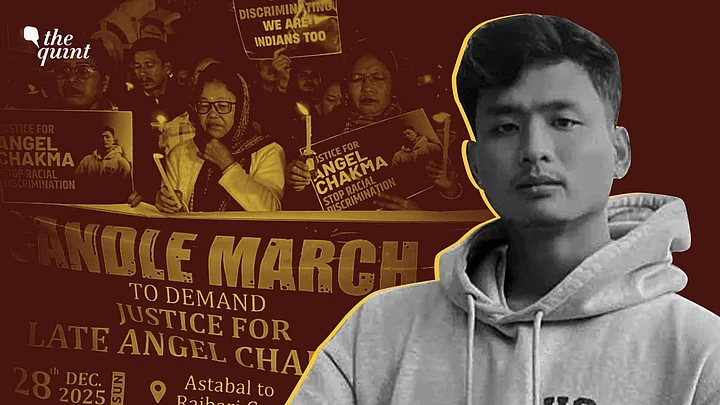
Anjel Chakma’s Killing and the Cost of Being ‘Not Indian Enough’

Anjel was from Tripura, but his experience is that of many people from across the northeast of India.

Published
story-hero-img
i
Aa
Aa
Small
Aa
Medium
Aa
Large

Anjel Chakma’s death should not die down as just another racial attack against a student from India’s North East. It should not become another legal footnote, another case in which those arrested get out on bail in a matter of time and the case closed due to lack of evidence, all because of deficiencies in investigation that our policing system is riddled with.

Imagine a 24-year-old youth in his final year of MBA, sent out by his parents with so much hope that one day, he would be employed in one of the many business houses' management teams. Those hopes and dreams have ended in a horrific dismay after Chakma was stabbed to death in Dehradun, Uttarakhand, after being subjected to derogatory but only too common racial slurs.

This is not the first time that intolerance against those who look different has claimed lives in this country. Anjel was from Tripura, but he could have been from any state of the North East, as far as his facial features are concerned.

ADVERTISEMENTREMOVE AD

New India but Same Old Intolerance

Be it Bengaluru, Delhi, or Dehradun, the level of ignorance of the average Indian about their own country is appalling. Most grow up believing that every Indian should necessarily be born with those sharp Aryan features. Even the colour of the skin is made much of. Hence, South Indians are derided for their dark skin.

When I lived in Philadelphia for a brief while, in 2006, I recall fellow Indians warning me that if I were to drive through a particular area of Ardmore, I should be extra careful of the ‘kalus', their pejorative reference to the African-Americans. I was appalled that Indians living in the US would harbour such racial overtones.

So, whose fault is it that schools across India don’t teach about the diversity of this country and the many races that inhabit the subcontinent? We all grew up learning about every state of India except our own because even the geography and history books then had so little written about this periphery.

So much so that even today when people visit regions like the North Eastern states as tourists, they find everything about us so different and our customs and traditions weird. The fact that our women, young and old, move around without any hassle, even at night, makes them wonder what part of India they are in.

Many Indians would not know that there are two major races that inhabit the North East—the Tibeto-Burmans and the Austro-Asiatic. The indigenous tribes of the six northeastern states of Arunachal Pradesh, Nagaland, Mizoram, Manipur, Tripura, parts of Assam and the Garos of Meghalaya are all Tibeto-Burman, having migrated from northwestern China to the foothills of Tibet and Myanmar and into the North Eastern region while the Khasi-Jaintia tribes of Meghalaya are Austro-Asiatic belonging to the Mon-Khmer group of languages spoken in Cambodia.

Institutionalised Ignorance

The history of India’s North East is not part of the school curriculum. In our times, we only got to study the history of this region while doing pursuing an Honours degree in History. Our freedom fighters from the region, who stood as bravehearts to defy the might of the British have only recently been written about and such write-ups are only read in academic circles.

They don’t form part of the general curriculum. Students in ‘mainland India’ (as people from the North East usually call other parts of India) would also have learnt about a part of their own country and perhaps learnt to respect the differences in looks, culture, language etc.

This is not another exercise in racial profiling of people from the rest of India but an education on the different aspects of this region inhabited by 238 ethnic groups according to BG Verghese in his book, India’s North East Resurgent. Verghese was one journalist who spent quality time in India’s North East to understand the people, their culture, their aspirations and their setbacks. The book—a primer on understanding India’s North East— was written a quarter of a century ago but the average Indian has perhaps not read the book or even come across it. That’s the tragedy of our times. We know more about the history and geography of the Western nations at the cost of our own.

When seen from Delhi, the allusion to India’s North East is a reminder of its geographical distance from the capital. But for those of us residing in these northeastern hills, mountains and valleys, the seven states are the centre of our world.

When our ancestors signed the Instrument of Accession to the Indian State, they perhaps did not envisage how the region's politics would be defined by Delhi, and that the mental and emotional integration with a“India” would take more than a lifetime of trying.

ADVERTISEMENTREMOVE AD

An Undeclared Apartheid

Anjel’s death relives this emotional distance and the inability of the average Indian to accept that there are parts of their own country where people’s facial features are different and may even be closer to how the Chinese look. But so what?

This is what migration has wrought the world over. After the end of the Apartheid regime in South Africa on 17 March, 1992—a regime that had claimed countless lives, was over and done with, we thought the world was a little better than it was. But we are mistaken. In India, there is a different kind of racial apartheid—subtle but alive and kicking. And Anjel Chakma is a victim of that undeclared apartheid.

That Anjel Chakma’s father serves the Border Security Force (BSF) — a force that guards our borders and hence a security institution that demands complete allegiance to the country and its symbols — the Indian flag and national anthem etc, does not seem to matter to the ignorant masses that inhabit this country.

India’s North East is connected to the ‘mainland’ by a 22 km corridor – the Siliguri corridor. The region shares just one percent of its boundaries with India and the rest 99 percent with countries like China, Nepal, Bhutan, Tibet, Myanmar, and Bangladesh is perhaps something that even the nation does not take seriously. True that the region lacks the best educational infrastructure hence student migrate to the rest of India with the hope of making a better life for themselves, but some return home dead, only to be buried in their sacred homelands.

While five people have been arrested for the murder of Anjel Chakma, who was done to death in the most horrific manner with one of the murder accused fleeing to Nepal, the people of this region must stand united to demand justice for the deceased young man.

Anjel breathed his last on 26 December, following severe injuries inflicted on his head and body parts. Graphic Era Hospital where Anjel was treated revealed that he suffered severe head, back, and spinal injuries and died after 17 days of treatment.

No one can fathom the grief of parents losing a son at the prime of his life. But the entire region has also lost a valuable son who stood to defend every North Easterner and would not take racial abuse lying down and paying for that with his life.

People of the North East cannot forget this racial slur and need to fight back by ensuring that Anjel’s killers spend the rest of their lives in jail.

(The writer is the Editor of The Shillong Times and a former member of NSAB. She can be reached at @meipat. This is an opinion piece and the views expressed above are the author’s own. The Quint neither endorses nor is responsible for them.)

Speaking truth to power requires allies like you.
Become a Member
Monthly
6-Monthly
Annual
Check Member Benefits
×
×