“New York Vich Munda Rehnda, Sohniye Punjabiye!”
(O beautiful Punjabi woman, the boy lives in New York).
The world watched as New York Mayor Zohran Mamdani, first Muslim and South Asian-origin person to ever be elected to that office, took his oath on New Year’s Day, 1 January 2026. From the choice of venue—a decommissioned Manhattan subway station—to swearing on the Holy Quran, the private ceremony was full of symbolism.
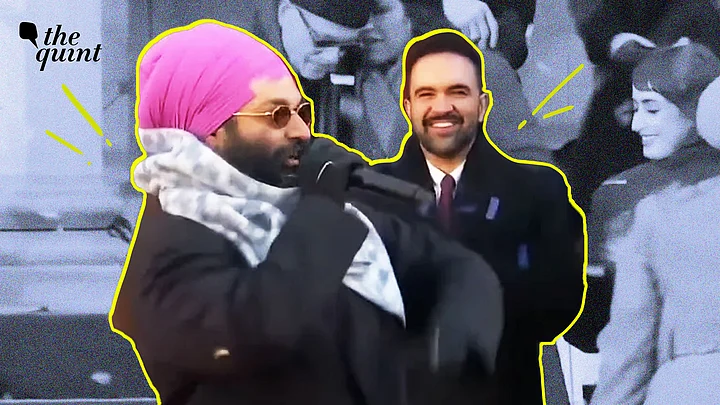
But what also got heads rolling was the flamboyant Punjabi music performance at his public inauguration at the New York City Hall, just hours later.
Skipping an otherwise traditional orchestra symphony, Mamdani’s inauguration featured pop artist Babbulicious—donning a fuschia dumalla (traditional round turban) with a long flowing beard—singing his famous song, ‘Red Challenger’.
Both Mamdani and his wife Rama Duwaji were seen vibing to the lyrics, with Mamdani seemingly caught off-guard as Babbulicious tweaked the lyrics to the tune of New York. The song is originally based in the artist’s city, Brampton, Canada.
The moment resonated far beyond music. A Sikh pop artist performing at the inauguration of New York’s first Muslim mayor struck a new chord in cultural representation in American politics, especially in a city still shaped by the trauma and aftermath of the 9/11 attacks.
However, despite symbolism, both Mamdani and Babbulicious faced vicious attacks online.
Rising Hatred & A Case of Mistaken Identities
Ever since Mamdani announced his candidacy, his campaign and subsequent election have been subjected to strong Islamophobia. Alt-right social media accounts have been attacking what they call an alleged “Islamic takeover” of America’s most famous city.
Netizens also took to social media to criticise Babbulicious’ performance, with some calling it “Arabic music” by “Muslim men on stage”, comparing Mamdani’s New York to “Afghanistan”.
Sikhs being racialised as Muslims is a case of mistaken identities that goes back decades, and it became especially common after the 9/11 attacks.
In the first month after the attacks—a time which saw an upsurge in Islamophobia—the Sikh Coalition documented over 300 cases of violence and discrimination against Sikh Americans throughout the US.
Simran Jeet Singh, professor at Union Theological Seminary and Senior Fellow at Sikh Coalition, said the instances of anti-Muslim and anti-Sikh hatred have surged in New York, especially with the “anti-Muslim rhetoric around Mamdani’s campaign”.
Asked about the bigotry against Muslims and Sikhs, Prof Singh said, “No one should attack someone else based on their religion, whether Muslim, Sikh, or otherwise. It would also be great to live in a world where people understand one another’s different backgrounds and respect them.”
While it’s pertinent to portray Sikhi as a distinct identity, Prof Singh said it’s also important for Sikhs “not to throw a different group under the bus” while doing so.
He said:
“First, it’s important for Sikhs not to deflect hate towards Muslims. Sikhi teaches us that no one should be attacked for their beliefs. Instead, we should end the cycle of hate, whoever the target is. At the same time, spreading education and awareness about different religions, including Sikhi, can help resolve people’s ignorance and create more understanding.”Prof Simranjeet Singh
The hate was not limited to those donning turbans or beards.
Former Columbia University professor, Manav Sachdeva, who currently works as Humanitarian Food Security Ambassador for President Zelenskyy’s Office, said: “The tragedy of 9/11 was compounded by the moral failure that followed: entire communities became collateral to rage. Muslims bore the brunt, but essentially all brown folk were considered a suspect—Sikh, Hispanic, Mixed, Muslim, Hindu—they were all misread, miscast, and sometimes violently targeted.”
He shared that as a graduate student at Columbia in September 2001, he was often called a “terrorist” on subways and on campus.
“I was chased by police on more than one occasion for simply ‘fitting a description’. And, my brother, an officer at Columbia, and I, were ultimately forced to leave our rental housing at Columbia because, according to our lady landlord, 'We looked like guys on TV blowing up the World Trade Centre'.”
Brampton to New York: Rise and Rise of Punjabi Music
Babbulicious is the stage name of the Canadian pop singer Babbu Singh.
Speaking to The Quint via email, Babbu shared that it was Mamdani’s team that reached out to him via social media. Babbu said: “Zohran has been a fan of the culture… Seeing him throughout his election was very empowering. He created a movement of ideas that represents all of us, and to be a part of that at his inauguration was truly an honour.”
“It’s important in all fields that there is someone who shares your identity. With Zohran Mamdani, his inauguration featured performers from many walks of life. Having a Punjabi Sikh with a big beard was one of the ways he chose to show representation."
The artist added that he's "received many messages since that day from people who felt very happy to see themselves represented through the performance and through Mr Mamdani as mayor".
Speaking on facing racism in the West, Babbu said that his hometown, Brampton, Toronto, has always been a big city with a strong sense of multiculturalism. “So, other than some name-calling here and there, I personally haven’t experienced much racism,” he added.
Asked how music and art can transcend the borders and help eradicate racism, Babbu said: “We need more art! There are so many stories to tell from our communities. Sometimes there’s fear from friends and family to put yourself out there, but if the spark is in you, you gotta let it out!”
“Feel free to feel free!” Babbu concluded the conversation on this note.
Be it Punjabi singer Diljit Dosanjh’s Emmy nomination—albeit for his acting role—or the record-breaking gathering at his performance at Toronto’s Rogers Centre in 2024, Babbu’s performance is the latest string in the quartet of a growing influence of Punjabi music worldwide.
Bringing Communities Together, Mamdani Style!
Prof Simran Jeet Singh also campaigned for Mamdani. He shared: “I ran the New York City Marathon with Mamdani’s poster, a day before the election. While there were a lot of people cheering for us, I also heard some boos, with people shouting ‘Go back home’ or ‘Go where you came from’.”
He said Mamdani’s campaign and subsequent election were also about bringing people from different backgrounds together.
Jaslin Kaur, a Sikh civil rights educator for immigrants and a field leader for Mamdani’s campaign, said the Punjabi community in the US was happy to see a mayoral candidate visiting gurdwaras and advocating for their rights.
She said it was not the first time Mamdani, also a former rapper and son of Punjabi-origin filmmaker Mira Nair, was seen grooving to Punjabi songs.
“The last time I sang to Punjabi music outside City Hall was with Zohran Mamdani and the New York Taxi Workers Alliance at the victory party for the medallion debt forgiveness plan in 2021. We danced with a diverse group of cabbies to songs by Jazzy B, Sukhbir, and Punjabi MC,” Kaur added.
The world watched as the city entered its new political chapter, and New York’s own ‘Munda’ Mamdani rocked to Babbu’s lyrics—and Bernie Sanders clapped along like a supportive Punjabi ‘Daarji’ (grandpa)!