
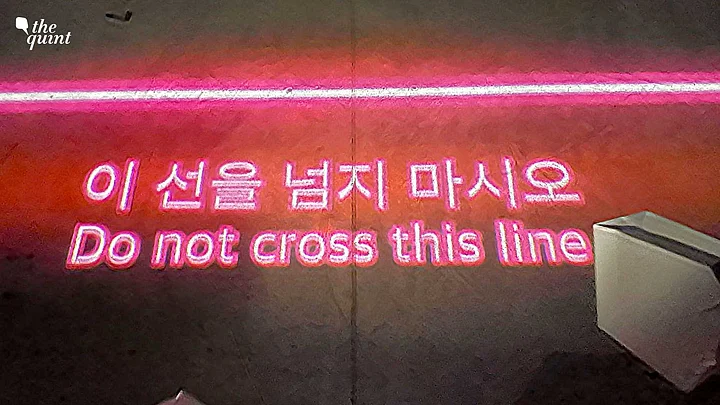
“But India and Pakistan were divided along religious lines,” remarks Vassil Sotirov, a veteran journalist from Bulgaria. "London did not give up on using its last remaining trump cards to perpetuate this division with its familiar divide-and-rule approach..."
Sotirov is trying to "comfort" me by recalling the Partition of India in 1947. We are seated next to each other on a bus from Seoul to the Korean Demilitarised Zone (DMZ), the buffer zone near the 38th parallel that separates North Korea and South Korea.
As a Seoul-born travel curator and guide shares her view of the North Koreans, I can’t help but look visibly shocked.
Contrary to my expectations, she is full of empathy. The 32-year-old talks of the shared cultural heritage between the two Koreas, including the Korean language and Confucian values, rather than the differences caused by the Cold War-era geopolitics that divided the Korean peninsula.
“We are all the same Koreans. We love kimchi, they love kimchi. We’ve only been divided for 74 years,” she tells us.
I murmur to myself – “And so have we.” Unlike Korea, British India's Partition over 75 years ago was not along ideological lines, but fast forward to today, the social and political lines have deepened, and the ‘otherisation’ of Pakistanis seems ‘normalised’ and complete.