"My only hope is that no party gets an outright majority so that neither of the alliances can be in a dominating position," says Mohammed Shafiqul, a 24-year-old software professional living in Dhaka ahead of the 12 February general election in Bangladesh.
On 5 August 2024, Sheikh Hasina, the country's longest-serving premier from the Awami League, was removed from power amid student-led protests. In her absence, the country's political arena was thrown open to a number of hitherto suppressed forces, many of whom are vying for power in the first post-Hasina election.
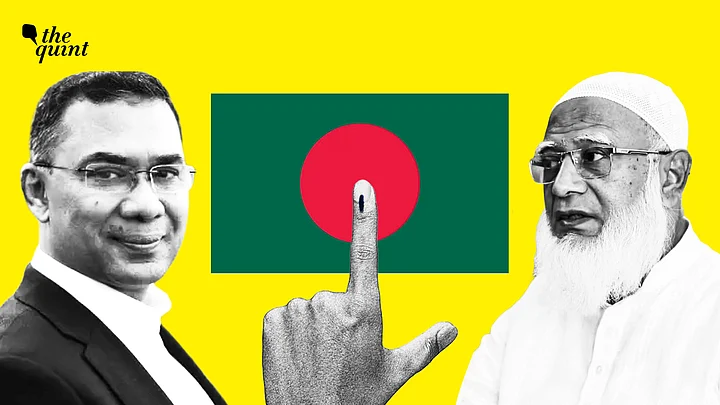
While 51 registered parties are contesting the polls, the two main alliances are the Bangladesh Nationalist Party (BNP) and the Jamaat-e-Islami (JeI)-National Citizen Party (NCP) combine.
While some are hopeful of the emergence of a new political order in Bangladesh, others say that the existing parties have also decided to trudge down the "autocratic" route akin to Hasina.
Lack of Enthusiasm Among the Youth
The upcoming elections have failed to rouse much fervour among the country's youngsters, aged between 18 and 37, who make up around 44 percent of the electorate.
While there was widespread youth disenchantment during the elections in 2014, 2018, and 2024—marred by allegations of vote rigging by the Awami League and Opposition boycotts—it remains to be seen whether youngsters will turn out in large numbers this time around.
"People aren't as enthusiastic about this election as one would imagine, especially young voters," says Shafiqul, a former member of the now-defunct Students Against Discrimination who did not follow suit like many of his colleagues to join the NCP.
When asked about the lack of the apathy among youngsters, 20-year-old Ekram Siffat said:
"People wanted the demon out, and she's out. The existing ones make no difference to us."
Meanwhile, Tarique Rahman's return to Bangladesh in December 2025—after 17 years in exile—is widely being looked upon as a "turning point" in the country's political landscape. "Lakhs of people from across Bangladesh flocked to his Dhaka rally along the elevated expressway—not all die-hards of the BNP," wrote Arka Deb, editor of a Bengali newspaper, in a piece for The Quint.
However, sections of the youth don't seem impressed by the BNP scion.
"We don't believe that he's a candidate out of the box. Just another 'typical' option, that's about it," Siffat asserts.
A Dhaka-based freelance journalist in his mid-20s, who spoke to The Quint on the condition of anonymity, said that for any kind of hopeful change to come about after the elections, a complete overhauling of the system will be needed.
"The country was ruled by an autocratic regime for so long that autocracy has now become ingrained in administrative processes. So, whoever forms the next government will have to fight to reform the administration," he says.
Even as young voters are apprehensive, several groups have been sidelined from voting on 12 February—some by law, others by intimidation.
'Keep a Low Profile or Go Into Hiding'
Following the student-led revolt that toppled Hasina's government, a number of Awami League members, including the party's vocal supporters, were forced to go underground. Members of Students Against Discrimination claim "thousands of the party's members have fled to India since August 2024". And those who didn't have been forced to keep a "low profile".
"I have to keep myself and my family safe. That's the only reason I've remained quiet," a former woman MP of the Awami League tells The Quint.
The ex-MP says she is one of the "lucky few" among members of the Awami League who are still able to live in Bangladesh. The only reason for that, which came as a blessing in disguise, is that she didn't receive a nomination from the party in the 2018 general elections.
"I actually disassociated myself from the party to an extent after I didn't get a nomination. I also wanted to distance myself from the vast corruption and overwhelming abuse of power that had become rampant under Sheikh Hasina."Former Awami League MP
She further says that while she had contemplated going independent in the 2025 elections, she was advised against it by residents of her former constituency. She claims:
"The people there told me not to contest because of just how unstable the situation is currently. The local authorities have been going door to door and taking Awami League supporters to jail without any charges. Every day, their families are being harassed. All my companions are afraid. So much so that they haven't stepped out of their homes in over a year."
In Kolkata, this reporter also met and spoke to a former Awami League worker who was among those forced to leave their homeland.
"I have started coming to terms with the fact that I won't be able to see my parents for years," says Muhammad Shaukat Ali who has been living at his uncle's home in Kolkata's Kidderpore area since September 2024.
Ali left Dhaka overnight amid an uptick in violence in 2024. He has been doing odd jobs in Kolkata and helping his uncle run a roll shop to make a living.
"Ekkhon bas etai jibon acche, dada" (Now this is my life), he tells this reporter over a cup of tea. "Kicchu korar nei (I'm completely helpless)."Muhammad Shaukat Ali
'Afraid To Speak Up': Bangladeshi Hindus in the Lurch
While Awami League members are pessimistic about the prospect of returning to their country, minority Hindus have been left in the lurch.
In their manifestos and public statements, the two alliances—the BNP and the JeI-NCP combine—have vowed to look after the safety and religious freedoms of Hindus.
For instance, the BNP's manifesto has pledged "strict legal protections" for their life and property, including places of worship. The party's acting chairman and late former prime minister Khaleda Zia's son Tarique Rahman has also publicly stated that Bangladesh "belongs to the people of all religions".
Similarly, JeI chief Shafiqur Rahman said during a public speech that there would be "no majority or minority" in Bangladesh and that all citizens would be accorded equal rights if the party comes to power. Its election manifesto also expressly mentions that no Hindu would be "forced to go to India" and that the party would ensure that they live with "dignity, safety, and respect".
The tall promises, however, haven't resonated with minority communities on the ground.
"No matter which party comes to power, I don't have any high hopes for our community," says Novelty Roy Uday, Convener of the Bangladesh Student Unity Council, a wing of the Bangladesh Hindu Buddhist Christian Unity Council (BHBCUC), a group formed in 1988 to look after minority rights in the country.
"Since August 2024, day after day there has been an increasing level of threat against the Hindus," he tells The Quint. "I live in the capital city, but even I feel afraid to speak out against the perpetrators. We can't do anything here."
According to data published by the BHBCUC, there have been 522 communal attacks in 2025—a stark contrast to the Muhammad Yunus-led interim government's estimate of 71 incidents. The body states that these incidents have led to 68 deaths. Further, they said, there have been as many as 95 attacks on temples, churches, and other places of worship of minorities and 102 attacks on minority-owned homes and businesses.
"The area where I live in Dhaka is renowned for its temples; so much so that there is an equal number of mosques and temples here. Every old house in my locality has a temple, and roads are named after prominent Hindus. But since August 2024, these temples have been taken over by other groups, claiming that they're their property. In some cases, the idols are even being broken or taken away."Uday Roy
"If the JeI comes to power, I feel that people like me will face systematic exclusion from job opportunities," 24-year-old Himadri Das (name changed on request) tells The Quint. "I was born and brought up in Bangladesh, this is my home. But for the first time, I don't see a future for myself here."
Broken Promises
It's not just Hindus and Awami League members that have been sidelined in the polls, but also those who have been heavily invested in the country's electoral process since the August 2024 uprising.
The NCP, formed by some members of the Students Against Discrimination, had come into existence amid much fanfare in February 2025. Many youngsters had pinned their hopes on the party to take Bangladesh towards a different direction—headed by youngsters with an incorruptible and fearless outlook, and far from the divisiveness displayed by its former masters.
Mushfiq Us Salehin, who served as the NCP's Joint Member Secretary, was one of the many hopefuls.
"When the NCP was formed, I left my job to work for the party full-fledged. I felt like it was a once-in-a-lifetime opportunity," he tells The Quint.
However, Salehin's hopes and those of many others came crashing down when the student-led party decided to join hands with the far-right JeI for the upcoming polls.
"It was heartbreaking for me," says Salehin, who was among the dozens of NCP members who resigned en masse after the formal announcement of the tie-up in December last year.
"When the NCP was formed, we had said we would undertake a new kind of politics. But the Jamaat is a radical Islamist party. They do not uphold the democratic values that we stand for. I had no option but to resign," he adds.
The JeI, which had been sidelined during Hasina's long rule, is now in the fore. A recent survey conducted by the US-based International Republican Institute stated that 53 percent of Bangladeshis had a favourable opinion of the JeI. Similarly, a recent opinion poll by the Dhaka-based Prothom Alo newspaper stated that the JeI would win the second-highest percentage of votes (26 percent) behind the BNP (66 percent).
This, in spite of the JeI's radical and controversial positions on a number of issues, including women's rights. The party officially maintains that no woman can hold top leadership roles, having cited their interpretation of the Sharia law—which they aim to implement through parliamentary means if they come to power. Further, the party hasn't fielded a single female candidate for the upcoming polls.
"I thought we were progressing as a nation. But the truth is that we are actually going back in time," says the female ex-MP of the Awami League.
Citing the example of Bangladesh's popular garments industry, which had a heavily female-dominated workforce (80 percent) until the early 2000s but now has a female-to-male ratio of roughly 50 percent each, the former MP says that this change in the demographic is just one of the many casualties of the rise of conservatism in Bangladesh.
"I don't know if the Jamaat will win. But if we take a lesson from the past, we see that rigging can be done. Sheikh Hasina, unfortunately, showed us the path. So if they rig the elections, they can emerge victorious, regardless of what opinion polls say," the ex-MP claimed.
Manifestos Include Big Economic Concessions. Can Parties Deliver?
The apathy among voters is also in part due to a slew of tall economic promises made by the BNP and JeI in their manifestos—which, some experts say, are not practically viable.
For instance, the BNP's flagship poll promise of a "family card" to be issued in the name of one woman in every household hasn't roused much applause. The party said that the scheme would initially cover 4 million households, providing around 2,000-2,500 Bangladeshi taka a month to women in cash or a monthly basket of essential commodities such as rice, oil, pulses, et al of equal value.
The scheme would cost approximately 1.2 trillion taka to put into effect. However, research conducted by Al Jazeera stated that this would require Bangladesh's current outlay on social sector protections to be doubled—an extremely arduous task.
In another apparent 'big on rhetoric, low on impact' poll pledge, the JeI has vowed to cut corporate taxes to 19 percent and VAT (Value Added Tax) to 10 percent. At present, however, certain companies face tax rates as high as or even exceeding 50 percent and some luxury products are taxed at around 700 percent.
"Bangladesh should be cautious about abrupt, across-the-board tax rate cuts because the country’s core macro vulnerability is limited domestic revenue mobilisation," Indian economist Soumya Bhowmick tells The Quint.
Bhowmick says that if the goal is to improve the business climate, the safer path is gradual simplification, base broadening, and stronger compliance, paired with predictable policy signals that reduce uncertainty for investors.
"When revenues are already weak, a sudden rate reduction can quickly create a financing gap, then push governments toward costly borrowing, delayed payments, or monetisation pressures that feed inflation and currency stress."Soumya Bhowmick