
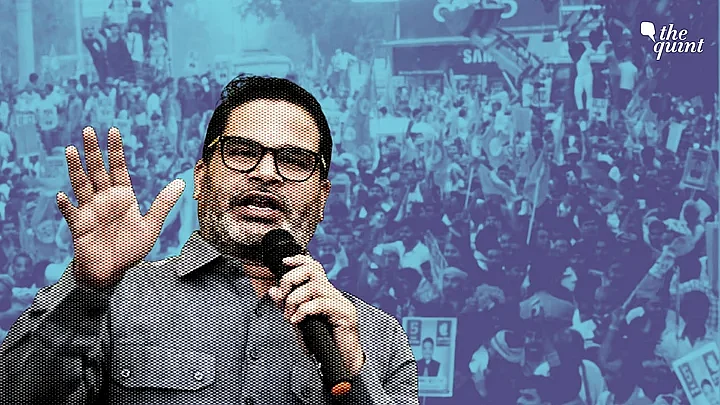
By-elections for a single seat, especially an Assembly seat, are usually low-key affairs. However, the by-election for the high-profile Bankipur seat in Bihar's capital Patna has grabbed eyeballs thanks to the entry of Prashant Kishor, former election strategist and founder of Jan Suraaj Party.
The Bankipur seat has been a Bharatiya Janata Party (BJP) stronghold since 1995. The party has consistently won the seat—and often by significant margins. Initially, BJP leader Nabin Kishore Prasad Sinha, BJP President Nitin Nabin's father, won four consecutive elections.
Following his death in 2006, his son Nitin contested the by-election and entered the Bihar Legislative Assembly for the first time. At that time, the constituency was called Patna West. In 2008, following delimitation, the Patna West seat ceased to exist, and the new Bankipur Assembly constituency came into existence.
Nitin won from this seat five consecutive times and served as a minister in Nitish Kumar's cabinet. In an unexpected move, he was appointed as the party's national president, leading to his resignation from the MLA post. This paved the way for the Bankipur by-election, which is scheduled for 30 July—and Prashant Kishor choosing the BJP’s safest seat to make his biggest political gamble.
The Caste Arithmetic Behind Bankipur
The Bankipur Assembly constituency is part of the Patna Sahib Lok Sabha seat. It is an urban area within Patna district. The constituency encompasses posh localities such as Boring Road, Krishnapuri, Kidwaipuri, Dakbungalow, and Fraser Road, as well as slum areas like Mithapur, Yaarpur, and Shivpuri, among others.
With an electorate of approximately 3.79 lakh, the constituency's electoral history reveals that Kayastha caste voters play a decisive role. Virtually all political parties have fielded candidates and secured victories here by taking this caste factor into account. Thakur Prasad—a Jan Sangh leader at the time and father of senior BJP leader and former Union Minister Ravi Shankar Prasad—won this seat in 1977. Prior to that, in 1963, Krishna Ballabh Sahay won the election from this seat on a Congress ticket and became chief minister.
Subsequently, in 1967, Mahamaya Prasad Sinha won from here on a Jan Kranti Dal ticket and also became chief minister. Sunil Mukherjee, the founding secretary of the CPI in Bihar, also reached the Legislative Assembly after winning from this seat in 1972.
In 1995, veteran BJP leader and kar sevak Nabin Kishore Prasad Sinha won from Bankipur, and continued to win consecutive elections until 2005.
Most leaders who have won from here belong to the Kayastha community—be it Mahamaya Prasad, Krishna Ballabh, Thakur Prasad, Dr AK Sen (a Bengali Kayastha who won on a CPI ticket), Ranjit Sinha (who won on a Congress ticket in 1980), Nabin Kishore, and subsequently Nitin Nabin himself.
Although caste equations shifted following the delimitation process, Kayasthas still constitute 14 percent of the electorate in Bankipur. Additionally, the constituency is home to populations of Brahmins, Bhumihars, and Rajputs, as well as Backward Classes and Dalits.
BJP's Kayastha Compulsion in Bankipur
Since the BJP had given only one ticket to the Kayastha community in the 2025 election—specifically for the Bankipur seat—it was practically compelled to field a Kayastha leader for this by-election as well.
This explains why Abhishek Sinha 'Bunty', the initial BJP candidate, belongs to the Kayastha community, and why the new candidate, Neeraj Kumar Sinha—who was given the ticket at the last minute after Abhishek's nomination was cancelled—also hails from the Kayastha community.
Kayastha falls in the upper-caste bracket. According to the Bihar Caste Survey Report 2022-23, numerically, they make just 7.85 lakh or 0.6 percent of the total upper-caste population of 2.01 crore.
The withdrawal of Abhishek Sinha's nomination is attributed to the fact that his parents were convicted in the decades-old fodder scam. His father, Ravindra Prasad Sinha, told the media: "My son made a sacrifice to save my honour." He also maintained that a son should not be punished for his father's sins.
Historically, Bankipur has chosen Kayastha leaders, but experts say the claim that the election can be won solely on the strength of Kayastha votes to be an exaggeration. Prabhakar Kumar, a guest faculty of sociology at Patna University who has done extensive work in Patna's slums, told The Quint,
"Voter turnout in Bankipur is quite low... and slum voters play a significant role because there are around a dozen slums in this Assembly area. The BJP receives votes from these slums as the right-wing organisations are very active there."
Data indicates that a total of 156,647 votes were cast in the last Assembly election, representing 41.33 percent of the total electorate. Of these, Nitin Nabin secured 63.34 percent of the votes. Prior to that, in the 2020 election, he had received approximately 59 percent of the votes, while in the 2015 election, he garnered 60.19 percent.
PK’s High-Stakes Gamble
Before the Assembly elections last year, Prashant Kishor had made bold claims. Yet, at the crucial moment, he did not contest the election himself.
The election results proved embarrassing for the Jan Suraaj Party, with more than 90 percent of the candidates failing to even save their security deposits. Given this, the question arises: why has Prashant Kishor—who stayed away from the major Assembly elections—entered the fray for a by-election on a single seat?
Sources within the party told The Quint that Kishor had started considering fighting in the Bankipur by-poll as soon as the seat was vacated. For this, the party had recruited college students to do ground surveys in Bankipur.
Speaking on the condition of anonymity, a student who was part of the survey told The Quint, “We were tasked to ask people what are the issues they want to be resolved and will they consider voting if Prashant Kishor fights the by-poll. Our survey indicated that the BJP has an edge in Bankipur.”
Given the initial survey outcome, it seems Kishor is contesting this seat to establish his party's relevance in Bihar after the debacle in the 2025 Assembly elections. Since this seat is held by the BJP's national president, putting up a tough fight here could boost his political stature.
Anoop Maithil, associated with the Jan Suraaj, said, "Our objective is to provide the state with a new political alternative. We can convey this message to the people only if we contest elections and win.”
Withdrawal of the BJP candidate from the fray, in the meantime, has put the party in an embarrassing situation, and has given ammo to Jan Suraaj. Kishor, attacking the BJP, claimed that the fear of defeat had forced the BJP to change its candidate in the last minute. The BJP has given no explanation to counter this attack.
Kishor has also alleged that BJP leaders have taken voters of Bankipur for granted, who, in turn, say that the party feels that even if they fielded a dog or a cat, they would win the seat. When asked about the same, Alok Raj, a BJP worker, dismissed the claim, saying, “No one has said that... Prashant Kishor has gone mad.”
Whose Votes Can PK Split?
With Prashant Kishor entering the electoral fray, an obvious question arises: whose vote bank will he make inroads into?
A source associated with the party stated, "We are targeting everyone, including RJD [Rashtriya Janata Dal] and BJP voters. Jan Suraaj has support across all castes and religions, and enjoys popularity among the youth."
However, a close examination of Kishor's campaign statements clarifies exactly who his target voters are.
Kishor is directly targeting Samrat Chaudhary in his speeches. He argues that if the BJP loses this by-election, a message will reach Delhi that the people of Bihar do not approve of Chaudhary as Chief Minister.
In a video posted on the Jan Suraaj's X handle on 10 July, Kishor is seen addressing a rally, saying Chaudhary was appointed chief minister by Narendra Modi, not by the public. He then urges the audience: "If you want to remove Chaudhary from the post of chief minister, vote against the BJP... This will let Modi know that the people of Bihar do not like Samrat Chaudhary."
Three days ago, an old video of Janata Dal (United) [JD(U)] leader Neeraj Kumar questioned the authenticity of Choudhary's educational degree. This video dates back to when the JD(U) was in alliance with the RJD.
Kishor has also called him "an accused" with seven murder cases against him, adding that Bihar won't become crime-free under his leadership.
Political experts say the attacks on Chaudhary is "deliberate", adding that they indicate that Kishor is trying to woo the upper-caste electorate—specifically Brahmin and Bhumihar voters—who are disgruntled over Chaudhary’s elevation as well as the alleged 'encounter' of Bharat Tiwari, a Brahmin native of Bhojpur, last month.
Chaudhary belongs to the Koeri caste which falls under OBC category. To capitalise on the Bharat Tiwari killing, Jan Suraaj even brought a poster of Bharat Tiwari during Kishor's nomination.
"Prashant Kishor certainly aims to draw in that segment of the upper-caste vote bank. But it does not appear that it will benefit him.”Mahendra Suman, political analyst
RJD's Quiet Strategy
As part of the Mahagathbandhan, the Congress has contested this seat in the past, but it lacks a significant vote bank. In the 2005 Assembly elections, the Congress secured merely 31,700 votes, accounting for just 18.69 percent of the total votes cast. Subsequently, in the 2006 by-election, the party received only 10,800 votes. Last year, the seat was given to the RJD, and the party fielded Rekha Gupta as its candidate. She secured 46,300 votes and finished second, indicating that the RJD possesses a respectable vote bank in the area.
This time, too, the RJD has fielded Gupta, who belongs to the Baniya community, and is keeping her campaign low-key. Even RJD leader Tejashwi Yadav has not started campaigning in the constituency yet.
As a strategy, a low-key campaign could help as the past hyper-aggressive campaigning by Tejashwi Yadav, with jubilant RJD supporters by his side, had resulted in non-Yadav voters’ polarisation against the RJD.
On the other hand, if Kishor succeeds in breaking away a part of upper-caste votes in his favour, it will help the RJD.
Analyst Mahendra Suman told The Quint, “If Kishor secures upper-caste votes, and the RJD candidate succeeds in pooling Kayastha and Baniya votes, and the party’s traditional vote bank remains intact, then the RJD may take the lead.”
Voices On The Ground
By-elections are rarely fought on specific issues. Most voters tend to maintain the status quo. However, Bankipur faces several problems, including water-logging, shortage of drinking water, dilapidated schools and colonies, and a lack of government health centres.
Vaijnath Thakur, a resident of Sabzibagh, said, "There is a persistent shortage of drinking water, yet no one is paying attention. There is a government girls' school in our ward, but not a single teacher goes there to teach. The school building is also in a dilapidated state. We have submitted petitions to Nitin Nabin and his party workers several times, but no solution has been found."
He said that he is considering "trying a new option" this time.
Sunil Kumar, who has been selling golgappas on Daldali Road for two and a half decades, said the area suffers from water-logging during heavy rains. However, he appears somewhat confused when asked which way the voting trend might lean. He said, "We vote for whoever our landlord tells us to vote for."
A middle-aged woman, who sells sattu near the Patna Collectorate and is a voter in the Bankipur Assembly constituency, said she votes for the BJP because she receives free rations from the government. "We have been voting for the BJP from the very beginning. It makes no difference to us who the specific candidate is."
Residents of Ambedkar Colony in the Yarpur slum said there are 500 houses in their colony. Local resident Tinku Raj said, “Laluji (former chief minister Lalu Prasad Yadav) had this colony built during his tenure, but no repairs have been carried out since then. In some houses, the stairs are broken, while in others, the roofs leak.”
Before the Assembly elections last year, the government sent an inspection team to have it repaired. But the work, he said, is yet to be done.
(Umesh Kumar Ray is a multilingual journalist from Bihar. He contributes to PARI Network, The Wire, The Quint, and other publications.)
