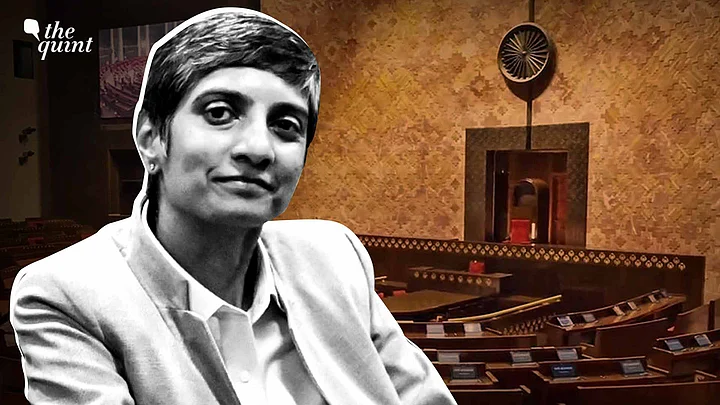
Menaka Guruswamy is now India’s first openly queer member of Parliament from the state of West Bengal. The internet celebrated as the 51-year-old lawyer was elected to the Rajya Sabha on 9 March, fielded by the Trinamool Congress (TMC), and took oath from the state in the Rajya Sabha on 6 April.
Guruswamy is the woman who had helped strike down Section 377 that had criminalised homosexuality since 1861 and will now be entering Parliament that had failed, in the last six years since, to construct anything on the ground that that verdict had cleared.
It is a good story. It is also a complicated one. And the complication is the story.
Clarity in Defiance
Let’s start with what is undeniable first.
In July 2018, Guruswamy stood before a five-judge constitutional bench and asked, on behalf of IIT students and graduates who were gay, “How strongly must we love, knowing we are unconvicted felons under Section 377? My Lords, this is love that must be constitutionally recognised, and not just sexual acts.”
Equipped with degrees and fellowships from world-class educational institutions such as Oxford and Harvard, she battled the case with the help of a team of senior lawyers, including another prominent lawyer named Arundhati Katju.
Both of them came out as a couple shortly after this verdict was delivered. TIME Magazine featured them in its 100 Most Influential People of 2019 list.
It was a moment of unusual clarity—where a woman who had fought openly for the right of a community to exist was herself existing openly at great cost.
The Paradox
It is that clarity that makes everything that has followed worthy of examination.
In 2023, Guruswamy appeared before the Supreme Court on behalf of the Rashtriya Swayamsevak Sangh (RSS) in the case of route marches by the right-wing organisation against the Tamil Nadu government. The RSS is the ideological parent body of the ruling Bharatiya Janata Party (BJP), and it is not ambiguous about its stance on queer rights at all. In 2018, the same year the SC struck down Section 377 of the Indian Penal Code, the RSS held homosexual relations to be “not compatible with norms of nature”.
By 2023, that position had visibly shifted—or at least its language had. In January that year, as the Supreme Court was preparing to hear petitions on marriage equality, Mohan Bhagwat gave an interview to the RSS’s own publications, Organiser and Panchjanya, in which he called queer identity "biological, a mode of life" and said the community should “have their own private space and feel that they, too, are a part of society.”
Guruswamy's father, a former advisor to the Ministry of Finance and former BJP strategist, wrote publicly that a lawyer’s duty is to the law, not the client's ideology. There is some merit to the argument. However, as it turns out, principles are born out of their contexts.
The RSS has worked actively to obstruct the legal recognition that queer Indians need. Appearing for them—however procedurally sound—lent a skilled and symbolically charged legal voice to an organisation that has spent years arguing against the community she became famous for defending. The tension deserves to be named, not dissolved in procedural reasoning.
And how can we ever forget the RG Kar Medical College case? A young doctor was sexually assaulted and murdered at a government hospital in Kolkata in 2024. It shook the whole nation and jolted awake protests by many, including junior physicians who went on strike.
Guruswamy joined Kapil Sibal, a senior advocate and former Union minister in the Congress government, to represent the West Bengal government and, specifically, former police commissioner Vineet Goyal in the Supreme Court. This triggered a controversy, as Goyal had revealed the identity of the rape victim. The anger that found her was real. It was also, in its way, a preview.
Because then, in January 2026, Guruswamy appeared in the Calcutta High Court for the TMC in proceedings challenging the Enforcement Directorate (ED)'s searches at the premises of I-PAC, the political consultancy firm closely linked to the party. The ED had raided I-PAC as part of a money-laundering investigation.
The TMC alleged it was a political operation ahead of the West Bengal Assembly elections. Guruswamy argued for the protection of the party’s political data.
Three Decades, One Moment
The chronology requires a closer look. She defends the state government in a legal court in two cases. She gets nominated. She gets elected.
The question is not whether she earned her seat. She has spent three decades arguing cases that most lawyers would not touch. The question is what determined the timing of this particular feat.
Is it a testament to her constitutional record or to her judicial dedication to the TMC when it wasn’t so popularly well-received? It is complicated to answer it in 'either' and 'or'. Both might be true. Only one of them seems to receive the attention and the applause.
This is what makes Guruswamy genuinely difficult to write about. She is not a hypocrite. She is something more interesting and more unsettling—a lawyer who holds an absolute belief in constitutional representation and a politician who has arrived in Parliament through a route that raises legitimate questions about whose interests she will now serve.
The queer community in India is watching. They need, from the country's first openly queer MP, something specific.
They need her to ask from the Rajya Sabha floor why Saurabh Kirpal—the openly gay senior advocate whose judgeship recommendation has sat unacted upon since 2017, whose sexuality the government cited as a possible security threat, and later the Research & Analytics Wing found no evidence of—has still not been appointed. They need her to push for legal recognition that the Supreme Court declined to grant—and the Parliament has shown no appetite for even discussing. They need her to do in the legislature what she did in the courtroom in 2018: ask the uncomfortable question out loud and not stop until there is an answer.
She is, by any measure, extraordinary. All her professional achievements are truly hers, including the ones where she defended a majoritarian organisation known for its homophobic stance and a state government on two occasions.
The woman who asked how strongly we must love, knowing we are felons, is now inside the institution that decides whether we remain so.
That is the contradiction she embodies. It is also, perhaps, the only kind of person who ever gets inside.
(Aaditya Pandey is a poet and freelance writer based in New Delhi, writing on art, culture, politics and queerness. This is an opinion piece and the views expressed are the author's own. The Quint does not endorse or is responsible for the same.)