
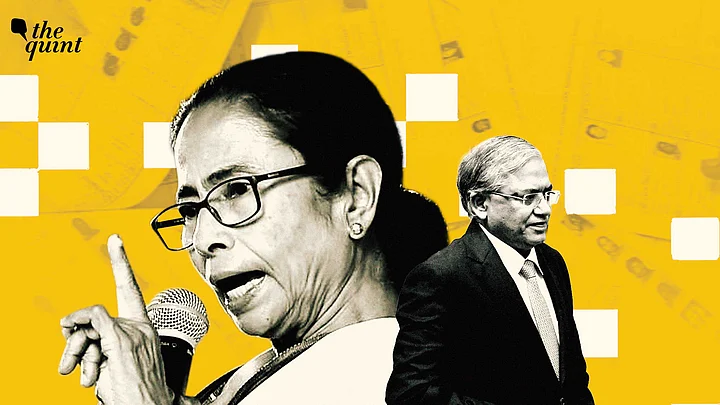
Former West Bengal Chief Minister Mamata Banerjee recently lashed out at Chief Election Commissioner (CEC) Gyanesh Kumar, calling him "Vanish Kumar"—and alleging that he made people's voting rights "vanish".
Speaking in Delhi, the Trinamool Congress (TMC) supremo on 1 October questioned the immunity provision for the CEC under the 2023 law, and stated that the people won't forgive those responsible for taking away their democratic right to vote.
The attack on the CEC sharpens the Serial Intensive Revision (SIR) row in West Bengal at a time when the Election Commission of India (ECI) is facing allegations of being "compromised" in wake of The Indian Express investigative report regarding a rift between the three Elections Commisioners.
The report are especially relevant for West Bengal, where lakhs of voters were denied their right to vote in the Assembly polls held in April. While Bihar and Assam also went to polls following SIR exercises in the respective states, experts have noted that the case in West Bengal was distinct—with mass deletions (91 lakh deleted initially, 27 lakh await rectification); inexplicable additions to SIR process such as "logical discrepancy"; and the fact that the deletions exceeded victory margins in over 150 Assembly seats, fundamentally altering the electoral-playing field.
The state also experienced sudden, mass administrative suspensions, intense public panic, and legal battles in the Supreme Court.
The controversy surrounding the SIR processes, however, is only one part of a larger story.
Under Gyanesh Kumar, the ECI repeatedly used language and adopted a tone that appeared strikingly unusual for a constitutional institution expected to maintain political neutrality. From being a refree, in increasingly acted as a political player. Some of these episodes may merit the attention not just of political observers, but of political scientists and historians in later years.