The Santhi Mandiram crematorium in Thrissur’s Kuriachira neighbourhood has been closed. It only has gas-run chambers. It receives two to three bodies a day. It cannot accept any. Crematorium managements across Kerala are informing local media that their facilities are running short of gas cylinders.
The Indian Oil Corporation’s bottling plant at Chelari in Malappuram—the plant that supplies commercial LPG across the Malabar region—halted refilling of commercial cylinders in the first week of March. Before the disruption, Chelari produced 3,456 commercial cylinders daily. The LPG bullet tanker arrivals from the Mangaluru and Kochi refineries fell from 32 to 16 per day.
Hotels, restaurants, and catering services across North Kerala began rationing gas. By the third week of March, the shortage crept into households.
Families in Malappuram reported waiting four to five days for cylinder refills that normally took two. Nationally, delays have stretched to 7–14 days. Black market cylinders are selling at Rs 1,800–2,500 against the normal Rs 900–1,000. The petroleum ministry has conducted over 12,000 raids and seized more than 15,000 cylinders.
Approximately 80–85 per cent of India’s LPG imports transit the Strait of Hormuz. The Strait is effectively closed. India imports nearly 50 per cent of its LPG requirements. The supply chain that connects the Gulf’s gas fields to Kerala’s kitchens has been severed. Kerala’s exposure is distinctive: the state has near-universal LPG penetration, one of the highest in India.
The irony is precise: the Gulf remittance money that brought LPG into every kitchen decades ago is now the same Gulf crisis that threatens to take it away.
1.38 Crore Women Voters
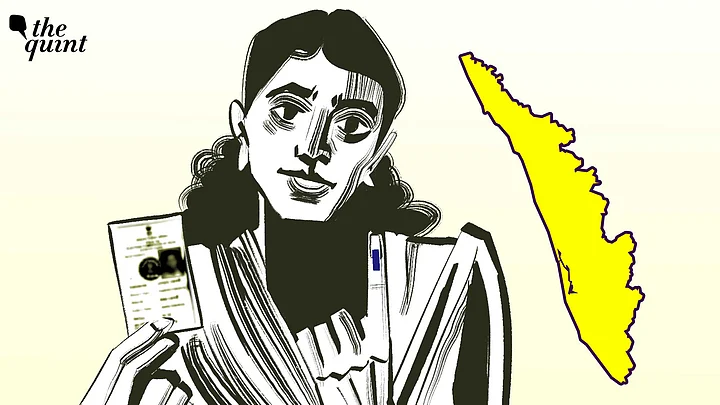
Kerala is one of the few Indian states where women outnumber men on the electoral rolls. The 2026 electorate comprises 1.38 crore female voters against 1.31 crore male—a gap of roughly 7 lakh. In an election where statewide swings of 2–3 per cent can shift 20–30 seats, the female majority is structurally decisive.
The issues that dominate this election are experienced differently and often more acutely by women. Of the 2.1–2.5 million Keralites in the Gulf, the overwhelming majority are men. The women are at home—in Malappuram, Thrissur, Kozhikode, Kannur—managing households, raising children, navigating the financial architecture of a life built on remittances. When the missiles struck the Gulf, it was women who bore the first hours of not knowing.
When panic transfers arrived, it was women who received the money and understood its message: we are scared. When the cylinder didn’t come, it was women who went to the distributor, stood in the queue, and came home empty-handed.
The Muslim Women of Malabar
Muslims constitute approximately 26–27 per cent of Kerala’s population. Malappuram is over 70 per cent Muslim. The Indian Union Muslim League (IUML) won 15 Assembly seats in 2021. But in 2026, the Iran war has added a geopolitical dimension the party has never navigated during a state election.
Kerala’s Muslims are predominantly Sunni. The Shia population is tiny. But the Iran crisis is not experienced through a Sunni-Shia lens in Malabar. It is experienced through a Gulf lens.
The countries being bombed by Iran—the UAE, Qatar, Saudi Arabia, Kuwait, Bahrain—are Sunni-ruled states where Keralite Muslims live and work. The countries launching the strikes—the US and Israel—are perceived as enemies of the broader Muslim world, regardless of sect.
This creates a complex emotional landscape for some Muslim women in Malabar. They sympathise with Iran as a victim of US-Israeli aggression. They are simultaneously anxious about husbands and sons in Sunni Gulf states that Iran is attacking. And they are furious at the Modi government’s silence on the strikes and its visible alignment with Israel. The CPI(M) has positioned itself to capture this anger—Vijayan’s condemnation and the party’s anti-imperialist framework align with the dominant sentiment. The IUML has been more cautious, careful not to appear “pro-Iran”—a label the Bharatiya Janata Party (BJP) would exploit.
The Ministry of Home Affairs (MHA) advisory on 2 March, directing authorities to monitor “pro-Iran radical preachers giving inflammatory sermons,” landed in Malappuram as surveillance. For Muslim women whose husbands are in the Gulf, whose kitchens are running out of gas, and whose community is being monitored for expressing grief over a religious leader’s assassination—the pressure comes from every direction simultaneously.
LPG, the Universal Equaliser
LPG is the most intimate electoral issue imaginable. It is the flame under the rice pot. Oil Minister Hardeep Singh Puri assured Parliament in early March that India has approximately one month’s buffer. It is now April. The war shows no sign of ending. If Hormuz remains closed through the month, the buffer exhausts before or shortly after the election.
The political calculus is layered. The Left Democratic Front (LDF) faces the first line of blame—voters hold the most proximate authority responsible, even when the cause is external.
The BJP faces an ironic vulnerability: Suresh Gopi, the party’s most visible Kerala leader, is Minister of State for Petroleum and Natural Gas—the ministry directly responsible for LPG allocation.
The opposition has been quick: “Your MoS Petroleum cannot even ensure gas for Thrissur’s kitchens,” a Congress candidate in Ollur said at a rally. The United Democratic Front (UDF) frames the shortage as a failure of both Centre and state—Modi’s foreign policy and Vijayan’s governance in a single breath.
The Sabarimala Split
The Sabarimala issue splits women in ways that do not align with the progressive-conservative axis commentators assume. Urban women in Thiruvananthapuram and Ernakulam broadly supported the Supreme Court verdict. Many were angered by the LDF’s U-turn. But in the Sabarimala heartland of Pathanamthitta, many Hindu women actively opposed the verdict—their argument was about tradition, not patriarchy. The BJP has positioned itself as protector of Sabarimala tradition, with women’s outreach in Thrissur specifically targeting the female Hindu vote.
So how is the wonen's vote splitting?
Women in Malabar will vote on the Gulf crisis and its household impact—the empty cylinder, the absent husband, the MHA advisory, the crematorium that cannot cremate.
Women in Pathanamthitta will vote on Sabarimala’s unresolved emotional residue. Women in urban centres will vote on safety and governance quality and women across the state will vote on the LPG crisis—the most universal, gender-crosscutting issue in the election.
The Muslim vote will not swing toward the BJP. The question is whether it consolidates behind the UDF, strengthening the IUML, or partially shifts toward the LDF, strengthening the CPI(M) in Muslim-majority seats. The answer determines outcomes in 25–30 constituencies across Malabar. In most of those constituencies, it is women who will cast the deciding votes.
(VK Shashikumar is a former roving foreign affairs correspondent who covered West Asia, and later set up the investigations team at CNN-IBN (now News18.). This is an opinion piece and the views expressed are the author's own. The Quint does not endorse or is responsible for them.)