(This article contains descriptions of substance use and addiction. Reader discretion is advised.)
Zahir Majeed* (name changed) was 12 when the killing of militant leader Burhan Wani in 2016 sparked a massive civil uprising in Kashmir, leading to lockdowns and curfews.
Like hundreds of teenage boys at that time, Zahir vented what he called his “frustrations with the government” by pelting stones at police vehicles near his home in Soura, a suburban neighbourhood on the outskirts of Srinagar.
During one of those tumultuous days, Zahir met two other protesters who introduced him to a "medicine that numbed their senses" so much so that the batons of the Jammu and Kashmir Police "had no effect on them.”
“They called it Tapal,” Zahir tells The Quint, referring to Tapentadol, a widely used opioid that has emerged as a key driver of Kashmir's growing drug crisis.
“When I popped it for the first time, I vomited. But, slowly, I got used to it,” he adds, sitting cross-legged on a bed inside the Institute of Mental Health and Neurosciences (IMHANS), the only government-run de-addiction centre in Kashmir.
'War' on Drugs
Last month, J&K’s Lt Governor Manoj Sinha launched ‘Nasha Mukt Abhiyan’, a 100-day campaign that marks the government’s harshest drive yet against the escalating problem of substance abuse in Kashmir. As part of the ongoing campaign, the administration has arrested hundreds of alleged traffickers responsible for the sale of illicit substances, seized properties of alleged peddlers, and destroyed fields where people had illegally grown poppy flowers (from whose unripened seed pod the gooey opium is harvested).
In his inaugural speech on 15 May, Sinha stressed that there would be “no safe space” for drug peddlers in the Union Territory. He also said the crisis was no longer confined to select pockets, making "a mass public movement" necessary. Within 45 days of the campaign, launched on 11 April, nearly 800 FIRs have been registered and over 900 arrested across the Union Territory.
Nevertheless, the administration’s drive to raze homes of the alleged peddlers, apart from arrests, has come under scrutiny from several quarters, with activists and experts raising concerns about the "bulldozer action" and the opacity of the legal process behind these demolition drives.
“No doubt that the recent actions have brought down the availability of drugs. But the legal process behind the demolitions has also not been very transparent,” argues Raja Muzaffar Bhat, one of J&K’s leading social activists.
“We can argue for the accused to be booked under stringent laws or subjected to solitary confinement. We can also ask for the setting up of fast-track courts so that the trial process is expedited. But what’s happening here is that the government is making the FIR the only basis for executing demolitions. What if the courts eventually decide to release the accused? What will you do about their families?”
The Strain of Addiction
Kashmir's struggle with substance use predates the current crisis. According to a 2022 survey by the J&K administration in collaboration with IMHANS, more than 52,000 people in Kashmir were addicted to opioids, according to a BBC report.
In August 2023, the Parliamentary Standing Committee on Social Justice and Empowerment estimated that upward of 1.3 million adults in J&K are consuming addictive substances, most of them being opioids. Despite the severity of the crackdown on the trafficking and illegal distribution of opioids, that number has spiked.
The cases of Zahir and others like him are emblematic of how this worsening substance abuse problem is impacting the youth, severely affecting their health and draining their families financially.
Financial ruin, in fact, plays a key role in urging people to seek out health centres and treatments.
The 2022 survey estimated that heroin worth Rs 9 lakh, cannabis worth Rs 1 lakh, and pharmaceutical opioids worth Rs 1.30 lakh are consumed in Kashmir every month. The report also concluded that a heroin addict spends up to Rs 88,000 every month on substances or related expenses. This aspect was corroborated during interviews with patients like Zahir, for whom the financial downturn became an important factor in their decision to seek treatment.
A former copper wares dealer, Zahir's daily earnings would clock Rs 4,000, of which he gave a portion to his parents. The majority, however, would be spent on substances. “Had I not been addicted, I would have saved lakhs of rupees,” Zahir half-jokes.
But Zahir is determined to regain that early vigour of his life. “I am supposed to get married this year. I desperately want to recover which is why I chose to get admitted here.”
He is aware that he has relapsed several times before. "I promised the doctor it won’t happen this time,” he says, as he scrolls through his Instagram feed, looking at pictures from his younger days.
The High Patient Load
The numbers, however, reveal the widespread nature of substance abuse in Kashmir, which, the experts contend, has turned into a “vicious cycle,” with patients struggling to keep pace with the treatments and frequent relapses.
In some cases, as per the doctors at IMHANS, they are required to perform amputations on the patients suffering from necrosis, a condition where the tissues die out from having been repeatedly injected without precaution.
At the Tele-Mental Health Assistance and Networking Across States (Tele-MANAS) desk at IMHANS, operators have registered an astounding rise in the distress calls.
“When we first opened the desk in 2022, we would receive 1,000 calls a month on an average,” Muhammad Saleem Mir, a counselling psychologist at IMHANS, tells The Quint. “Now that has risen to 1.5 lakh calls a month, and a majority of them are related to addiction. That’s also because of the government’s ongoing campaign.”
Doctors at the facility tell The Quint that seven out of every 10 cases at IMHANS’s outpatient department are follow-up cases, many of whom have relapsed. The OPD, hospital authorities say, registered between 8,000 and 10,000 patients in April alone, a majority of them related to substance use.
Dr Sajid Muhammad Wani, Assistant Professor at IMHANS, explains:
“Patients only come here when they are at the end of their tether... Many of them have turned broke, have accompanying conditions such as Hepatitis C, or have become involved in criminal activities in their rush to obtain the drugs.”
And there simply aren't enough doctors or trained professionals to deal with the volume. When The Quint visited the centre in April, the crowd outside outnumbered that outside the ‘Emergency’ section of Shri Maharaja Hari Singh Hospital near which IMHANS is located.
In the blistering summer heat, patients waited for hours for their turn. The impatience among the crowd to get an early appointment even led to a brawl, with cops eventually breaking up the commotion.
Zahir was among the eight patients admitted at the facility's specialised de-addiction treatment when The Quint visited. He has since been released, but the centre remains at maximum capacity. There are 20 beds in total. “No sooner do we discharge the treated patients than we receive newer admissions,” a member of the facility staff says, pleading anonymity.
Fuelled by Conflict
Though all the patients have a unique backstory to share about how they reached their current condition, most of these have an overlapping element: the political conflict.
Although Zahir deeply regrets stone-pelting, he tells The Quint he was overcome by the same sense of political alienation that his peers had felt.
“I kept chasing the euphoria that I had first felt while trying drugs. But I couldn’t have it,” he says.
The scramble led him to jump from one opioid to another.
“I tried Alprax and Clonazepam as well (both sedatives that must only be administered under strict observation of a doctor). I also felt the thrill, especially after I was under the influence of drugs. During the clashes between protesters and forces, I would even force a police armored vehicle to turn turtle, just with my bare hands.”
The first brush that 29-year-old Saqib Ahsan (name changed), another admitted patient at IMHANS, had become addicted with opioids was 10 years ago when his close friend was shot dead, allegedly by the Indian Army while breaking up a protest in North Kashmir’s town of Handwara.
“We studied together ever since we were children,” says Saqib, referring to the killing of Nayeem Qadir Bhat, a famous cricketer whose death had triggered massive protests in Handwara.
“His killing left me emotionally scarred. I didn’t go to my home for two months and stayed at his place. It was during this time I developed an addiction to heroin.”Saqib Ahsan
Saqib was initially able to overcome by loss. His parents sent him to Pune for graduate studies so he could be isolated from the political unrest roiling Kashmir. “In Pune, I was even working as a junior artist in Bollywood movies.”
He boasts of having landed in brief roles in movies such as Kesari, Baaghi 2, and Indu Sarkar.
In 2019, following the abrogation of Article 370, Saqib returned to Kashmir. He found himself constrained by the circumstances, unable to to go out or move freely. The lockdown only intensified the following year on account of the COVID-19 pandemic.
“This was the time when we used to roam around in orchards to meet friends. That’s when my friends introduced to me to Tapentadol pills,” he says.
Soon, his struggles began again. He recently experienced a collapse due to drug overdose, and his parents brought him to IMHANS. But at the de-addiction centre, Saqib is deeply struck by a sense of guilt.
“I don’t go to any of my relatives’ places. My parents have to accompany me here all the time. My condition has brought immense shame on our family, and I want to undo that, which is my I want to recover from all this."
'Spreading Like a Plague'
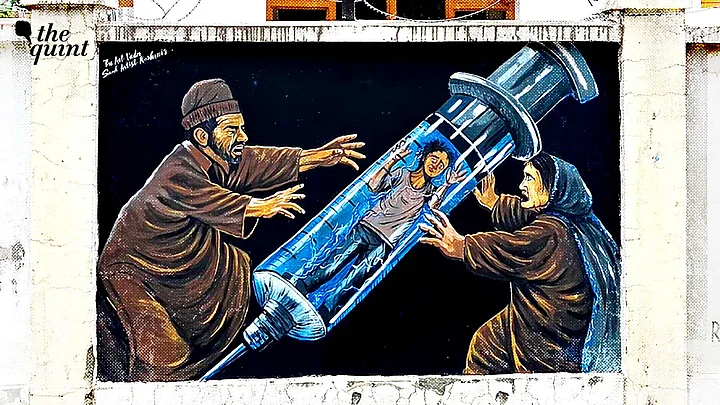
Earlier this year, Shahran Fayaz, a 28-year-old artist, drew a mural near the Polo View market in the heart of Srinagar, which has become a popular attraction for the passers-by.
The mural shows an anguished mother, tears streaming down her face, as she struggles to free her son who is trapped in a giant syringe filled by what looks like a liquified opioid that drug addicts inject into veins.
“The drug addiction is spreading like a plague. The idea was to hammer home the extreme nature of this problem,” Shahran, who is pursuing a PhD in statistics at Sher-e-Kashmir University of Agricultural Sciences and Technology, tells The Quint.
“I have seen minors involved in this. Just recently police picked up a young boy from our locality in Srinagar for selling drugs. I had previously tutored him in mathematics. It was so painful to see where we are headed as a society. So, I decided to make use of my art to help address it.”Shahran Fayaz
At the centre’s outpatient department, doctors say a disproportionately large number of patients use substitutes to fulfil their drug cravings before relapsing.
“An overwhelming number of cases at the OPD are those who come to seek more substitutes under one pretext or the other,” a senior doctor tells The Quint, speaking on the condition of anonymity. “We deny them. Because this substitute medicine is only supposed to be administered once a day under strict supervision."
Patients nevertheless manage to consume substitutes other than the ones prescribed, and resume the addiction when their withdrawal symptoms intensify.
“The relapse usually happens when they experience grief, strain, or even happiness. And even during the festivals like Eid. It is like a vicious cycle."Doctor (name withheld), IMHANS
No Magic Bullet Solution
Clinical psychologists who have for years mapped the problem of drug addiction in the Valley describe the issue of frequent relapse cases as problematic. “But that is because the illness is like that. It is a chronic mental health condition. It cannot disappear overnight,” explains Zoya Mir, the founder of Psychlite.
Mir says that community-level intervention can help overcome the crisis.
“Patients actually far outnumber the health facilities that are there to address this crises,” she says. “And the theraputic and community interventions that are supposed to address this gap are far a few between. There’s a dearth of what we call psychosocial rehabilitation.”
(Shakir Mir is an independent journalist. He has also written for The Wire.in, Article 14, Caravan, Firstpost, The Times of India, and more. He tweets at @shakirmir.)