
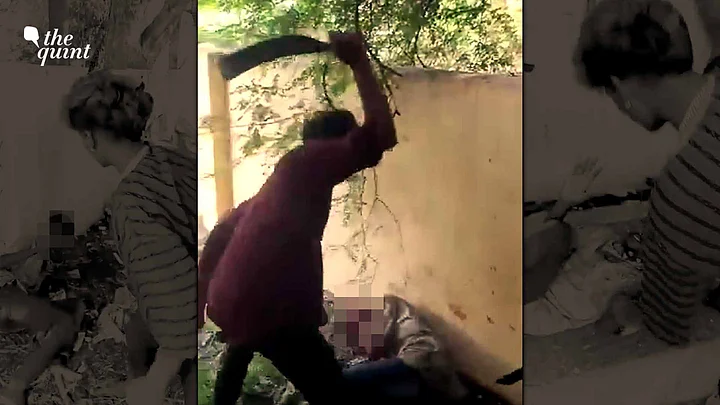
On 27 December, K Suraj, a 19-year-old migrant worker from Odisha, was forced to disembark from a suburban EMU train near Tamil Nadu's Tiruttani by four juveniles, all below the age of 17. He was then threatened to accompany them to an isolated area near an abandoned railway quarters where he was brutally attacked with sickles. The assault was filmed on a mobile phone by one of the attackers, allegedly with the intention of uploading it as an Instagram reel.
Suraj, who had migrated to Chennai from Odisha's Kalahandi district following a family dispute, sustained deep cuts and injuries to his head, face, and hands. He reportedly lost consciousness—and was later found lying in a pool of blood by bystanders.
Almost two weeks after the tragedy, his treatment, sudden discharge, and subsequent 'disappearance' have triggered serious questions about the issue of migrant safety and the Tamil Nadu government's handling of the case.
The Motive
Speaking to the media last week, Asra Garg, Inspector General of Police, North Zone said preliminary investigation showed the attack was the result of a personal altercation—and was not motivated by Suraj’s identity as a migrant.
"We examined his version in the complaint and the FIR, and found that the incident stemmed from a dispute after he questioned the boys as to why they were staring at him. It was not entirely due to his being from north India.”
He further confirmed that all the four assailants were minors from Nemili near Tiruttani. After the FIR was filed under the relevant provisions of the Juvenile Justice Act, three juveniles were sent to a government observation home in Chengalpattu, while one was handed over to his parents after due process.
Garg, however, did not directly address concerns about alleged drug use by the juveniles or the broader questions surrounding migrant vulnerability in suburban transit zones.
Suraj was first taken to Tiruttani Government Hospital, then referred to Tiruvallur Government Headquarters Hospital, and subsequently shifted to Chennai’s Rajiv Gandhi Government General Hospital for advanced treatment. However, his 'disappearance' and the police's reluctance to share any further details about his present location have become a political flashpoint.
Apart from accusing the Tamil Nadu police of "downplaying concerns" that the assault reflected hostility towards migrant workers, senior political leaders, including AIADMK General Secretary and Opposition leader Edappadi K Palaniswami, publicly questioned whether Suraj is alive, citing the lack of clarity about his condition and whereabouts after his discharge.
Similar concerns have been raised by NGOs who work closely with migrant workers.
The police, on the other hand, said Suraj had requested discharge from the hospital on his own and had chosen to leave Tamil Nadu. Citing privacy and procedural constraints, they said information about his whereabouts could not be made public.
Unanswered Questions and Contradictions
While the official narrative seeks to separate the assault from larger concerns around migrant safety, several gaps remain.
Speaking to The Quint, journalist Sandhya Ravishankar said,
“The police version does not explain how a victim who suffered multiple sickle injuries to the head, face and hands could be discharged without prolonged medical supervision nor why the police are unable to confirm his condition or current location. In the two-minute video, the assailants attacked Suraj nearly 60 times with sickles all over his body.”
Ravishankar also noted that the police have sidestepped repeated claims raised by political parties, activists, and local residents that the juveniles were under the influence of narcotic substances at the time of the assault, and the trend of filming an attack by minors which is symptomatic of a wider pattern of digital violence.
All the four accused are school dropouts.
“By insisting on viewing the assault purely as a spontaneous clash between individuals,” she said, “the state risks ignoring deeper structural issues like the easy access to drugs among minors, weak policing in transit zones, the normalisation of violence through social media and the heightened vulnerability of migrant workers who lack local protection networks.”
A Nagaraj, who runs a rehabilitation centre for youth battling addiction, said the case has highlighted the growing availability of narcotic substances among minors in Tamil Nadu—something which police case records, juvenile justice data, rehabilitation admissions and NGO field studies reveal. Even studies conducted by his organisation and data from admissions at his rehabilitation centre show an increase in minors seeking treatment for substance abuse, he claimed.
Although Tamil Nadu Health Minister Ma Subramanian has publicly stated there is no drug menace in the state, Nagaraj alleged, “Beyond politics, the mushrooming of rehabilitation centres itself is a mirror of rampant drug use.”
At the same time, local residents and social media users point out that the accused juveniles had previously posted videos of themselves intimidating people and engaging in violent acts, as also verified by The Quint. In several instances, members of the public tagged police handles seeking intervention, but no visible preventive action followed. These pages have been since withheld.
“Social media platforms continue to host and algorithmically amplify content that normalises violence, substance use and other extreme behaviours, effectively rewarding vulnerable youth with visibility and validation. For those from economically and socially fragile backgrounds, this digital exposure directly undermines recovery and increases the risk of relapse,” psychologist R Prabhu told The Quint.
“In group settings, filming also serves as proof of participation and a means of asserting dominance within peer circles. Many minors lack awareness of the legal and long-term consequences of digital footprints, operating in largely unmonitored online spaces.”G Karthikraj, a research scholar on juvenile behaviour in digital media
Karthikraj also warned that without stricter platform accountability and digital supervision, social media will continue to function as a catalyst rather than a deterrent for juvenile violence.
Migrant Workers: Essential but Exposed
Tamil Nadu attracts migrant labourers from Odisha, Bihar, Jharkhand, West Bengal and Uttar Pradesh due to its relatively stable industrial base, construction sector, textile hubs and infrastructure projects. Migrants take up low-paying, high-risk jobs in construction, sanitation, factories, hospitality and logistics, often working long hours with minimal legal protection.
For many, Tamil Nadu offers better wages and continuity of work compared to their home states. However, this economic dependence also places them in vulnerable positions, socially isolated and often residing in poorly policed semi urban and suburban pockets.
“Despite this dependence, migrants remain socially and politically marginal. Many live in informal settlements or work sites near railway lines, industrial belts and suburban transit zones where policing is weak. In this context, incidents like the assault on Suraj expose the fragile position migrants occupy. When violence occurs, the lack of documentation, local networks and legal awareness often makes it easier for cases to be minimised, reframed or quietly closed."A Nagaraj
According to official data compiled by the Tamil Nadu Labour Department, around 7.75 lakh inter-state migrant workers had been registered through the state’s labour portal by mid-2023. By August 2024, this number rose to about 8.17 lakh registered migrant workers.
However, government officials have consistently maintained that these registrations represent only a small fraction of the actual migrant population. Estimates suggest that registered workers account for barely 10 to 12 percent of the total interstate migrant workforce in the state.
By mid-2025, official tallies indicated that over 12.17 lakh migrant workers had been documented across sectors in Tamil Nadu. A significant share of this workforce originated from eastern and northern India, with Odisha accounting for around 2.89 lakh workers, followed by Bihar with approximately 2.51 lakh, Jharkhand with about 1.95 lakh, and West Bengal with nearly 1.91 lakh.
Officials have stated that compiling this database has taken nearly five years, meaning the numbers represent a cumulative buildup from around 2021 onwards rather than fresh annual inflows.
Crucially, these figures do not reflect the actual scale of migration. In 2023 itself, the Tamil Nadu government estimated that nearly 67 to 70 lakh migrant workers were living and working in the state, many of them unregistered, undocumented, and outside any formal welfare net.
Consequently, migrant labour has increasingly become a political talking point. Several Dravida Munnetra Khazagam (DMK) MPs and leaders have publicly portrayed the presence of Hindi-speaking North Indian migrant workers as evidence of economic failure in the Bharatiya Janata Party (BJP)-ruled states.
Experts argue that reinforces social othering and reduces migrants to economic tools. “While the state government officially promotes inclusivity, political rhetoric has often painted migrants as symbols of economic failure in the BJP-ruled states,” said Ravishankar.
Against this background, the ruling party's official stand that the attack on Suraj was “not about migration” ring hollow, observers added.
Law, Order and Narrative Control
Following the circulation of the assault video, Tamil Nadu Police wrote to X seeking the removal of posts shared by former BJP state president K Annamalai, AIADMK leaders, and journalists.
The move sparked debate over whether the state was prioritising "narrative control over addressing systemic failures".
The AIADMK spokesperson Kovai Sathyan accused the government of evasion and intimidation.
"A man who was bleeding for nearly half a day with multiple cut injuries, how can anyone believe that he was discharged on his own and sent away alone? Is there no humanity left?” he told The Quint.
“There are serious procedural lapses. The DMK government is refusing to take responsibility, and the police appear to be shielding the government. The real questions remain: what exactly happened and how was it handled? Why is there no transparency? Why are facts being hidden? If the victim was admitted and undergoing treatment in a hospital, the government must take responsibility. Instead, it appears he was forced to get discharged to escape accountability and now his whereabouts are unknown.”
He further stated, “On top of this, notices are being sent to the X platform seeking the removal of posts, including mine. Shockingly, these notices claim that the account-holders are identifiable in the video as the persons holding the weapon used in the assault. This clearly indicates an attempt to silence voices through intimidation. Where is the accountability?”
The Quint reached out to several DMK leaders for comment, though all denied to speak on the issue.
As Suraj’s disappearance from public view leaves unresolved questions, especially whether Tamil Nadu’s development model truly safeguards those who build its cities, clean its streets and power its industries, for migrant workers across the state, the message remains unsettling. Survival is possible. Safety is not guaranteed.
(Vinodh Arulappan is an independent journalist with over 15 years of experience covering Tamil Nadu politics, socio-culture issues, courts, and crime in newspapers, television, and digital platforms.)
