
ADVERTISEMENTREMOVE AD

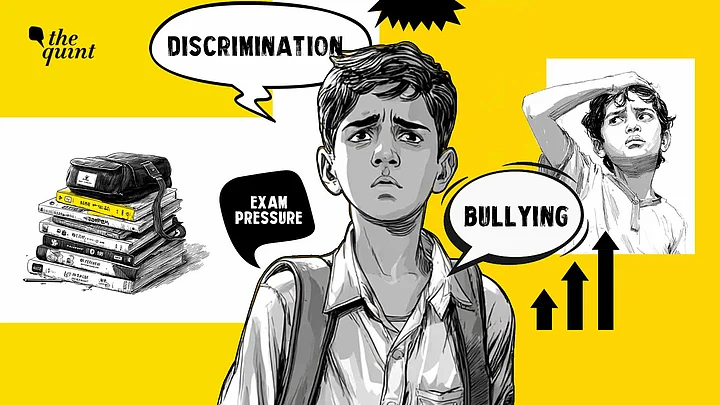
34% Rise in Student Suicides Since 2019 Sparks Call for Institutional Support

Family problems led to suicides among under-18, with 14,831 cases recorded between 2019 and 2023.

Published
story-hero-img
i
Aa
Aa
Small
Aa
Medium
Aa
Large

On 6 December, a 25-year-old computer science student from Jharkhand took his life, allegedly over ‘health concerns,’ in his hostel in Greater Noida. As many as five cases of student suicides were recorded in November alone.

  • A class four girl from Jaipur died by suicide after 18 months of ignored bullying complaints.  

  • A 16-year-old leapt in front of a Delhi metro amid teacher harassment. 

  • A Class 11 student died at home in Rewa, Madhya Pradesh, alleging mistreatment. 

  • A 14-year-old was found hanging from a tree in a Rajasthan village.

  • A 20-year-old medical student hanged himself in his room in Maharashtra's Chandrapur.

Between 2019 and 2023, India recorded 62,886 cases of student suicides, marking a 34.4% increase from 10,335 in 2019 to 13,892 in 2023, as per the National Crime Records Bureau (NCRB) (sourced by Dataful by Factly)

These harrowing incidents in the last month highlight the rampant increase in the number of student suicides in the country and the lack of institutional support for students. 

The Quint looked at the data between 2019 and 2023 on the issue to analyse the rise in such cases, their causes and the affected age groups in the country. 

ADVERTISEMENTREMOVE AD

What Does Data Say

Between 2019 and 2023, 62,886 students died by suicide in India, marking a 34.4 percent increase. In 2019, the fewest cases were reported (10,335), whereas in 2023 the highest were reported (13,892) in the country. 

Maharashtra and Tamil Nadu remained the worst affected by student suicides between 2019 and 2023, with Maharashtra reporting 8,779 cases and Tamil Nadu 5,845 cases over this period. Additionally, Maharashtra consistently reported the highest number of student suicides throughout the said timeline.

Other states that featured in the top five and were worst affected by student suicide cases between 2019 and 2023 were Uttar Pradesh, Madhya Pradesh, Jharkhand, Karnataka, and Odisha.

(Readers can hover over the map or search for a state’s name to view the corresponding figure.)

Additionally, the total number of suicide victims below 18 years of age was 10,785 in 2023. In 2022, the figure was 10,205; in 2021, 10,732; in 2020, 11,396; and in 2019, 9,613. These accounted for more than 70% of all suicide cases in each of the respective years.

We also found that “family problems” was the leading cause of suicide among those under 18 across all five years, with 14,831 cases recorded between 2019 and 2023.

“Fear of examination” emerged as a major cause only in 2019 and 2023, accounting for 2,880 suicide cases among those under 18.

Other cited reasons for this age group included “love affairs” and “illness,” as reported by the NCRB.

Noting on the recent crisis with students under the age of 18 taking their lives, Rashika Mehrotra, a Coordinator and Teacher Trainer from Lucknow, Uttar Pradesh, said:

It was heartbreaking that children carry emotional burdens far heavier than their age. It also shows that as adults, parents, teachers, and systems, we may not always be noticing their silent struggles. It is a reminder that children need more presence and less pressure
Rashika Mehrotra, a Coordinator and Teacher Trainer.

Additionally, the data from 2019 to 2023 consistently showed that the ‘most vulnerable age groups’ for suicide were young and middle-aged adults between 18 and 30 years, followed by those aged 30 to 45 years. 

Schools ‘Not a Safe Space’ for Students

In November, a heartbreaking audio of the nine-year-old girl from Jaipur revealed repeated bullying patterns. Despite her family’s repeated complaints, school authorities allegedly ignored the said distress. 

In the same month, the 16-year-old deceased student from Delhi left a note accusing his teachers of sustained harassment. The note reportedly said, “My last wish is that action be taken against them so that no other student does what I did,” reported the Hindustan Times

Multiple cases reveal students enduring relentless mental harassment and physical abuse, frequently at the hands of their own teachers, with their desperate cries for help going unheard.

Mehrotra also mentioned how schools play a very big role in a child’s mental well-being and said, “A child spends most of their day in school, so the environment, the teachers’ behaviour, and the space we create deeply influence how safe, valued, and confident they feel. A calm, supportive school can truly shape a child’s emotional balance.”

In July, the Supreme Court declared the rising trend of student suicides a “systemic failure,” issuing sweeping directions to schools, colleges, coaching centres and other educational institutions to safeguard student mental health. 

The apex court cautioned that the educational model’s obsession with rankings and exam results rather than holistic growth has replaced the joy of learning with relentless pressure, fueling distress and despair among students.

Mehrotra opined on the subject and said:

“Many curricula today try to include emotional well-being, but there is still a long way to go. We see attempts such as circle time, mindfulness, inclusive practices, but the real impact comes when teachers use the curriculum with empathy, not just as a checklist.”
Rashika Mehrotra, a Coordinator and Teacher Trainer.
ADVERTISEMENTREMOVE AD

Lack of Data on Suicides by Marginalised Students

A 2023 Lok Sabha answer revealed that there was no data that noted the caste identity of students dying by suicide in India. 

However, several instances of marginalised background students studying in the Indian Institute of Technology (IITs) and National Institutes of Technology (NITs) have been witnessed in the last few years, with the most recent being the death of Ritham Mondal at the IIT-Kharagpur in July. This marks the fourth such case of suicide in the Kharagpur campus in 2025 alone. 

Additionally, in 2021, Union Education Minister Dharmendra Pradhan told the Lok Sabha that 122 students enrolled in centrally-funded higher education institutes died by suicide between 2014 and 2021. Of those 122, 24 were from Scheduled Castes (SC), three from Scheduled Tribes (ST), 41 from Other Backwards Classes (OBC), and three belonged to minority communities. 

Another parliamentary answer from 2023 revealed that between 2019 and 2021, 98 students died by suicide across the Central Universities (CUs), IITs, NITs, Indian Institute of Information Technology (IIITs), Indian Institute of Management (IIMs) and Indian Institute of Science Education and Research (IISERs). 

The answer cited issues like family problems or mental disorders as reasons for the suicides. However, there was no mention or acknowledgement of social or caste discrimination on campuses by the government. 

ADVERTISEMENTREMOVE AD

Discriminatory campuses further caste biases: Higher education campuses have shown repeated signs of exclusionary behaviour in terms of language and food in India. A report by Article 14 noted that students from marginalised backgrounds faced language challenges, limited support from professors, and difficulty integrating socially. The report mentioned that those students from remote villages found difficulties in adapting to English, creating social exclusion within campus life.  

“Significant work remains to be done to ensure genuine inclusivity. People from marginalised communities may still face discrimination, and microaggressive incidents often come to our knowledge. However, on the positive note, educational institutes are promoting inclusiveness by anti-bullying campaigns, embracing more diversity.”
Anuna Bordoloi, Consultant Clinical Psychologist at Fortis Healthcare

Mehrotra noted that the New Education Policy (NEP) 2020 largely emphasised inclusion and holistic development for students from any social background. She, however, mentioned that educational spaces needed to be secure and accepting to bring these ideas to practice.  

Adding to the conversation, Bordoloi stressed the need for greater social sensitivity, thoughtful engagement with information, and respectful behaviour by parents in front of children.

ADVERTISEMENTREMOVE AD

Way Forward - Mandates for Educational Institutions by the Supreme Court

The apex court mandated that every institution appoint qualified counsellors or psychologists, suspend batch segregation based on academic performance, and subject all teaching and non-teaching staff to regular mental health training in July. 

Speaking on the stigma around school and guidance counsellors, Sanskriti Singh, a clinical psychologist from Delhi, said:

“I can attest to the fact that many students hesitate to approach school counsellors. This often begins with fear of being judged or labelled. They worry about how classmates or teachers may perceive them if they seek help. Some worry that their concerns will not remain confidential or that information will be shared with parents or principals/ teachers without consent.”

Singh also noted that students often avoid counselling because sessions feel unapproachable or superficial, and underqualified counsellors fail to build trust, acting more like school authorities than support figures.

The court directed educational institutions to train all staff to engage sensitively and inclusively with students from vulnerable and marginalised backgrounds. It also asked states and union territories to frame regulations, including registration and grievance-redressal mechanisms, for private coaching centres.

ADVERTISEMENTREMOVE AD

Suicide-Prevention Helplines: Immediate Support - But Do They Work?

The Quint checked the responsiveness of a few suicide-prevention helplines in India. 

When we called the National TeleManas helpline, a pre-recorded message prompted us to select a state and language, but no professional ever answered in any of the languages. 

We also reached out to the Aasra 24×7 helpline, which is aimed at providing voluntary, professional, and confidential care and support to people who are depressed or suicidal, but the call went unanswered. This helpline did not have a pre-recorded message as the previous one.

In contrast, the Fortis Stress Helpline picked up within seconds, and the professional on the line sounded reassuring during the brief conversation with our reporter. 

In 2017, The Quint carried out a similar exercise, calling 11 suicide-prevention helplines across India. Only three calls were answered, and of those, just one appeared genuinely helpful. 

The Times of India reported the real-life account of a person who, during a crisis in 2018, called several suicide-prevention helplines listed online but received no assistance. To verify the situation, the publication dialled the first 20 helpline numbers itself and found a grim reality: most calls went unanswered, some numbers were switched off, and only three picked up.

Bordoloi said, “Suicide-prevention helplines are highly effective in moments of crisis, helping reduce suicidal thoughts, impulsivity, and immediate self-harm attempts through compassionate, anonymous, and trustworthy support. However, their success depends on trained empathetic staff, strong psychological first-aid protocols, shorter shifts, proper supervision, and multilingual availability to serve India’s diverse population.” 

ADVERTISEMENTREMOVE AD

(Data sourced: National Crime Records Bureau (NCRB). Accidental Deaths and Suicides in India, Suicides in India: Year, State and Gender-wise Number of Suicides by Profession of Victims [Data set]. Dataful.

Speaking truth to power requires allies like you.
Become a Member
Monthly
6-Monthly
Annual
Check Member Benefits
×
×