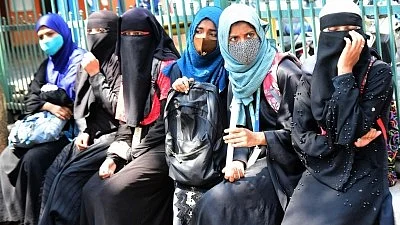
The Karnataka government has officially withdrawn its February 2022 order that banned the wearing of hijab and other religious symbols in aided and private schools and pre-university colleges.
The new circular, issued by the Department of School Education and Literacy on 13 May, now permits students to wear limited traditional and faith-based symbols, including hijab, turban, sacred thread, and rudraksha, along with the prescribed uniform in educational institutions across the state.
According to Live Law, the government’s order nullifies the earlier directive and states that no student wearing such permitted symbols shall be denied admission, progress, examination, competition, or participation in academic activities.
The order also prohibits any institution or authority from compelling students to remove these symbols, except during examinations where national or state-level dress codes may apply.
As reported by The News Minute, the decision has drawn criticism from opposition parties. Bharatiya Janata Party (BJP) leader R Ashoka accused the Congress-led government of engaging in “vote bank politics” and alleged that the move was a response to recent political developments and dissatisfaction among minority voters.
He stated, “The Congress government, rattled by the fallout of the Davanagere bypolls and growing anger within its minority voter base, has once again resorted to its old divisive playbook.”
In a related development, further statements from BJP’s Amit Malviya echoed similar concerns, asserting that the withdrawal of the ban institutionalises religious identity in classrooms.
Malviya argued, “This is not empowerment. This is the institutionalisation of religious identity in classrooms and the slow burial of childhood under layers of dogma.”
“Schools must be spaces where young minds grow free, curious and equal, not where political parties reinforce separateness for vote-bank politics,” Malviya said, criticising the government’s approach.
Midway through the policy’s history, coverage revealed that the original 2022 order had led to widespread protests and litigation. The Karnataka High Court had previously ruled that wearing hijab was not an essential religious practice under Article 25 of the Constitution, and the Supreme Court’s split verdict on the matter remains pending before a larger bench.
Implementation guidelines in the new order specify that permitted symbols must not obstruct discipline, safety, or student identification. The government’s preamble emphasises secularism as equal respect for all beliefs and institutional impartiality.
The order directs school authorities not to humiliate or demean any student for wearing such symbols, referencing the principle “Iva Nammave” (They are ours) from 12th-century reformer Basavanna as details emerged.
The order states, “No student shall be compelled to remove permitted symbols. Equally, no institution or authority may forcibly remove them.”
Political reactions have continued, with analysis showed that opposition leaders view the move as selective secularism and allege discrimination in the application of uniform policies. The government, however, maintains that institutional discipline can be preserved without a blanket prohibition on traditional symbols.
Reporting indicated that the new guidelines apply to all government, aided, and private schools and colleges in Karnataka, with exceptions only for examination dress codes as mandated by relevant authorities.
Note: This article is produced using AI-assisted tools and is based on publicly available information. It has been reviewed by The Quint's editorial team before publishing.