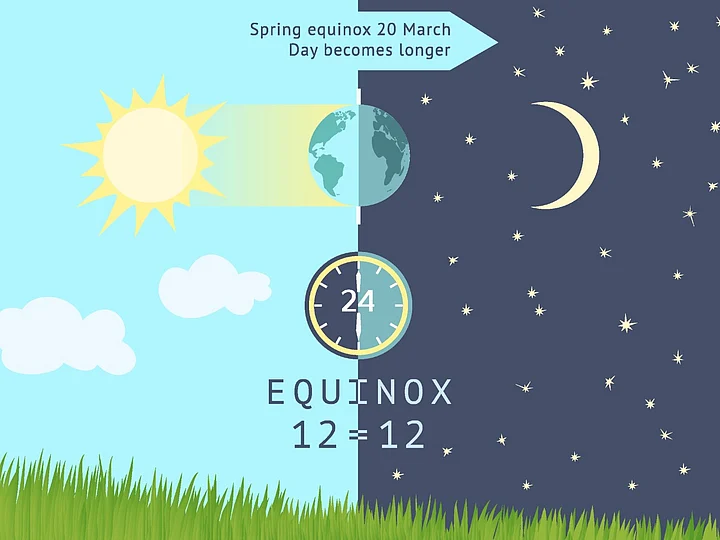
With the first equinox of the year, March counterpart officially marks the end of the winter season, welcoming spring to the Northern Hemisphere. 20 March celebrates the arrival of the annual astronomical event and signally the season change as well. The beginning of daylight saving time has dragged in the rising daylight hours that will hit an all-time high during the June summer solstice. With the first day of spring 2024, the astronomical shift has kicked off the vernal equinox. The meteorological spring consistently commences on 1 March each year but its astronomical counterpart doesn't hit the calendar on a fixed date. On the contrary, the Southern Hemisphere is enjoying the first fall season day today.
Vernal Equinox 2024: Date and Time
According to the National Weather Service, the spring equinox for the Northern Hemisphere is scheduled to take over on Tuesday, 20 March at 8:36 am.
Vernal Equinox 2024: Significance
According to National Weather Service the word ‘equinox’ is derivation from two Latin words, ‘aequus’ (equal) and ‘nox’ (night). Twice a year, the Earth's axis is titled at an angle making it neither facing towards the sun nor away from it. The astronomical phenomenon results in nearly equal amounts of light and darkness encompassing all latitudes. With these equinoxes occurring only two times a year, the sun is directly overhead at noon at the equator.
Seasons are caused by the Earth's tilt and rotation, which is on a tilted axis of 23.5 degrees, on average. As the Earth orbits elliptically around the sun, it is at its closest point in January and the farthest in July. Near the summer solstice, that occurs around 21 June, the Northern Hemisphere is in direct path of the sun's energy, leading to longer days and shorter nights.
Despite the sun's actual position below the horizon, sunlight's refraction causes it to appear above it, which further results in nearly equal hours of day and night. The higher altitudes from equator experience longer days because the sun takes longer to rise and set. Consequently, even days before and after the equinox, the day length exceeds about 12 hours and six and half minutes at the equator.