
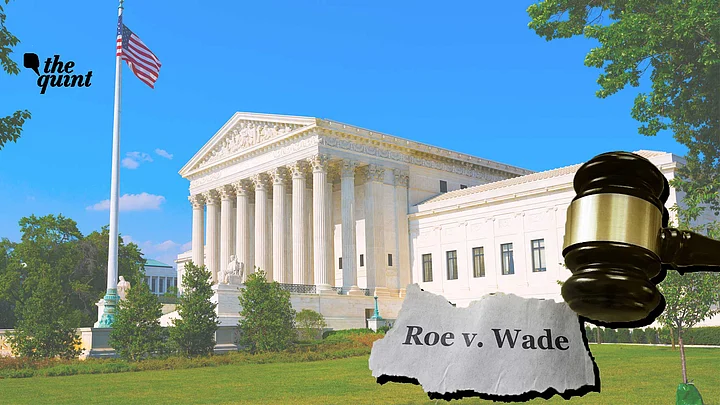
(This was first published on 21 December 2021. It has been republished from The Quint's archives over US Supreme Court overturning Roe v Wade)
The Supreme Court of the United States (henceforth SCOTUS) heard oral arguments on Wednesday, 1 December, regarding a Mississippi abortion case (filed in 2018) that risks the repeal of the landmark 1973 judgement in Roe v Wade that legalised abortion all over the country, Reuters reported.
There are multiple angles to this case. On one hand, the Supreme Court has to decide whether it wants to uphold Mississippi's state law that prohibits abortions after 15 weeks.
On the other hand, it will also decide whether or to not overrule Roe v Wade due to the merits of case regarding something known as "foetal viability," an element of both the 1973 case and the current pending Mississippi abortion case, formally known as Dobbs v Jackson Women's Health Organization.
Foetal viability is a medical term that refers to a point at which a foetus can survive outside the womb and is currently agreed to be around 23 or 24 weeks. In 1973, this number was 28, but has eventually reduced due to advancements in medical technology, according to The New York Times.
Clearly, there are many things to unpack here. Before we go over them one by one, the reader should keep in the mind the central question of this whole controversy, which is, are bans on abortions before the foetal viability point unconstitutional?