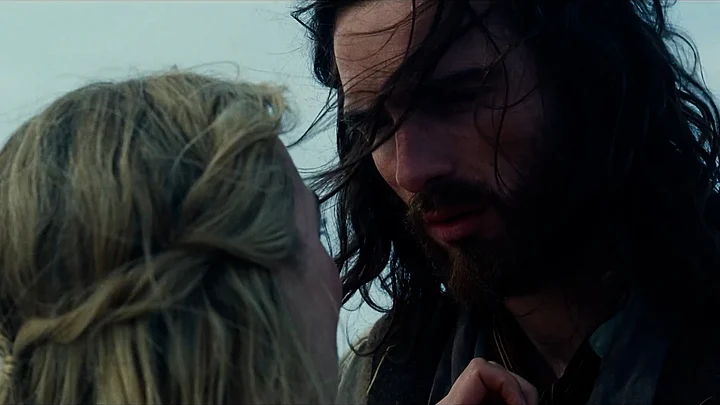
Emily Brontë tragically died of tuberculosis in 1848 after living a life marked by intense personal isolation and poor health. Most would believe that Brontë had suffered enough. Nearly not enough, says director Emerald Fennell who has taken upon herself to torment Brontë even in her death with a film adaptation of Wuthering Heights that is fanfiction at best, cultural vandalism at worst.
The 136-minute period drama is just Heathcliffe and Catherine endlessly rage-baiting and gaslighting each other.
They break up and then make up, fight and patch up for seemingly no concrete reasons that warrant any attention. The fickle-mindedness is difficult to keep up with and takes away from the gravitas—whatever little of it exists—as the writing renders the characters painfully devoid of depth.
Caricatures on the Moors
The first act is marked by humour that is meant to be edgy but ends up undercutting the seriousness of the characters. You don’t laugh with them; you laugh at them. And once this strain of humour establishes the film’s tonal register early on, it becomes difficult to take even its most emotionally weighty moments seriously.
Catherine, played by Margot Robbie is, for lack of a better word, annoying. She is a teenage edgelord come to life—having the intelligence of a sloth doesn’t help her cause. Some of her gesticulations are so extra that you wonder if Heathcliff left because he couldn’t keep up with her theatrics.
Not that Heathcliff (Jacob Elordi) is the brooding gentleman he was in Brontë’s classic. He radiates golden retriever energy so unmistakably, he could be the muse of Sabrina Carpenter’s song ‘Manchild’.
Exasperation Replaces Tragedy
There comes a point when watching Cathy and Heathcliff becomes exasperating. Toward the final act, Nelly (played by Hong Chau), referring to the relentless back-and-forth between the two, asks Cathy, “How many weeks of this must we endure?” I wondered the same. Nelly follows it up with, “You are both revolting,” and I found myself silently mouthing, “Thank you for saying it,” because heaven knows they truly are—even from the viewer’s vantage point.
They come across not as hopeless lovers torn apart by the cruelty of circumstance in which they find themselves, but as nincompoops who lack the conviction to stick to their decision.
The problem with Cathy’s arc isn’t so much her wavering mind as it is Fennell’s refusal to meaningfully engage with her dilemma. What makes Cathy choose Edgar over Heathcliff? How does Catherine grapple with the guilt of having made this choice? None of these complexities are explored or even established with enough seriousness.
The characters go through heartbreak without the viewers feeling the slightest trace of emotion. At times, Catherine doesn’t really come across as a fully-grown, well-rounded woman but as a child in an adult’s body.
Thirst Trap Aesthetics, Absent Chemistry
For a film that was marketed as being sexually provocative and freaky, Wuthering Heights barely has any memorable scenes that establish Catherine and Heathcliff’s sexual chemistry. The scene in which Catherine fantasises about Heathcliff, cross-cut with dough being aggressively slapped against a kitchen counter, is straight out of a TikTok thirst trap.
Her visions of his bare, scarred back aim for tortured sensuality but land as hollow aesthetic posturing. Even so, Catherine acts so coy and disinterested around Heathcliff that you wish she would—at least once—own her desire without disguising it as indifference.
Where the Film Briefly Finds Its Pulse
In all fairness, the film does some things right. The motif of self-harm is surprisingly resonant. Catherine slaps herself in the mirror and, at one point, compels Nelly to cinch her corset unbearably tight—a deliberate act of self-inflicted punishment.
Catherine’s guilt shapeshifts into self-loathing and ultimately self-harm. This metamorphosis is portrayed quite effectively by Fennell, establishing herself as a filmmaker capable of complex psychological excavation (withholding her stylistic choices).
The final act of the film—the part where Catherine breathes her last and loses her baby—is emotionally affecting even if its intensity is undermined by the film’s earlier tonal flippancy.
I wouldn’t want to dignify the absolutely bizarre arc where Heathcliff torments his wife Isabella (Alison Oliver) with an analysis. It is truly one of the most absurd things I have seen on-screen—one which doesn’t serve any larger purpose nor does it add stylistically to the narrative.
In film studies, adaptation theory argues that a film can either closely transfer most details of the source text or the original source can serve as loose inspiration.
Fennell’s film somehow attempts all of it and yet achieves none of it. It doesn’t complicate the themes and anxieties of the source text but instead diminishes them to the point that the film barely functions as an adaptation.
Gothic Romance Stripped of Its Emotional Core
Despite its fleeting moments of competence, Wuthering Heights is laughably bad. It is Wattpad fanfiction that should have never left the website’s confines, much less made into a full-length feature film.
The soundtrack, drawn from Charli XCX’s new album of the film's name, does little to deepen or meaningfully complicate the narrative’s tonal register. As a die-hard Charli XCX stan who practically evangelises ‘Brat’, even I find it hard to defend the popstar here.
If the many adaptations of Emily Brontë’s Wuthering Heights formed a highway, Fennell’s film would be less a pit-stop, more a jarring pothole—one that threatens to derail the entire journey toward a definitive adaptation.
In trying to modernise a classic, the film forgets the one thing that made it endure: emotional truth.
Wuthering Heights released across theatres in India on 13 February.
(Deepansh Duggal is a film critic based out of New Delhi. His work has appeared in Hindustan Times, OPEN, Outlook, Frontline Magazine and The Economic Times. He has a particular interest in anti-capitalist narratives and films that lie at the intersection of power and ideology.)