
Sometime in April 1991, I sat in the North Block room of the then finance minister Yashwant Sinha as he briefed a small group of journalists on the grim economic situation. India’s fiscal deficit at the end of the previous fiscal year stood at well over 8 percent of the GDP.
Unknown to us, the Reserve Bank of India (RBI) governor was busy preparing to fly out to Switzerland and mortgage more than 20 tonnes of gold from the national reserves in a visually and viscerally disturbing moment for the country.
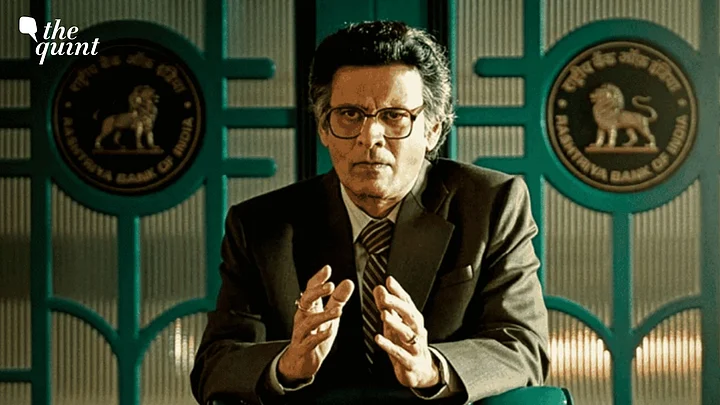
Memories of that sunny morning in the majestic sandstone building came tumbling as I watched Governor: The Silent Saviour, starring Manoj Bajpayee as A Ramanan, the protagonist in a role evidently inspired by, but hardly resembling in looks, manner or personality, the then controversial central bank governor, S Venkitaramanan.
The engaging tale told is with a sense of nostalgia, generously sprinkled with fictional details and twists—and the fiction includes an upfront disclaimer that characters do not resemble persons living or dead. You can see or hear of people loosely resembling former prime ministers Chandra Shekhar, Manmohan Singh, and Rajiv Gandhi.
Bollywoodising History
I am not surprised that those days inspire sensational Bollywood fiction. I once exchanged emails with filmmaker Imtiaz Ali, suggesting a love story in the backdrop of the 'Mandal-Mandir' days of 1990, when India was shaken by an anti-reservation stir against then Prime Minister VP Singh’s job quota order for backward castes, followed by BJP president LK Advani’s controversial Rath Yatra to build the Ram temple at Ayodhya that ultimately took shape.
I had also mentally constructed an RBI governor inspired by the events from 1992, soon after Manmohan Singh ushered in sweeping economic reforms in July 1991.
Ravaged by identity politics and rattled by the US-Iraq Gulf war that made oil prices zoom, India’s economy witnessed something that today’s Gen Z cannot easily imagine. This is precisely the peg on which director Chinmay Mandlekar and producer Vipul Shah use in a fictional flashback through the eyes of reporter Aditi Verma.
Played elegantly by Adah Sharma, the character is credited with the gold mortgage newsbreak, though she bears absolutely no resemblance to my bearded friend Shankkar Aiyar, who actually did so in real life.
In March 1991, Sinha presented an interim budget of the lame and short-lived Chandrashekhar government with a speech that said: “The burden of servicing the accumulated internal and external debt has now become onerous. I need hardly stress that neither the government nor the economy can live beyond its means for long.”
The narrative of Governor has the ingredients that capture those times in a maudlin Bollywood mould, which stands saleable irrespective of the facts that inspired it: A governor with a religious Hindu wife, an office peon with an aspiring daughter, an artistic RBI economist with an ambitious colleague.
Truth, Fiction and Propaganda
Family ties, identifiable characters, conflicts, fire, rain, and road rage can easily obfuscate economic facts but the makers of the movie, mercifully and laudably, do not twist the soul of the crisis—though they play with many things including numbers, names and events deliberately exaggerated to weave an engaging narrative.
Humanising and dramatising events is an old storyteller’s trick, but this one works well to inform an India, in which 65 percent of the current 150 crore were born after 1991. The shiny yellow metal connects them all.
Bajpayee, as the bespectacled, soft-spoken but tenacious Ramanan, excels in an understated style that includes a southern-accented Hindi that is just right and defies caricaturing. Noushad Mohamed Kunju plays CR, fashioned after Deputy Governor C Rangarajan. The moustachioed, Malayalam-accented Rangarajan is far from the Tamil-speaking Iyengar I personally knew those years but his verbal duels and the Right-Left tilts of the two central bankers provide dramatic fodder that carries the story well.
I am tempted to forgive subtle shades of propaganda from producer Vipul Shah, who was recently in a controversy over The Kerala Story, which grossly exaggerated religious conversion on the 'love jihad' label, because the chronology and the core events do stir memories that younger Indians need to know about.
From portraits of Sardar Patel and a somewhat snide reference to Nehru, there are elements of Modi-era propaganda in Governor. But what stands out is the gutsy effort to educate common people on the principles of boring macroeconomics and the importance of institutions like the RBI (Rashtriya Bank in the film).
Ode to Unsung Heroes
At a time when Prime Minister Narendra Modi’s government is being accused of undermining institutions, the movie is a good reminder on how largely unsung officials and executives somehow keep institutions going—and what newer generations must learn to understand their significance.
I have seen real-life characters resembling RBI officer Sharma (played by Paritosh Sand) and his colleague Divya, junior executives who keep institutions going through highs and lows.
In what seems like a Modi-style twist, they are glorified in a ‘karmayogi’ package—dogged, patriotic and dutiful. Such characters are real, and precede the current prime minister, I can assure you.
You see them in the RBI, ISRO, the Election Commission, and other places where big bosses come and go, and are often beholden to bright juniors—or should be.
Interestingly, the movie has hit the screens when India is going through an economic slump that resembles 1991, but on a much smaller scale. “Hot money” NRI deposits, which fled India in those months to trigger the crisis, are back in fashion in an ironic rescue act.
Who knows, they might just make a Governor 2—given Bollywood’s penchant for milking franchises with sequels. Sanjay Malhotra had better get his act together. And Nirmala Sitharaman may be inspiring a Bollywood scriptwriter as we speak. Popcorn patriotism is immensely saleable, preferably with feisty female protagonists.
(The author is a senior journalist and commentator who has worked for Reuters, Economic Times, Business Standard, and Hindustan Times. He can be reached on Twitter @madversity. This is an opinion piece and the views expressed above are the author’s own. The Quint neither endorses nor is responsible for the same.)
