Disclosure Day hits the ground running. Walking is not its style. We’re flung into a story that’s already in motion.
It’s a bit like joining a film midway through: no context, no beginning or warning. Catch me if you can, it seems to say.
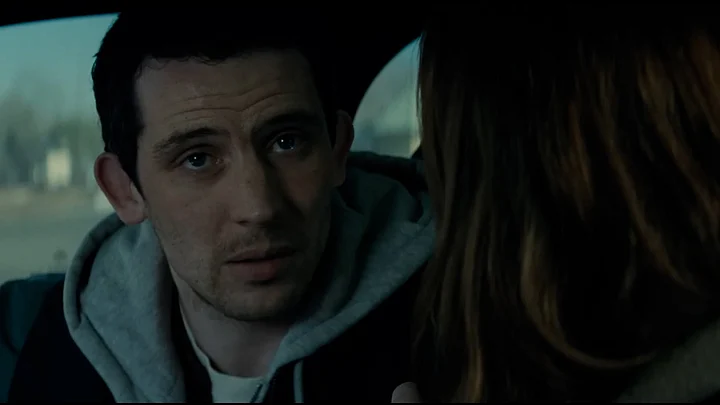
A young cybersecurity specialist (Josh O’Connor) has something in his bag that a shadowy supervillain (Colin Firth) and his deep-state corporation wants. They’ve abducted said hero’s girlfriend (Eve Hewson) to make the trade at a wrestling arena.
But this hero, Daniel, somehow escapes with both girlfriend and bag intact. (If the baddies were competent, the story would’ve ended in a minute). So Daniel was being chased, stays chased, and remains on the run. A meteorologist with psychic powers, Margaret (Emily Blunt), joins him along the way.
This climbing-onto-a-moving-train treatment means that—unlike Mad Max: Fury Road—Disclosure Day has a lot of explaining to do.
But the explanation is rarely worth the disorientation: clunky, corny, a retro theme in a post-truth planet, something about aliens and extraterrestrial technology being real and the US government (who else?) keeping it a secret, something more about Daniel and co wanting to ‘disclose’ this information to the world so that everyone stops fighting.
Apparently, knowing that UFOs are real, regimes are sinister, and aliens could be Gods would prevent a third World War. Oh, Daniel!
Spielberg’s Nostalgia Collides With Modern Conspiracy Culture
The film seems to sense that the contents of the bag are not that cool (it’s no Inception machine), so it uses the non-stopness of its narrative, nifty set-pieces, and a breathless 1990s-action-thriller tone to distract the viewer from thinking too hard.
Momentum becomes its language. It also uses our perception of director Steven Spielberg’s filmography—our relationship with his alien-obsession plots, futuristic techno-jargon, childlike wonder, even journalism—to sell the weird personality of the film.
The result is a disappointing and strangely distant science-fiction drama that evaporates the second we leave the cinema hall.
The camerawork flexes every now and then with creative transitions and single takes. The film opens with a POV sequence of a wrestler in the middle of a match, and there’s a shot that makes falling cereal look like a fake hailstorm. But it’s hard not to be suspicious of the vacuum that these visual gimmicks conceal.
One might see Disclosure Day as Spielberg’s boomer-coded prayer for humanity in an age of fascism and political intolerance. One can see it as his final word on where we stand in the universe, and how perhaps extraterrestrial creatures have been the protagonists and survivors all along. One can even see it as a superhero film in disguise, where characters like Daniel and Margaret are biblical versions of famous comic-book figures with mysterious powers.
However one sees it, though, this is a rare Spielberg movie that has to pretend to be smart. The harder it pretends, the less transfixing it is.
Long-time collaborator John Williams’ score unfolds like an analog soundscape in a digital thriller. I’m all for contrasts, but it’s jarring here. There are times when you expect a dinosaur to interrupt a pulsating car chase, or an Indiana Jones character to swing into a conversation about “experiencers” and chosen ones.
Old-School Emotion in a New-Age Thriller
What’s endearing, though, is the maker’s commitment to the material. The plot goes everywhere and nowhere, but that doesn’t stop the film from looking for pockets of classicality and go-for-broke emotions.
Some of the better parts feature Margaret disarming people with the force of empathy in a therapy-like voice. These are moments that could’ve gone woefully wrong, but Emily Blunt makes them work, almost selling the sappy central theme.
The frantic 15-minute climax goes old-school with the anatomy of a breaking-news broadcast, and for a bit, you almost forget the revelation it’s in service of. I also like the self-reflexiveness of the whole thing, however silly the method.
Here’s a storyteller who has thrived on the awe of human-alien contact for decades, but he’s willing to sacrifice all the fancy to engage with the brutal reality of the modern world. As hard as it is to believe that local television networks can do this in an internet age, one is tempted to grant the filmmaker ETCU (Extraterrestrial Cinematic Universe) privileges.
Big Ideas, Murky Mythology
Beyond the B-movie entertainment, perhaps the troubling part about Disclosure Day is the nature of its mythology. One of the ‘gifted’ characters even exclaims that she will not be anyone’s religion, and another is a former nun grappling with the morality of this (incoherent) situation. But that’s just the script shying away from its most overt text.
There is a sense that the film introduces new meanings of divinity and faith without bothering to grapple with the consequences.
And most of us are wired to see fabled filmmakers through the lens of reverence and acceptance, whatever their ideologies. What else can explain the geeky gibberish called 'Frankenstein' being lauded last year?
At a political and personal level, Spielberg has always been one of the most expressive American creators. But it’s difficult to detect a Munich-style balance here. He seems so consumed by the evolution of his own thoughts that perspective becomes the alien entity. The future he envisions, then, is very much a slicker and social-media-centric iteration of history. People have a right to know things, sure, but how true is too true?
At its greediest, the film feels like a stubborn reaction to Instagram filmmaking and godless horror. But the only real disclosure that happens concerns the failure to disclose anything new.
Disclosure Day releases in theatre on 12 June.
(Rahul Desai is a Mumbai-based film critic. His reviews and columns have been published in Mumbai Mirror, Film Companion, The Hindu, Firstpost, Ottplay, News9 and others. He currently writes for The Hollywood Reporter India.)