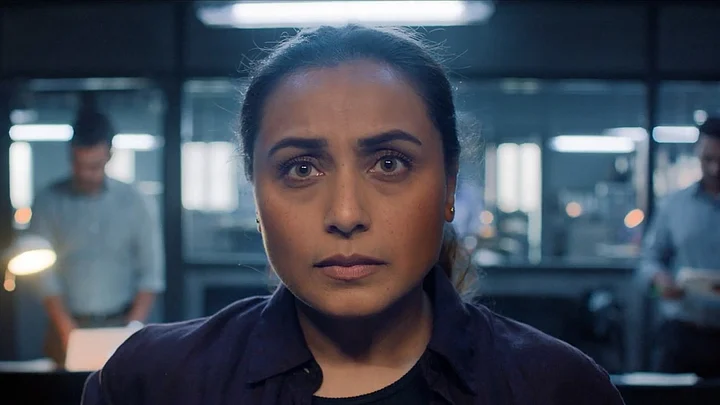
Mardaani 3 is less a film about living, breathing characters, operating at the intersection of crime and poverty, and more a 129-minute lecture in feminist fury. It is a sincere attempt by director Abhiraj Minawala to deliver a fitting addition to the franchise, even if it ends up inheriting some of the same pitfalls that plagued the first two films.
Rani Mukerji returns as Shivani Shivaji Roy, a character who collapses under the sheer weight of her own self-seriousness. She screams, kicks, and punches, but at no point does she evoke the slightest admiration in the viewer as a formidable figure upholding the film’s feminist ideals.
The film is desperate to sell Shivani’s physical and mental prowess, but Mukerji lacks the gravitas needed to embody a policewoman who commands respect instinctively. So when she walks into a room to a chorus of salutes, or single-handedly overpowers the antagonists, the moment registers more as disbelief than awe.
Stark Promise, Undone by Heavy-handed Storytelling
The film opens with the kidnapping of two girls in Bulandshahar—one is the daughter of the ambassador to Turkey, and the other is the daughter of her caretaker. The stage is set to explore systemic injustice—how drastically the police response differs when rescuing an ambassador’s daughter compared to that for girls from underprivileged backgrounds.
In comes Amma (played by Mallika Prasad), a creepy, psychopathic child trafficker who locks horns with Shivani and refuses to turn over the ambassador’s daughter. Shivani seeks help from Ramanujan (played by Prajesh Kashyap), a man who is fighting the beggar mafia without institutional backing—or so it seems. A game of cat-and-mouse plays out as Shivani tries to rescue the kidnapped girls from Amma’s grip, only to be betrayed by Ramanujan.
Mardaani 3 treats child trafficking with the intellectual depth of a PowerPoint presentation. For a film that deals with weighty themes, Mardaani 3 never manages, even accidentally, to accomplish a very basic task: to illuminate, complicate, or provoke genuine understanding of the violence it exploits.
Its critique of the system operates strictly on the surface level, and any expectation of it addressing the intersectionality of poverty and gender will lead to disappointment. There is even a moment where Shivani (Mukerji) seems to mispronounce POCSO as “POSCO,” a lapse that is hard to ignore.
A Thriller that Pauses to Explain Itself and its Politics
The plot does little to ease the superficiality of the film. At one point, Amma casually checks into Shivani’s house like it’s an Airbnb and walks out without any consequences. For some reason, Amma is very chill about this random visit to the cop trying her best to nab her, even if the viewer is entirely disbelieving.
The tension of a police officer chasing a supposedly dreadful criminal is all but missing. Whatever little of it exists is built not through strategically paced scenes designed to keep the viewer engrossed, but held together loosely by long-winded dialogue that lectures the plot in a matter-of-fact manner. The plot doesn’t unfold at all; it is delivered wholesale through dialogue that exists solely to explain events to the viewer.
The film’s themes are beaten into submission with such crude insistence that I half-expected a character to announce their politics outright. Sure enough, someone does: “Capitalist hu, ma’am,” Ramanujan says, rather proudly, when his plans to engineer a mutated version of the HPV virus are exposed. Subtlety, by this point, is long dead.
The film, at times, accidentally self-satirises. “Plan mat batao, results dikhao,” Shivani is told at one point by one of her superiors—advice that the film could have benefited greatly from, since cinema works best when it shows rather than tells.
Moral Messaging Turns into Self-Parody
An endless investigation plays out across the metro stations in Delhi, secret labs in Sri Lanka, and the dimly lit streets of Paharganj. One thread leads to another, but none of them seem to pay off. The investigation itself seems like a long road to nowhere.
The penultimate moments of the film, unsurprisingly, are as cliched as one would expect. Shivani channels her rage and flogs Ramanujan; the whipping—complete with a soundtrack invoking Hindu goddesses—is framed as feminist catharsis, but it is indistinguishable from nationalist propaganda fantasies of terrorists being publicly beaten. In both cases, the scenes fail to earn the emotions they so desperately seek to evoke; their intent is to appease rather than inspire admiration.
Mardaani 3 is less a film about living, breathing characters existing at the intersection of crime and poverty and more a 129-minute-long lecture on feminist fury.
It is a solid attempt by director Abhiraj Minawala to add a fitting instalment in the franchise, even if it inherits some of its pitfalls from the first two films.
Mardaani 3 released in theatres on 30 January.
(Deepansh Duggal is a film critic based out of New Delhi. His work has appeared in Hindustan Times, OPEN, Outlook, Frontline Magazine and The Economic Times. He has a particular interest in anti-capitalist narratives and films that lie at the intersection of power and ideology.)