'Putin Has Direct Role in Russia’s War Crimes': Vrinda Grover on UN Body Report
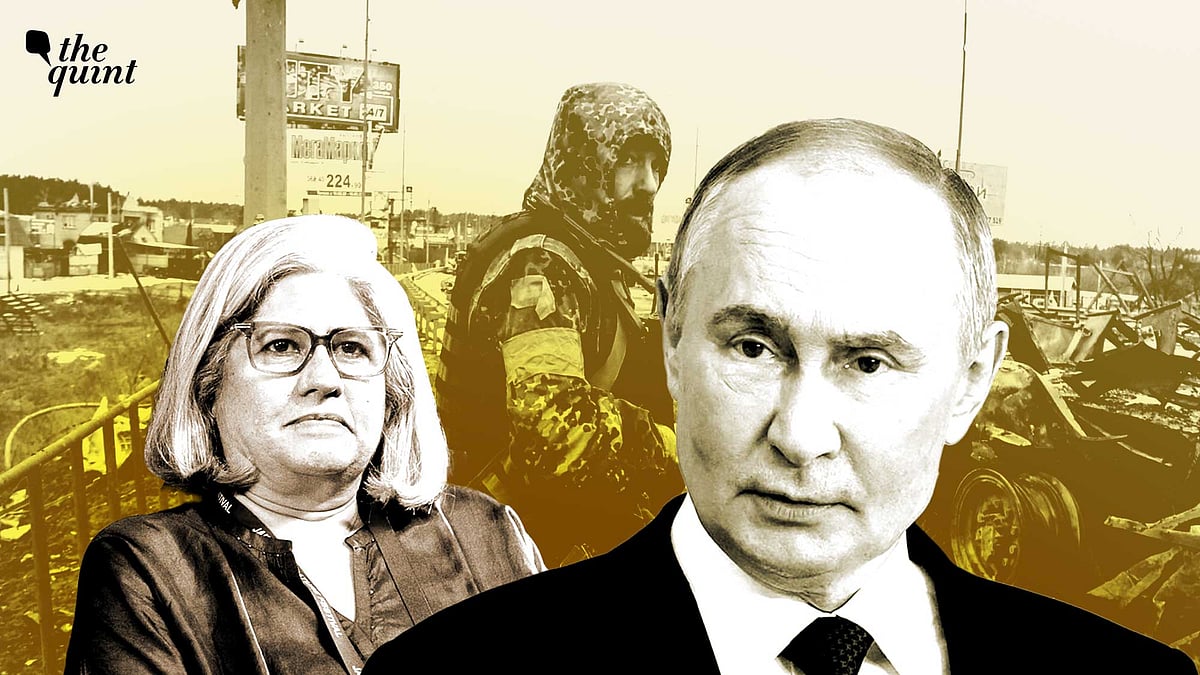
Vrinda Grover, who is part of a 3-member UN commission, says torture is used in all Russian detention facilities.
advertisement
(Trigger warning: References to torture, sexual violence, and suicide.)
"Torture is used in all Russian detention facilities with authorisation from President Vladimir Putin," says Supreme Court advocate Vrinda Grover in an exclusive interaction with The Quint.
As part of a three-member independent commission set up by the UN, Grover reveals harrowing findings of human rights abuses unearthed during their investigation into the Russia-Ukraine war—ranging from sexual violence against women and children to the systematic use of torture to extract false confessions from prisoners of war.
She says that the Russian leadership is fully aware of the gross human rights violations taking place, including the forceful deportation of Ukrainian children and their placement within Russia through 'adoption' and 'long-term placements'.
Edited excerpts from an interview:
The commission's latest report from March states that several prisoners were deployed into the Russian Army. Is there any evidence that forceful means were used against those who did not want to join voluntarily, like torture, blackmail or threatening them by getting their families involved?
The prisoners who are deployed may not be Russian; they may be from other countries as well. They're told, 'Your sentence will be waived if you join the Russian Army'. These people don't have any military training. Some perfunctory training is provided, and these people are sent to the frontlines, which are highly dangerous.
The commission's findings also state that certain Ukrainian children were forcefully taken away from their parents and initially kept in transit centres. Later, the Russian government said that adoption was their preferred choice for the placement of children within Russia. Is there any evidence that some Russian couples were forced to adopt children?
We have found that several children were taken from occupied areas of Ukraine. As you mentioned, they were first kept in transit centres and then taken further—deported to either occupied areas or within Russia itself.
As statements by President Putin indicate, adoption was the preferred mode for the placement of children within the country. But adoption was an illegality that was being committed.
Families who have adopted are publicly applauded and given incentives. Because of these incentives, the current investigation states that families are coming forward to take these children in for so-called 'long-term placements'.
The commission also states that Russian citizenship is being imposed on Ukrainian children who have been detained. Do you feel that this is a larger narrative at play by Russia to initiate cultural appropriation, to try and ensure that the future generation of Ukrainians grows up in Russia without any links to their country of origin?
Over 46,000 children who have been taken from Ukraine as part of this forcible transfer were granted Russian citizenship. This is very systematic on the part of the Russian government.
These children are either being brought up in Russian institutions or placed with Russian families, and hence they are being deprived of their cultural background.
We are looking at a process by which the child is not only going to grow up away from his or her family, which is traumatic as it is, but also in a cultural environment which is alien to Ukrainian society.
They will undergo what is called 'Russification': it's not just the formal awarding of citizenship but also cultural aspects which will be instilled to change their viewpoints.
What about the children who haven't been adopted or put into long-term placements so far? Do we know where they are being held currently and what their living conditions are?
What we have learned from the children who managed to return is that they are kept in very coercive environments, to the extent that they are not allowed to communicate with their families or even allowed to express a desire to return home.
There was a very tragic case of a young boy who wanted to return. He actually made efforts to escape and go back home, but each time his attempts were obstructed. He was so traumatised that he committed suicide.
What would you say about the way in which Russians are treating civilians and prisoners of war in their custody? For instance, the report states that many are being tried as 'terrorists' in Russian courts. Is this a complete departure from the Geneva Convention and other related legal frameworks?
The commission has found that there is widespread and systematic use of torture in all Russian detention facilities. Torture is a part of a policy used by the Russians, and it amounts to crimes against humanity. Civilians are not only tortured but also compelled to self-incriminate, to sign false confessions and admit they were part of hostilities. In order to prosecute prisoners of war, fake charges of espionage and terrorism are being foisted upon them.
The nature of the trials raises a very big question as well. These trials completely abandon fundamental fair trial guarantees. A lot of the evidence presented is procured through the use of torture. And therefore, there is no presumption of innocence. Further, very harsh imprisonment terms are imposed on prisoners, which can range from eight to 35 years, and sometimes even life imprisonment.
What evidence has the commission found that these alleged violations were carried out with direct authorisation from Russian President Putin?
Perpetrators who were responsible for torture include the Federal Penitentiary Service. Another perpetrator was the Federal Security Service, which is otherwise commonly referred to in Russian as 'FSB'. The FSB comes in particularly during the time of interrogation. We have also found that the investigative committee in Russia, which comes under President Putin, also committed torture.
Several administrative authorities, including regional governors, work under the direct authority of President Putin. Whenever there is any hindrance, it is immediately removed through Putin's direct intervention.
There is also evidence of an aircraft from the Russian presidential fleet being used to transfer around 53 children from Ukraine to Russia. Similarly, an aircraft of the Russian Air Force was used to transfer children in September or October 2022.
One of the most tragic portions of the commission's findings details alleged sexual abuse committed by Russian soldiers, including of children who were as young as 13 and 15 years of age. Have you found that sexual violence is being actively used as a tool to break the spirit of occupied Ukrainian communities?
Right from the time when Russia's occupation began, when the house searches were being done in Ukrainian villages, there has been a systematic use of sexual violence. Such practices are common at filtration points, makeshift detention centres, institutional detention facilities, et al.
As a member of this commission, what would you want the impact of the report's findings to be on the global community, and particularly on Russia?
As we all know, there are multiple conflicts taking place in the world today. Our belief is that impunity should not be allowed to continue. Whatever the peace process is between parties, it needs to be underpinned by concerns of accountability and justice.
When I speak of justice, it needs to be both judicial and non-judicial measures of accountability. Judicial measures refer to holding to account those who have perpetrated the crimes, either domestically or through forums like the International Criminal Court. The non-judicial measures, which are equally urgent, include providing victims a range of support—not only in terms of compensation and livelihood, but also psychosocial support, medical support, and means to help them reintegrate with society again.