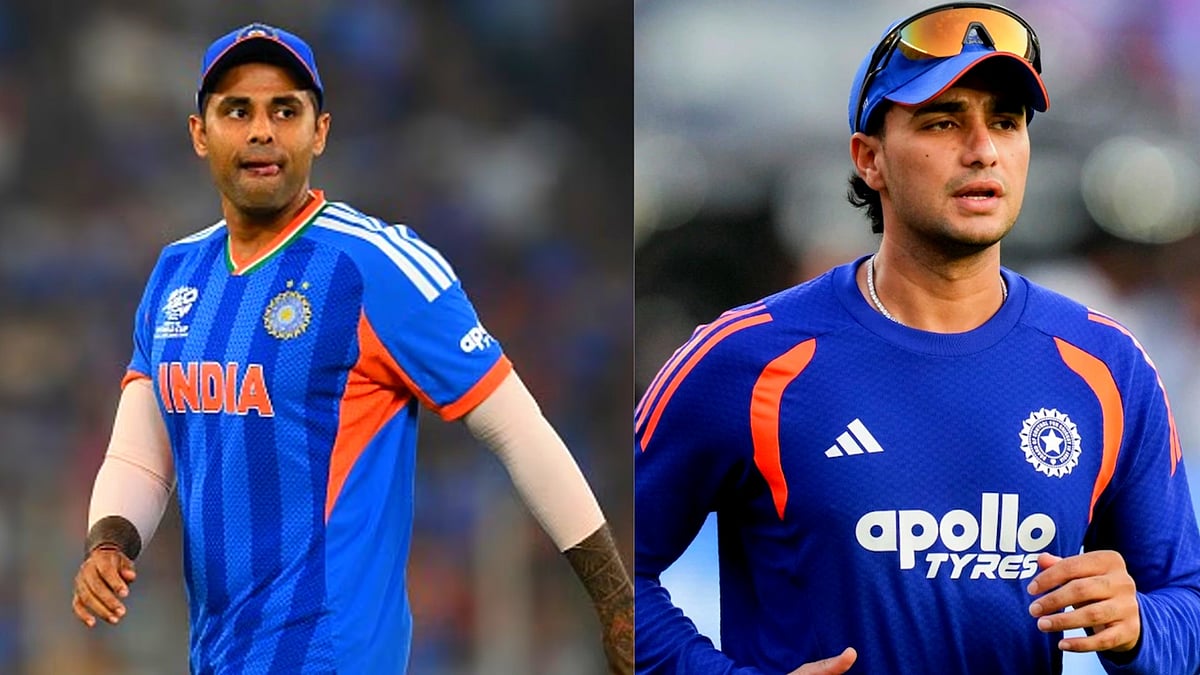
If there was ever any doubt, it was put to rest by the Indian captain, Suryakumar Yadav, ahead of his team’s Super 8 clash against South Africa at the ICC Men’s T20 World Cup 2026. Yadav, while addressing the press, all but confirmed that Abhishek Sharma will retain his place in the match against last edition’s runners-up, which will be held in Ahmedabad’s Narendra Modi Stadium on Sunday, 22 February.
Sharma has had a horrific start to his T20 World Cup career, recording three consecutive ducks. Notably, he is only the third batter in the history of this tournament to not score a solitary run in his first three T20 World Cup matches, after Ashish Nehra and Uganda’s Roger Mukasa.
On being asked about whether he was worried about Abhishek Sharma’s form, or, evidently, the lack of it, Yadav could only offer a sarcastic smile. He answered:
I am not worried about Abhishek Sharma's form. I am worried about the people who are worried about Abhishek's form. Why are they so worried about Abhishek's form? But I think about those teams who are going to play against him. That he has not yet scored a run. You know the rest of the answers. When he scores a run, you have seen what happens. It happens, it's a team sport, it keeps going on. Now the team has a requirement that the boy should play with his identity. So he is trying to play. If it happens, then it's fine, if it doesn't, then we are there to cover. Last year he covered for us, now we will cover for him.
Suryakumar Yadav
ADVERTISEMENT
ADVERTISEMENT
Surya Explains Tilak Varma’s Role
Sharma, though, is not the only southpaw in the Indian team to have his form under the scanner. Tilak Varma has faced scrutiny as well, despite scoring 106 runs, and being India’s fourth-highest run-scorer at the moment. The reason being — a strike rate of 120.45, that is in striking contrast with India’s usual batting template that resonates with aggression.
Yadav, though, had a justification for it. He clarified that Varma has been assigned a specific role by the team management, and he is doing just that.
I have told him, the team management has told him that he has to bat that way. If one wicket is down, then he is definitely, he can go and have his own game in the powerplay. But as soon as two wickets are down, then he has to take a little bit of backseat, get a partnership again, get to the 10th over and then we have enough firepower to continue and take on the bowling. But yeah, definitely I am sure he must not be happy with how he is batting right now, I am sure. He must be and he has practised a lot as well in the last 2-3 practice sessions. But I don't have any concern regarding him. He has been delivering for India at No. 3 really well and I am very confident that he will do it better.
Despite having arguably the most daunting batting unit in this competition, India have not really set the world alight with a flurry of fours and sixes. The only match where they breached the 200-run mark was against Namibia. Lack of runs in the powerplay, notably, has been a major stumbling block in India’s bid to score 200+ totals.
Explaining the issue, the Indian captain said:
It's going well in power play. We're making 50-40 runs. That's normal cricket. Now we've played so well in bilateral. It happens – we have expectations, we also have expectations from ourself. Expectation to make 220, 240, 250. But wickets are a little different here. The four wickets we have played on so far were a little different and challenging. Off spinners were not bowling earlier but are now. So we have started preparation for that and hopefully we will tackle it as we start our Super 8 journey.
Suryakumar Yadav
Unlike how they usually have batted in recent bilateral meetings, the Indian batting display has not solitarily been about acceleration and aggression in this tournament, with the team’s middle-order also decelerating if need be.
Elaborating on the batting approach, Yadav added:
We are trying to explode from the start. Because everyone knows their game. Everyone knows their template of T20. But at the end, we don't have to be a team that we keep hitting and hitting. Sometimes, we can get into a situation where we lose two wickets quickly, or three wickets quickly. So we have to be a little smart team also to bat well between 7 to 15. And then we have enough firepower that once the base is strong, we can score around 60, 70 runs in last five overs. So, till now those situations have come. Now whenever we get a good start – then we’re bat with those same templates. But, sometimes such tricky situations come in the T20 where you're two down, three down. So in the middle overs, you have to respect the game and keep your main game to the side. The team has to play according to the requirements that the team has.