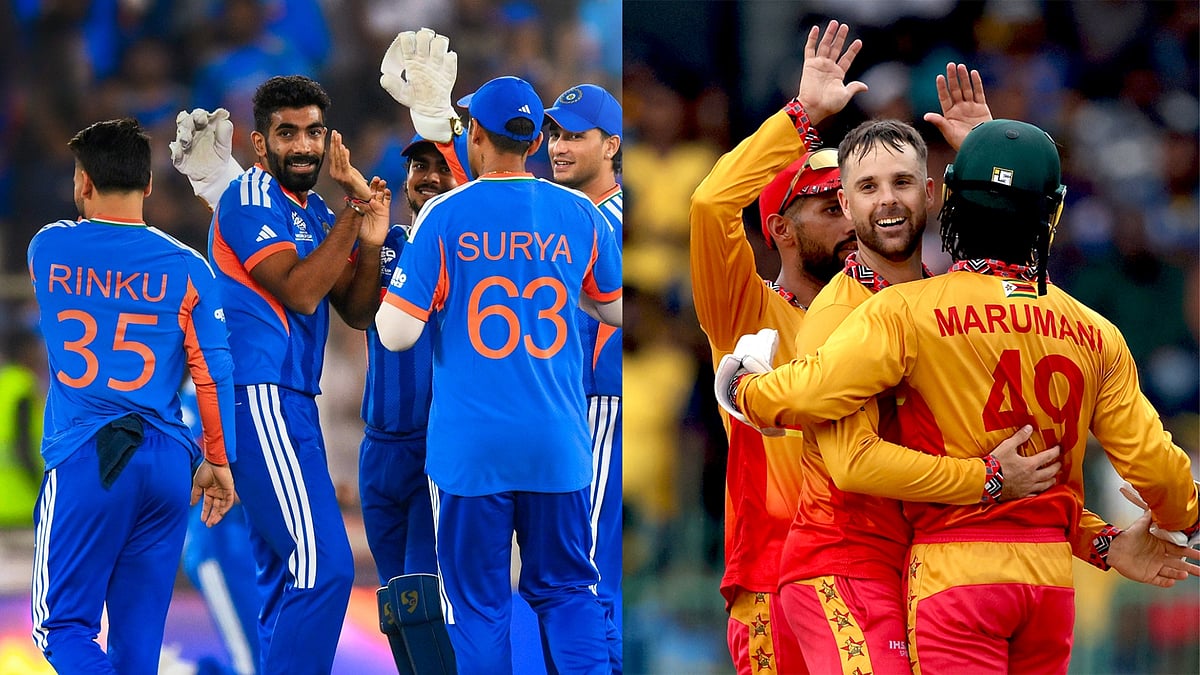
T20 World Cup 2026: India vs Zimbabwe — a First-Of-Its-Kind Fixture. Literally.
T20 World Cup 2026: India find themselves in a position they wouldn't have thought they would be in.
advertisement
“Pressure does funny things to people.”
Before the commencement of the ICC Men’s T20 World Cup 2026, had you been asked to predict which player — and from which team — might utter that line ahead of India’s first do-or-die encounter, Zimbabwe’s Ryan Burl would hardly have featured among the likeliest candidates.
Yet, here we are.
Yet, here we are.
India have played Zimbabwe 13 times in this format of the game — 12 of those matches being held at the Harare Sports Club. The Chevrons have won three of those matches. Neither of those defeats had a catastrophic cascading effect on the Indian team.
Yet, here we are.
The Context of India vs Zimbabwe
Where is the action at?
At the MA Chidambaram Stadium in Chennai, where India will face Zimbabwe in their second Super 8 fixture. This is a match whose precise stakes will be known even before the first ball is bowled. Whether a straightforward win will suffice, or whether a substantial Net Run Rate (NRR) boost will be required, depends on results elsewhere.
The context of the game is as such that after losing their first Super 8 fixture to South Africa, India find themselves in a precarious position.
Precarious, after a solitary defeat?
The concoction of the two has resulted in a table that might trigger nightmares among the most indifferent Indian fans. Both West Indies and South Africa have a NRR far superior to that of India.
Discussing margins of victory in a preview can appear discourteous to the opposition, but the reality is — depending on the outcome of the fixture between the other two Group 1 teams, India’s requirement from this game will be finalised.
A win, or a win by a significantly large margin?
Who Comes, Who Goes?
When a team suffers their biggest-ever defeat at the T20 World Cup, in terms of runs, every aspect is a talking point. More so, if the team is India. More so, if the team possesses the world’s number 1 T20I batter in the squad, who has scored 15 runs in four matches.
After three consecutive ducks, Sharma finally scored his first runs at a T20 World Cup in the last match against South Africa. Though, he did not look comfortable in that fixture either. Though, from what batting coach Sitanshu Kotak said in the pre-match press conference, it seems certain that Sharma will have the long rope.
Since 2025, Sharma has scored the third-highest runs as an opener (1026) among those who are playing at the T20 World Cup, with only Brian Bennett and Sahibzada Farhan ahead of him. His strike rate of 196.93 is also the highest among those who have scored a minimum of 300 runs as an opener.
If Sharma retains his place — and with Ishan Kishan firmly entrenched after his recent exploits — the question arises: is there room for Sanju Samson? Unlike the firm stance taken earlier regarding Suryakumar Yadav, Kotak kept options open.
The obvious question here is — provided he plays, who will Samson replace?
Tilak Varma seems to be the most likely option. Though he is currently India’s fourth-highest run-scorer in this competition with 107 runs, his strike rate of 118.88 has caused his team a few troubles. Moreover, while Varma is India’s second-highest run-scorer in T20Is since 2025 with 674 runs, his strike rate of 127.41 ranks him at the 11th spot.
That aside, no other changes are likely, barring Axar Patel replacing Washington Sundar. Rinku Singh had to leave the team with a personal emergency, but he will be available for selection against Zimbabwe.
What Are the Concerns?
An off-spinner bowling the first over has become the Indian team’s equivalent of death and taxes — inevitable. Taking a cue from Aiden Markram, Aryan Dutt and Salman Ali Agha, we might see Sikandar Raza rolling his arm over in the first over today, having recovered from his injury.
For India’s southpaws, off-spin remains a major trouble. The following are the strike rates of left-handed Indian batters against off-spin in the ongoing tournament.
Shivam Dube — 131.58
Ishan Kishan — 117.39
Abhishek Sharma — 100.00
Tilak Varma — 88.89
Lowest batting average vs slower balls
(Photo: CricViz)
Life moves swiftly at a T20 World Cup. Teams that appear invincible one week can find themselves staring at elimination the next, but by the end of the day, depending on not one, but two results, India could reclaim their usual stature.
Will they? Or, as Ryan Burl said, will pressure do funny things to the Indian cricket team?