
Is Mohan Bhagwat's Lament Against ‘Me, Myself’ Politics a Message for Modi?
Since 2024, the RSS Chief has made several remarks, which have been seen as being directed at the Prime Minister.
advertisement
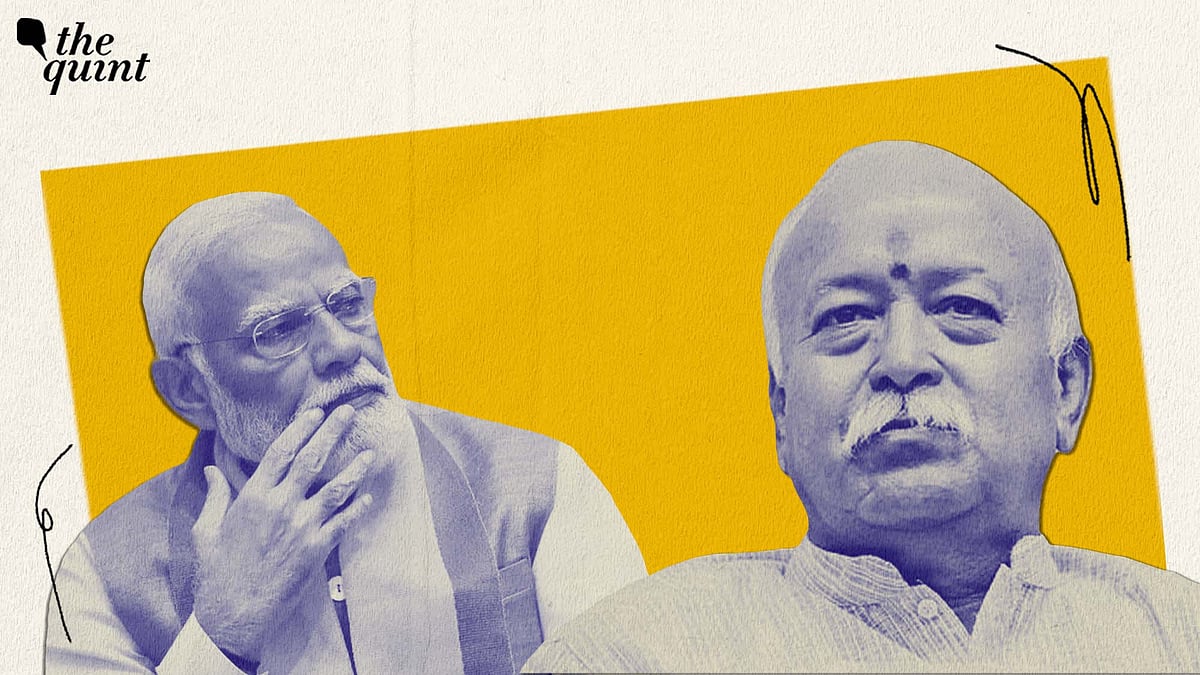
Rashtriya Swayamsevak Sangh (RSS) chief Mohan Bhagwat recently expressed his frustration with politics, with an unequivocal condemnation of the “me, myself” malaise. For him, politics hasn’t lived up to expectations to bring desired changes in the society.
Bhagwat, in his comments in Madison Square Garden, New York, further blamed politics for the prevalence of “self-interest”. On the surface, Bhagwat’s comments may seem general in nature, but the possibility that he was signalling to Prime Minister Narendra Modi cannot be ruled out.
“…change is not happening through politics alone. I am sorry to say, but politics has largely become a game of self-interest,” Bhagwat remarked, as he spoke at the MSG, New York during the ‘One World, One Humanity’ conference.
The RSS chief further qualified his comments, saying that “… wherever there is ‘me’ and ‘mine’, there is no solution, ‘we’ and ‘ours’ is the only solution.”
One could argue that the RSS chief was referring to world leaders in the context of unresolved global conflicts. But it may be emphasised that Bhagwat underlined the inadequacies of politics in bringing about changes while highlighting interventions that “we’ve already begun" directly through “society”.
Favouring the “we, ours” approach as a way to achieve solutions, Bhagwat appeared to make his preference clear for collective leadership.
Why Decode Bhagwat with Modi Lens?
Since 2024, the RSS Chief has made several remarks, which have been seen as being directed at the Prime Minister. Bhagwat, true to form, rarely makes direct comments about political personalities but rather speaks through innuendos and indirect references.
The RSS chief also has, in the past, sounded displeased with electioneering turning into personal sparring. After the 2024 elections, Bhagwat had said that “decorum wasn’t maintained in elections.”
Besides Bhagwat’s past remarks, the RSS-BJP relations remain fluid. As Modi approaches the age of 76 on 17 September and the BJP commemorates a fortnight of the “service outreach” to commemorate the PM's birthday, the spotlight keeps returning on the “who after Modi?” question. Last year, in the weeks preceding Modi’s 75th birthday, feverish speculations ran through India’s political capital about the future of Modi’s tenure as Prime Minister. That question is resurfacing again.
Also, Bhagwat within the RSS-BJP ideological family, is arguably the only person who will be the final arbiter of the leadership transition in the saffron political outfit. In 2013 also, Bhagwat is widely believed to have brought peace to the BJP by persuading LK Advani and Sushma Swaraj to back Modi as the party's PM face for the 2014 Lok Sabha elections.
That explains the exalted position of the RSS chief in relation to the BJP, which cannot risk snapping the ties and asserting full autonomy as a major chunk of the cadres of both the outfits comes from a common pool.
“Me, Myself” and Modi
Modi’s style of functioning, marked by excessive centralisation of power and decision-making, has been his hallmark.
In Gujarat, as the Chief Minister of the state, Modi's office became almost the sole decision-making centre. Old timers recall that bureaucrats were more powerful than ministers in Modi’s Gujarat days. But he was still a Gujarat leader, and the BJP at the national stage, boasted of a number of influential leaders who together gave a sense of collective leadership within the party.
After that, the BJP seemed transformed as an electioneering extension of 'brand Modi'. The BJP’s fortnight-long service outreach, called “Seva Sankalp Abhiyan”, starting on the PM's birthday, is an unmistakable example of the outfit amplifying the personal image of Modi.
Bhagwat Still Sees the Glass Half-Empty
Bhagwat spoke of influencing policies in his MSG remarks in New York. That suggests that the RSS has a wish list on the policy front. The RSS regularly holds “Samanway Baithak”, or coordination meetings, in which all its affiliates take part, including the BJP. This meeting is actually seen as the forum through which the RSS and its other affiliates communicate their priorities to the BJP, which in turn conveys the message to the government.
The RSS, per insiders, is growing alarmed that the excessive centralisation of leadership is now showing visible signs of governance gaps, as well as creating a political void within the BJP.
While it may be said that the youth has seen past the façade of shining 'brand Modi' in the course of their three-week-long protest at Jantar Mantar in New Delhi, the RSS' concerns did not emerge after the protests alone.
The RSS has indeed been counting the episodes — the Modi government couldn’t deliver on the National Education Policy 2020, a key interest area of the Nagpur-headquartered outfit; the social rupture after the contentious UGC resolution; the furore over the Aravalli rule (stayed by the Supreme Court); Modi’s US foreign policy, which has alarmed the RSS and its affiliates on economic issues; and, worryingly for the RSS, the deepening of the caste divide.
Lately, the RSS has been dropping hints of eagerness to not be seen as being clubbed with the BJP. To this effect, the RSS has intensified its own outreach. The RSS leaders have been discussing the risks of being seen through the BJP prism as the Modi-centric governance model and politics of the BJP begin to reveal cracks.
(Author is a senior Delhi-based journalist, who for over two decades has reported on the BJP, the RSS, and the PMO. This is an opinion piece and the views expressed above are the author’s own. The Quint neither endorses nor is responsible for the same.)
- Access to all paywalled content on site
- Ad-free experience across The Quint
- Early previews of our Special Projects
Published: undefined