
Behind Every Kitty Party Is a Woman Reclaiming Her Time
The joke was never about tambola, Atka Matka Jhatka, or cards. It was about who was allowed the luxury of leisure.
advertisement
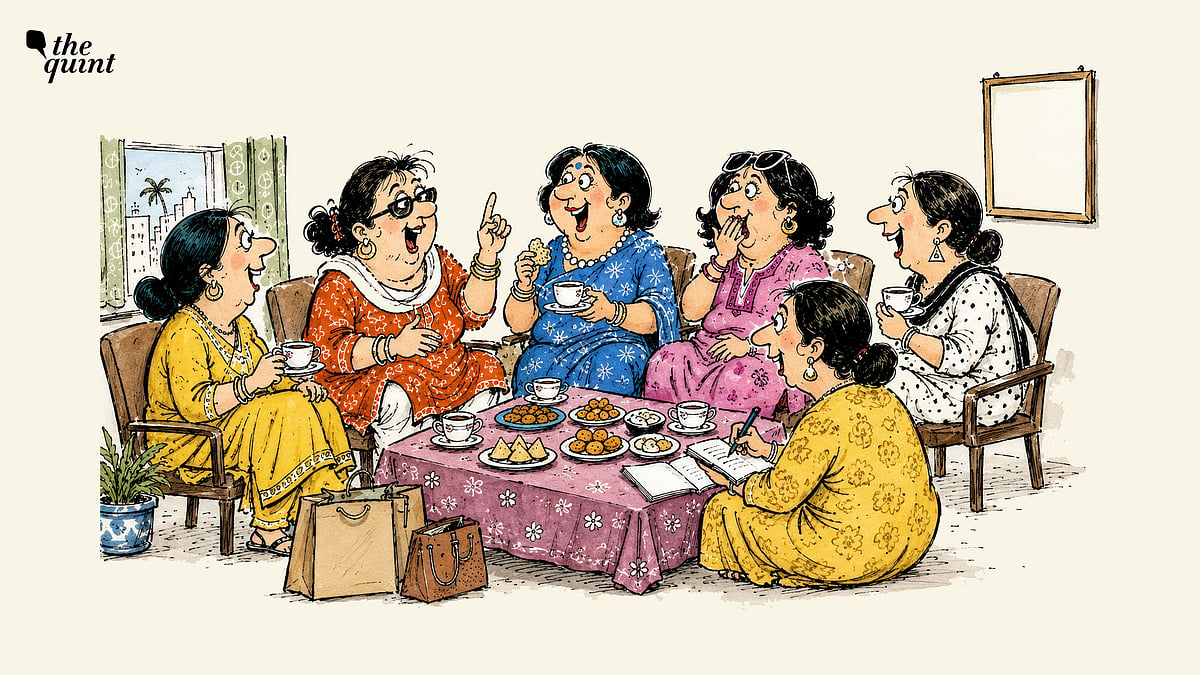
The scene is ordinary enough to be familiar. She laid the saree out by nine but did not drape it until after lunch. The whistles from the pressure cooker had fallen silent, the dal left to simmer and the last phulka had puffed on the flame. The kitchen closed like a shift at a factory, except there were no wages for the work demanded . When she finally adjusted her pallu over her shoulder, she told herself it's just an afternoon of cards, tea, and old friends.
She arrived at three. The living room was warm and alive. The laughter was a release after a morning spent in lowered voices negotiating with families, finishing chores, making sure everyone else had been looked after before allowing themselves to leave the house. It was an afternoon gathering as going out after sunset for dinner was not permissible.
Somewhere in the same city, a reel from the gathering was uploaded. Within hours, the women were reduced to the internet stereotype. The comments came "bored housewives," "women with nothing better to do," "peak aunty behaviour." Three hard earned hours of leisure trolled insensitively.
The joke was never about tambola, Atka Matka Jhatka, or cards. It was about who was allowed the luxury of leisure.
Among the comments beneath the reel was one from a 68-year-old woman. She wrote that she had never truly experienced her childhood with friends. Married in her teens, her life became a continuous cycle of responsibilities from caring for in laws, raising children to running a household. Now, in her late sixties, these few afternoons offer a small window to her unlived childhood.
Another woman, in her forties, wrote that she left for a kitty party only after finishing every chore. Despite this her in-laws would still criticise her for going out. Her husband and daughter on the contrary encouraged her to go out. The questions were not raised in her absence .It was the idea that a married woman is bound by duties and such acts of self expression were rebellious .
It reflected a familiar social script. A man's free time is earned, while a woman's free time is assumed.
History Of A Dismissed Institution
The modern kitty party is widely believed to have taken shape in the 1950s, in the aftermath of Partition. As many displaced middle-class families in North India rebuilt their lives, women began forming informal savings circles. Each month, every member contributed a small amount to a shared pool, and the entire sum was given to one member in rotation. The system made it easier to meet larger household expenses or emergencies.
Over the years, these gatherings came to mean much more than money. By the 1980s, kitty parties had become a familiar marker of urban upper-middle-class life. It helped them buy a refrigerator, a washing machine or a microwave to make everyday life a little easier.
Sometimes, the money went towards indulgence, a new saree or a saloon visit. These women always hesitated or felt guilty while spending money on themselves. Kitty to them was a small pocket of financial freedom.
The Norwegian anthropologist Anne Waldrop, spent years researching kitty parties among middle-class women in Delhi. She frames the institution through the ghar/bahir divide.
According to Waldrop, the women she interviewed were aware of the stereotypes around them . In anticipation of criticism they held a view that what they were doing was unnecessary and unimportant.
Her research also revealed something unusual and unique that some of these women admitted spending their kitty winnings in pampering themselves . They felt hesitant spending money on their discretionary spending. The hesitation revealed that competent adult women spending hours in unpaid domestic labour had to justify financial prudence.
Who Owns A Woman's Time?
For decades, researchers have documented about women's free time not being distributed equally.
Sociologist Susan M Shaw described this as "ethic of care" . It is a deeply ingrained belief that a woman's worth is measured by how she takes care of the people around her. By this logic her own leisure must be earned rather than basic human entitlement
The 68-year-old commentator wasn't asking for sympathy. She was stating facts. Six decades of her life were diminished in ethics of care. This pattern is common in every culture around the world. It is the consequence of a social order that teaches women their time is always owed to someone else.
Psychologist Dana Jack spent years studying what she called "self-silencing", the slow habit of swallowing your own needs to keep the peace at home. The women in her research described it as a "loss of self."
Psychologists Edward Deci and Richard Ryan describe autonomy as one of our most basic psychological needs. It is a human need. When a woman has little say over her education, marriage, or work. When a woman has to justify even how she spends a Tuesday afternoon, she is losing more than leisure. She is losing autonomy.
Thus a kitty party is not an escape from responsibility. It is one of the few socially accepted spaces where she gets to be herself.
This doesn't romanticise every gathering. Some reproduce class hierarchies, colourism, gossip, or exclusion. These flaws should not erase what the institution has offered generations of women. A claim to their lost time.
The Surveillance Doesn't End At The Front Door
The forty year old woman was not blamed for not having fulfilled her duties. She had done everything she was supposed to do before she left the house. Yet, the judgement fell upon her.
According to Anne Waldrop, this is a common occurrence. It is women's leisure time, not the husband's, that gets monitored by the mother-in-law, sister-in-law and other family members, who take it upon themselves to define what "a good woman" should be doing. The kitty party is not just an outing but a place which needs to be justified both when entering it and after coming back from it.
The problem lies in the very structure of things. Only when a woman stops her invisible work does it become noticeable.
Who Leisure Gets To Be Sophisticated?
The judgment doesn't stay inside the house. It circulates into Reels.
Pierre Bourdieu, the sociologist who worked on taste and class, argued that we never judge an activity on its own merits. We judge them by who is doing it.
Pierre Bourdieu argued that taste is never neutral. We don't judge an activity in isolation, we judge it as who is doing it, where it is taking place, and the social world which surrounds it. The activity is nearly identical but what elevates it are the markers around it. The rich accent, the designer bag resting on the table, limited collection dress, the solitaire on a finger or the aesthetic of the venue.
A woman in Punjabi Bagh pooling her savings with friends in a drawing room and a woman in a Khan Market café discussing investments over single-origin coffee are participating in remarkably similar financial and social rituals. Yet one is dismissed as an "aunty" pastime while the other is celebrated as networking or "ladies who lunch." Nothing fundamental has changed ,what changed is the grammar of the setting.
That is how class operates through taste in India.
What The Laughter Is Actually About
For the internet, women at kitty parties are a stereotype . Mocking that costs nothing. Understanding it requires asking a different question: How many tasks did she complete before she earned the right to leisure?
For those women it's not just a party, it's an afternoon where she gets to be herself.
The party is over now. On her commute back to home her mind runs different errands.The dinner, the kitchen left to clean before she sleeps ,list of groceries and the kids. A full day meal plan for the next day.
For those three hours she is not someone's wife, daughter-in-law or mother. She is a woman enjoying herself and laughing over lunch.
It is not a frivolous afternoon, but a claim to time.
(Aastha Jadon is a PhD scholar in Political Science whose writing explores gender, culture, and everyday politics. This is an opinion piece and the views expressed are the author’s own. The Quint neither endorses nor is responsible for them.)
- Access to all paywalled content on site
- Ad-free experience across The Quint
- Early previews of our Special Projects
Published: undefined