
Kiara Advani Row: Why Women Picking Own Partners Still Rattles Indian Society
The ‘good’ Indian woman may now be ambitious & outspoken, but stay emotionally & sexually legible within patriarchy.
advertisement
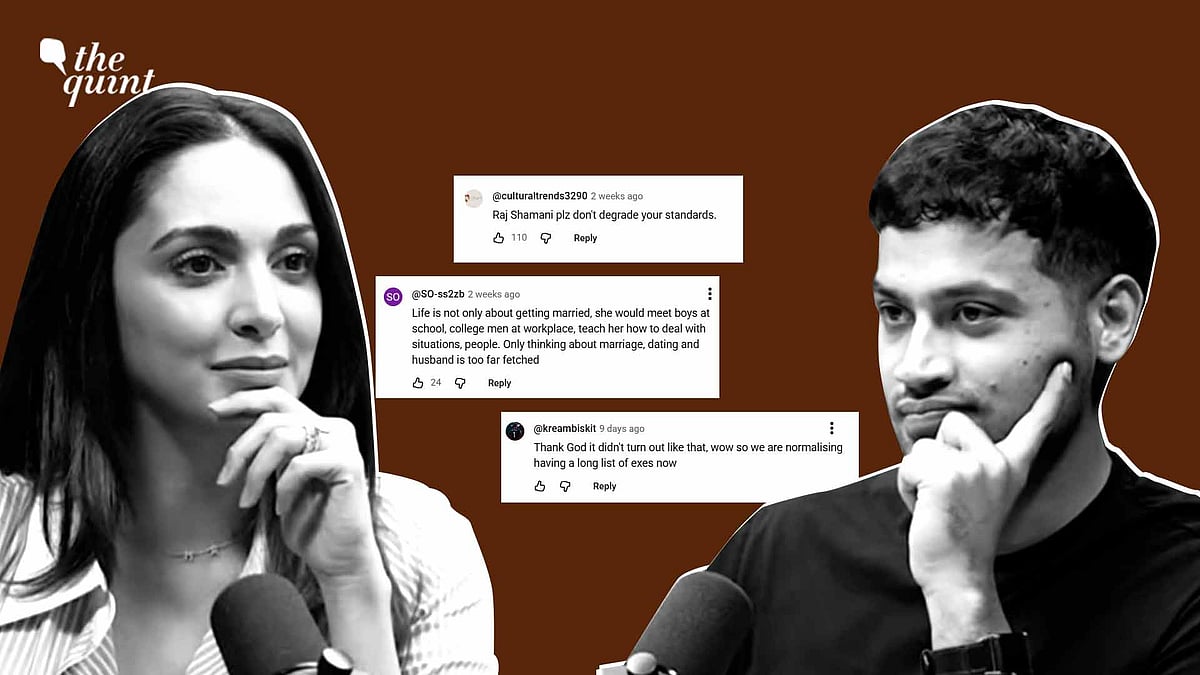
In a recent appearance on influencer Raj Shamani’s podcast, Figuring Out, actor Kiara Advani talked about motherhood, parenting, and partnerships, among other things.
When Shamani asked her how she’d teach her daughter to deal with “today’s men,” she responded, saying, “I would want her to see a very full life. I don’t want her to feel like she has to only date one person... Hopefully, I’d like to bring her up in a way that lets her make all her choices for herself… without any preconceived notion of how it’s meant to be.”
It was, by all reasonable standards, an extraordinarily ordinary statement.
Arranged Control
Arranged marriage systems are built around comparison, selection, and assessment, where families evaluate caste, finances, careers, horoscopes, social standing, and values before deciding whether two people should spend their lives together.
Moreover, compatibility is not some shallow modern obsession. It shapes emotional safety, domestic labour expectations, financial values, parenting philosophies, political beliefs, sexual comfort, communication styles, and the ability to navigate illness, conflict, vulnerability, and change together.
Treating women’s pursuit of compatibility as morally suspect reveals how little patriarchal cultures have historically prioritised women’s actual happiness within marriage.
Historically, controlling women’s sexuality has been central to preserving caste hierarchies, inheritance structures, and family honour. Marriage in India has, therefore, functioned less as a romantic institution than as a system for regulating women’s bodies, labour, and choices.
As such, women independently evaluating compatibility transforms marriage from something many men feel entitled to into a relationship women actively choose. The unpredictability that this choice ushers in, threatens structures built around the assumption that women should seamlessly move from the control of one household to another.
The hypocrisy is difficult to ignore since Indian society rarely objects to romantic experimentation itself as much as it objects to women participating in it. While, men dating multiple women before marriage is a simple case of ‘boys being boys,’ and a sign of maturity since they’re not ‘settling’ for the first girl they lay their eyes—and lust—upon.
The issue, then, is the idea of women possessing the same romantic and sexual subjectivity that we’ve normalised in men.
'The Good Wife'
This contradiction becomes especially visible in the way modern Indian womanhood is imagined. Women are now encouraged to study, work, earn, and become professionally successful, but still not to desire too openly, reject men too freely, possess visible romantic histories, or delay marriage too much lest their biological clocks—tied to a woman’s primary duty in a marriage—should run out.
Older patriarchal anxieties around purity, obedience, caste respectability, and controlling women’s sexuality are now repackaged through manosphere terminology like ‘high value women,’ ‘wife material,’ and ‘body count.’ Social media has not created new misogyny so much as given older forms of patriarchal control a new vocabulary and algorithmic reach.
We witnessed a similar uproar in October 2023 when Deepika Padukone appeared alongside her husband, Ranveer Singh, on Koffee with Karan, and talked at length about their relationship. It was, for the most part, an unusually wholesome episode, where the actors spoke about how they met, gradually fell in love, got engaged, navigated marriage, and supported each other through life and mental health struggles.
The episode aired at midnight, and by 9 am the next morning, social media had begun slut-shaming Padukone. Turns out, somehow, out of an hour-long conversation full of warmth, affection, vulnerability, and emotional maturity, they had chosen to obsess over one brief remark from the couple about how they weren’t immediately exclusive when they first started seeing each other.
So much so, that woman with visible romantic history isn’t seen as a person anymore—as, arguably, no woman is, in any patriarchal order—but as someone whose value has somehow been diminished in the ‘marriage market.’
It’s been three years since, and the rhetoric is yet to die down. Even today, Padukone is routinely accused on social media of not being good enough for Ranveer Singh.
In fact, after his recent commercial success this year, social media was flooded with posts insisting he should divorce her, alongside waves of misogynistic memes calling her a ‘chhinar’ and exposing, in real time, how quickly public conversations about successful women collapse into discussions about their sexual worth.
Between Patriarchy & Death
The same misogyny has again reared its head in the ongoing media discourse surrounding the alleged murder of Twisha Sharma, within six months of being married to a Bhopal-based lawyer.
Her mother-in-law Giribala Singh—a retired district court judge, no less—has continued to be remarkably more invested in conducting a posthumous audit of Twisha’s alleged romantic history than in addressing the fact that her daughter-in-law had just died under deeply disturbing circumstances while her son remained absconding for nearly 10 days following her death.
In public responses to violence against women, character often becomes a form of evidentiary currency. Before people can decide whether a woman deserves empathy, they need to assess whether she was respectable enough to deserve victimhood.
Dead women are retroactively turned into unreliable narrators of their own suffering, and their romantic histories scrutinised more aggressively than the actions of the men accused of harming them. Patriarchal cultures instinctively investigate women’s purity before investigating violence done to them.
The outrage over Kiara Advani’s remarks is yet another revelation of the unsettling truth that Indian society does not—despite everything it claims—actually believe marriage is, in any way whatsoever, sacred. If it did, women pursuing compatibility before making a commitment that’s, by Brahminical patriarchy’s own logic, so sacred and serious that it spans seven lifetimes, would not feel so scandalous.
The panic begins only when women, rather than patriarchal gatekeepers, start deciding for themselves what makes a relationship worth committing to.
(DevRupa Rakshit is a queer, autistic individual, ARTivist and independent multimedia journalist based in Bengaluru. This is an opinion piece and the views expressed above are the author’s own. The Quint neither endorses nor is responsible for the same.)
- Access to all paywalled content on site
- Ad-free experience across The Quint
- Early previews of our Special Projects
Published: undefined