
TVK’s INDIA Entry Comes With a Question: How Far Will Vijay Go Against the BJP?
Tamilaga Vettri Kazhagam's entry brings popular appeal to the Opposition, but the bet on national numbers remains
advertisement
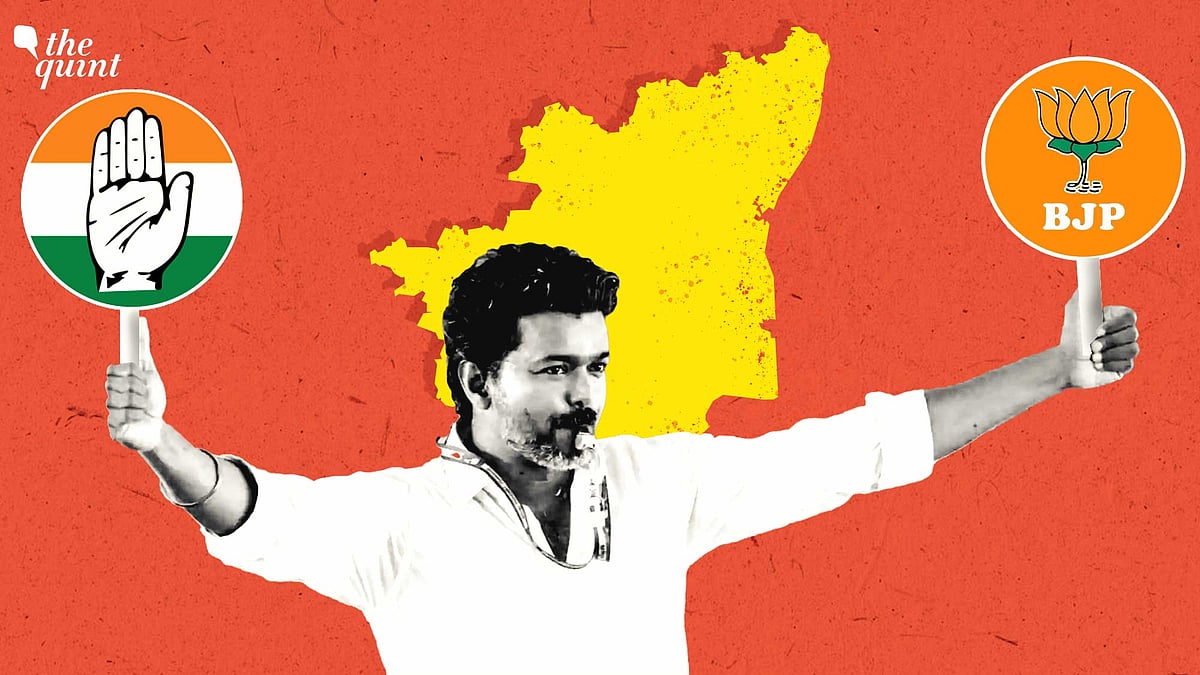
The Tamilaga Vettri Kazhagam’s (TVK) entry into the Tamil Nadu unit of the INDIA bloc raises three interrelated questions. What does it do to the INDIA bloc when the ruling party in Tamil Nadu joins it? What does the shift mean for the Dravida Munnetra Kazhagam (DMK), which was the Congress’s principal ally in the state?
And, more importantly, can TVK’s commitment to an alliance whose principal national purpose is to oppose the Bharatiya Janata Party (BJP) be trusted when it has shown reluctance to confront the BJP and the Union government on several issues?
Today, Congress has moved away from that relationship and joined hands with TVK, whose leader Vijay has himself been projected by sections of his party as a possible national leader. The DMK has categorically ruled out an alliance with Congress in the future. The political consequences of these developments could extend beyond Tamil Nadu.
An Unprecedented Union
On 3 October, TVK ministers Aadhav Arjuna and Marie Wilson attended the Tamil Nadu INDIA bloc meeting at the Congress headquarters in Chennai. Congress state president B Manickam Tagore called it a historic development.
Arjuna said that TVK’s participation itself meant that the party was part of the bloc. The meeting also decided on protests against Chief Election Commissioner Gyanesh Kumar over the Special Intensive Revision of electoral rolls.
For the INDIA bloc, the immediate gain is substantial. It now includes the ruling party in Tamil Nadu and a Chief Minister with considerable popular recognition. Congress, Viduthalai Chiruthaigal Katchi (VCK), Marumalarchi Dravida Munnetra Kazhagam (MDMK), and Indian Union Muslim League (IUML), which were recently associated with the DMK, are now aligned with TVK. The two Assembly bypolls on 6 October are the first electoral test of this new arrangement.
But the shift also creates a paradox. In the 2024 Lok Sabha election, the DMK won 22 of Tamil Nadu’s 39 seats, making it the largest parliamentary component within the INDIA alliance in the state. TVK has no Lok Sabha members. The bloc has therefore gained the party that runs the Tamil Nadu government while losing the party that currently holds the largest number of parliamentary seats from the state.
The Fine Print
For the DMK, the change is more serious. Its earlier relationship with Congress was built over several elections and rested on an established organisational and political understanding.
The bypoll results could deepen this shift. Madurantakam and Dharapuram became vacant after the All India Anna Dravida Munnetra Kazhagam (AIADMK) MLAs Maragatham Kumaravel and P Sathyabama resigned and joined TVK.
If TVK performs strongly, the result could strengthen Vijay’s bargaining position and encourage further defections, especially from AIADMK. Congress may have helped TVK form the government, but a stronger TVK would have less reason to depend on Congress to the same extent.
And that brings us to the question of reliability. TVK has formally joined the Tamil Nadu INDIA alliance, but it has also made it clear that it does not want the alliance to define its entire political identity.
Hedging Bets
Vijay did not participate in the joint campaign meeting held by the alliance partners during the bypoll campaign and campaigned separately. Of course, that does not prove that he intends to leave the alliance. But, it does show that TVK wants to retain an independent political identity even while benefiting from an alliance with established parties.
There are also substantive reasons for asking how far this commitment goes. TVK’s position on the BJP and the Union government has not always matched that of the Congress and other INDIA parties.
The delimitation issue is one example. After the Tamil Nadu Assembly passed a resolution seeking to maintain the state’s existing share of Lok Sabha representation, Vijay attended the Southern Zonal Council meeting chaired by Union Home Minister Amit Shah.
Another indication came in the Assembly in August, when Minister Vanni Arasu criticised Narendra Modi and Amit Shah during a debate on delimitation. Aadhav Arjuna, the TVK minister, intervened and suggested that references to Modi and the BJP leadership be removed from the Assembly record, arguing that the discussion should remain focused on state rights.
Cult of Personality
And now, the SIR issue provides an even clearer test. Congress has demanded the removal of Chief Election Commissioner Gyanesh Kumar and has made the issue part of a wider national campaign against the Election Commission.
TVK opposes SIR, but Minister A Rajmohan has said that removing one person will not solve the problem and has described the demand to remove Kumar as a diversionary tactic. Rajmohan has also said that TVK and Congress have no difference over SIR.
But the distinction is obvious. Congress wants the CEC removed, TVK says the SIR process is flawed, but opposes targeting Kumar. These are not identical positions. The 15 October Chennai protest, in which TVK is expected to participate, will therefore be an important test of whether the party is prepared to act with its new allies even when their demands go further than its own.
There is another very important, unresolved issue: Vijay’s national political ambitions. Some TVK voices, including its ministers, have previously projected him as a possible Prime Ministerial face. Congress, meanwhile, continues to regard Rahul Gandhi as its principal national face.
The decision to put the “Vijay for PM” discussion on hold has made the present arrangement easier, but it has not eliminated the underlying tension.
Nor has TVK clearly explained what its relationship with the national INDIA bloc will be if the two sides disagree on major national issues.
That is why TVK’s entry should not be treated simply as an expansion of the INDIA bloc. It is also a test of what the bloc itself is becoming. Is it a national political coalition with a common position on major issues, or a collection of state-level arrangements built around electoral convenience?
Impeding Intentions
For the DMK, the challenge is equally significant. It has lost Congress and several other former allies to a new political formation. It now has to compete with a government that controls the state administration and has attracted parties that were its partners until recently.
However, the DMK retains a large parliamentary presence, an established organisation and decades of political experience. Its exclusion from the present Tamil Nadu arrangement does not automatically translate into national marginalisation.
So, what does TVK’s entry actually represent? It is certainly a significant realignment. But it is too early to call it a settled political arrangement. The bypoll results, the alliance’s conduct after the election, TVK’s participation in joint protests, and Vijay’s positions on national issues will provide stronger evidence. The central question is therefore not whether TVK has joined the INDIA bloc. It has, at the Tamil Nadu level.
The more important question is whether it is prepared to share the political positions and political risks that membership of the INDIA bloc entails.
Until that becomes clearer, TVK’s entry should be seen as a significant realignment for Tamil Nadu, a setback for the DMK’s existing alliance structure, and a new test for the INDIA bloc.
(P John J Kennedy is an educator, columnist, and political analyst. This is an opinion piece and the views expressed are the author's own. The Quint does not endorse or is responsible for them.)
- Access to all paywalled content on site
- Ad-free experience across The Quint
- Early previews of our Special Projects
Published: undefined