From Trump's Antics To Ukraine & Palestine, 2025 Has Been a Year of Uncertainty
When you strip away the geopolitics, it's innocent civilians who are left to bear the lion’s share of the suffering.
advertisement
Volodymyr Zelenskyy says there will almost certainly be no ceasefire in Ukraine before Christmas. This means the war is more than likely to stretch on into a fifth year to the dismay of everyone—barring, perhaps Vladimir Putin, for whom the war seems to be a means to a number of different ends.
Whatever the Russian president wants to gain immediately—prestige, territory, a pliant government in Kyiv, access to eastern Ukraine’s considerable resources—the war also appears to be fulfilling a number of Putin’s long-term foreign policy aims: it is driving a wedge between the US and Europe and exposing big divisions within Europe itself.
What’s more clear is that Putin will almost certainly reject the plan outright. How this will play in the White House is anyone’s guess. While the US president has shown that he is susceptible to the Russian leader’s blandishments, he has also displayed a short fuse when he thinks Putin isn’t taking him seriously enough.
Donald Trump: A Politician of Consequence
After Trump was elected for a second term in November 2024, James Cooper of York St John University referred to the president as an "international disruptor". Cooper predicted that Trump’s unconventional style might yield results via the “madman theory”, which holds that his unpredictability could prove to be an effective foreign policy approach. Quite how effective remains to be seen.
Cooper also predicted that Ukraine and America’s Nato allies might find Trump’s foreign policy outlook a major concern. And so it has proved. The US has halted military aid to Ukraine, leaving Kyiv scrambling to secure reliable support from its European allies which—as we’ve seen, are struggling to secure the funds. And America’s Nato allies in Europe learned last month, when the US released its 2025 national security strategy, that they can no longer rely on the US for security in the way that they have in the eight decades since the end of the second world war.
Ukraine Conflict: No End in Sight
Despite nearly ten months elapsing, it’s hard to forget the now-notorious White House meeting at which Trump and his vice-president, JD Vance, lambasted Zelenskyy for not being grateful for the help the US had given Ukraine. All diplomatic niceties abandoned, the Americans rounded on the Ukrainian president, accusing him of “gambling with world war three” and demanding: “You either make a deal or we are out.”
The state of the conflict in Ukraine, 16 December 2025.
Wolff, of the University of Birmingham, and Malyarenko, of the University of Odesa, have been contributing to our coverage of the conflict between Russia and Ukraine and its geopolitical implications for more than a decade.
Our coverage of the Ukraine conflict has also been informed by Frank Ledwidge, formerly of UK military intelligence, now an expert in military strategy at the University of Portsmouth. Ledwidge is a regular visitor to Ukraine and in August contributed this vivid piece of reportage from Kharkiv, Ukraine’s “unbreakable” eastern capital.
The Tragedy of Palestine
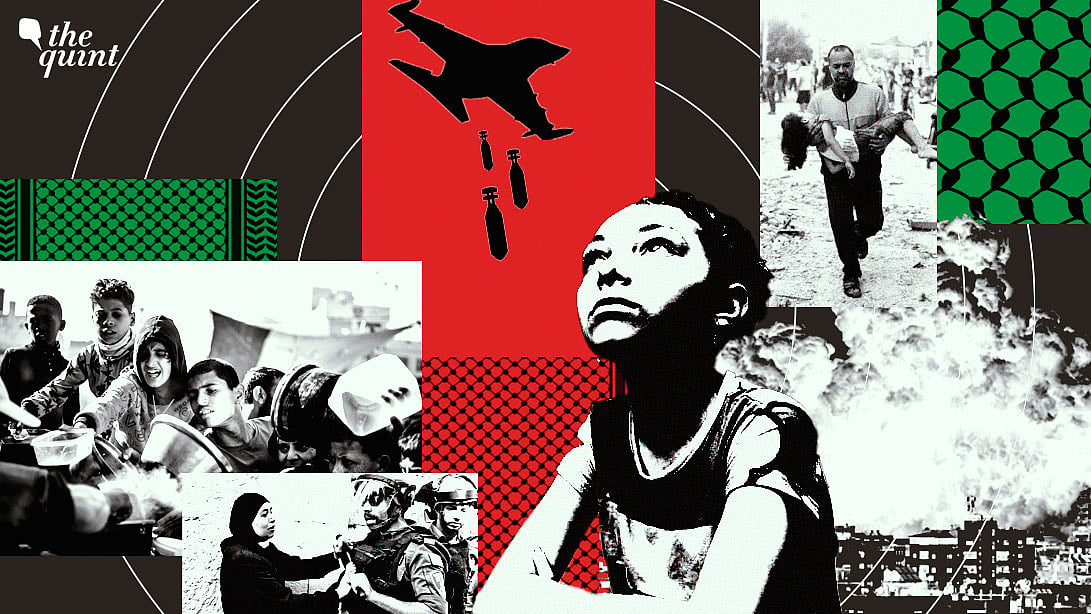
This was the year that many western countries came off the sidelines and formally declared their recognition of Palestinian statehood. These declarations, by the UK, France, Australia and Canada, were largely symbolic. As things stand the prospect of a two-state solution remains as remote as ever. The (very tenuous) ceasefire in Gaza has not progressed further than a cessation of the wholesale killing of Palestinian civilians in the enclave.
In Gaza meanwhile, and despite the ceasefire, the violence continues— albeit on a smaller scale, at present. Within days of the ceasefire being signed, and notwithstanding a stipulation that Hamas must disarm and disband, the militant Palestinian group was already regrouping.
Winter descends on the refugees seeking shelter in a camp in Khan Younis in the southern Gaza Strip, December 15. About 90% of the population of the Gaza Strip has been displaced by the conflict.
Tahani Mustafa, formerly a Palestine analyst for the international crisis group and now a lecturer in international relations at King’s College London, used her considerably range of contacts on the ground in Gaza to bring us this report.
What 2026 may hold for the people of Gaza remains uncertain. There’s been little or no progress on establishing a framework for governance in the enclave and at present Israel’s strategy seems to be to encourage as many Gaza residents as possible to leave via the Rafah crossing into Egypt.
What is clear, though, is that whatever Israeli and its allies plan to do in Gaza, it will be critical to secure the support and cooperation of the Gulf states, without which any plan for the future of the region will be a non-starter.
Scott Lucas, a Middle East expert at the Clinton Institute, University College Dublin, has been contributing to our coverage of the region for more than a decade. As the Gaza ceasefire was announced in October, he answered our questions and underlined the vital role played by other powers in the Middle East.
Civil War in Sudan
The bitter conflict in Sudan has often been eclipsed this year by the wars in Ukraine and Gaza, and it’s significant that it is not among the wars the US president claims to have solved in his eleven months in power. But the regular reports of wholesale slaughter of civilians, mass rape and other war crimes have been no less terrible for that.
Refugees fleeing the violence in Darfur, western Sudan. seek shelter form the sun, April 2025.
But when you strip away the geopolitics, as ever, it is innocent civilians who are left to bear the lion’s share of the suffering, as is clear from this harrowing report based on interviews with refugees flooding south to escape the violence.
(This article is republished from The Conversation under a Creative Commons license. Read the original article here.)