
Fatalism of ‘First Ram, Then Bam’: Bengal’s Left Can't Return by Enabling BJP
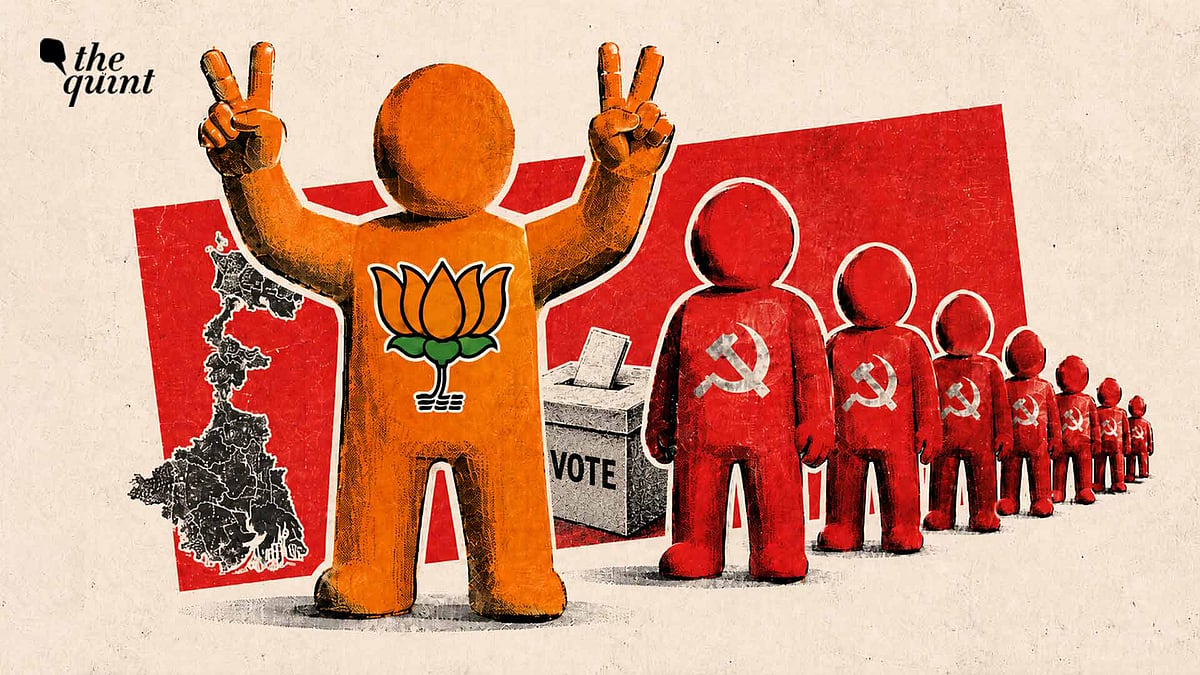
The ‘First Ram, Then Bam’ idea is a political self-sabotage dressed up as tactical realism.
advertisement
One of the strangest arguments to emerge from West Bengal’s recent electoral churn is also one of the most politically revealing: Ebar Ram, pore Bam – this time Ram, next time the Left.
The slogan is not necessarily literal. Nor should it be treated simply as a joke. It captures a real voting logic among a section of anti-Trinamool, non-BJP voters.
At one level, this logic is understandable. Many voters were angry with the TMC. Allegations of corruption, recruitment scams, local coercion, welfare brokerage and party-level control over everyday life had created deep resentment.
For many opposition supporters, especially in areas where the Left had organisationally thinned out, the BJP appeared to be the only force capable of defeating the ruling party.
A Political Self-Sabotage
Tactical voting, in itself, is not necessarily irrational. In a first-past-the-post system, voters often abandon their preferred party to support the candidate most likely to defeat the party they dislike most.
Lokniti-CSDS’s 2021 West Bengal post-poll survey found that 10.7% of valid respondents said they had voted “to defeat someone else”, while another 6% described their vote as shaped by “a bit of both” preference and opposition.
There are voices from the ground that capture this calculation. In 2019, Sitaram Yechury acknowledged that he had heard the slogan “Ebar Ram, pore bam” during the campaign, while insisting that this tendency was among Left supporters rather than CPI(M) members.
A 2021 ground report from Birbhum and Purulia recorded former Left workers explaining that they were still emotionally or ideologically attached to the Left, but saw the BJP as the only available instrument against the TMC.
One former CPI(M) worker from Birbhum reportedly described himself as not ideologically comfortable in the BJP, but willing to “hold on” to it to defeat Trinamool; another from Manbazar argued that he had not left the Left “in his mind” but had temporarily moved to the BJP to end TMC rule.
In the run-up phase to the election in 2026, while talking to the local CPI(M) workers in the North 24 parganas district, the same logic echoed, recurrently.
The numbers themselves show the danger. The Election Commission’s West Bengal 2026 results showed the BJP won 207 seats, the AITC 80, the Congress 2 and the CPI(M) just 1, with one seat remaining outside the declared tally at that stage. This is not the arithmetic of a Left revival. It is the arithmetic of a right-wing consolidation.
The problem lies in thinking of a vote as a temporary signal that can later be withdrawn without consequence. The voters may privately think that they are voting BJP only to defeat TMC.
But the ballot does not record private intention. It records public power. It strengthens the party that receives it. It gives that party seats, legitimacy, resources, cadres, confidence and the right to claim that it now represents the anti-TMC political imagination.
This is where Antonio Gramsci becomes useful. For Gramsci, political power is not maintained only through force or office. It is also maintained through hegemony, through the ability of a political force to make its worldview appear natural, ordinary and inevitable. Hegemony works when ideology becomes “common sense”.
Why the 'Temporary Option' Analogy Fails
That is precisely the risk in Bengal today. The BJP’s victory is not merely an electoral event. It is an attempt to reorganise Bengal’s common sense.
It seeks to redefine anti-corruption politics through Hindutva, anti-incumbency through majoritarian grievance, and democratic change through a nationalised right-wing vocabulary.
Each election, each booth-level mobilisation, each slogan, each social media campaign, each welfare promise, each accusation against minorities, each claim about national pride, each attack on “appeasement” helps create a new structure of political feeling.
By the time the supposed Left versus Right showdown arrives, the terms of that showdown may already have been rewritten.
Once empowered, it will not prepare the ground for socialist renewal. It will work to absorb anti-TMC anger into its own ideological bloc. It will seek to make itself the permanent pole of opposition to both Trinamoolism and the old Left order.
Gramsci would call this a struggle over the “national popular”, the ability to speak in the name of the people, the nation, morality and history.
The BJP’s success lies partly in its ability to convert local anger into a larger civilisational story. Corruption becomes not just corruption but the decay of a supposedly appeased and compromised regime.
Border anxieties become not just questions of migration, labour or governance but evidence of national injury. Welfare leakage becomes not just administrative failure but proof of minority favouritism. In this grammar, class anger is not eliminated. It is redirected.
Redirection Is Fatal for the Left
The Left cannot rebuild itself if the language of popular anger has already been communalised. It cannot revive class politics while helping legitimise a force that reframes inequality through religious majoritarianism.
It cannot ask Muslims, Dalits, workers, migrants and precarious citizens to trust it later if, at a decisive moment, sections of its own social base treated the BJP as a useful instrument.
It tells them that secular politics is negotiable when the ruling party becomes unpopular enough. Once that trust is broken, it cannot be restored through slogans alone.
This does not mean the Left should minimise TMC’s failures. That would be intellectually dishonest and politically disastrous. The TMC’s record must be scrutinised rigorously.
Its corruption, coercion and patronage networks cannot be wished away. A serious Left politics must oppose both TMC authoritarianism and BJP majoritarianism.
But opposition is not the same as substitution. Replacing one form of domination with another does not create democratic renewal. It only changes the ideological colour of power.
The Left’s crisis in Bengal is not only electoral. It is hegemonic. It has lost not merely seats but the ability to define what counts as justice, dignity, development, secularism and people’s power.
Recovering that ground requires patient organisation, not borrowed majoritarianism. It requires unions, student fronts, neighbourhood committees, women’s organisations, minority trust, rural credibility and a new moral language of equality.
(Niladri Chatterjee, Senior Lecturer and Researcher, Department of Cultural Sciences, Linnaeus University, Sweden; Affiliated researcher, University of Oslo, Norway. You can reach out to him at: niladri.chatterjee@lnu.se).
- Access to all paywalled content on site
- Ad-free experience across The Quint
- Early previews of our Special Projects
Published: undefined