
Bollywood with RSS: A New Normal
Celebrities of yore attended meetings with RSS members behind closed doors, away from public view. Not anymore.
advertisement
The Bollywood fraternity, whether through video messages, endorsements, or their presence at a recent Rashtriya Swayamsevak Sangh (RSS) event in Mumbai, has sent out a message that it’s not shy of its "secular" image in engaging with the Hindutva flagbearer.
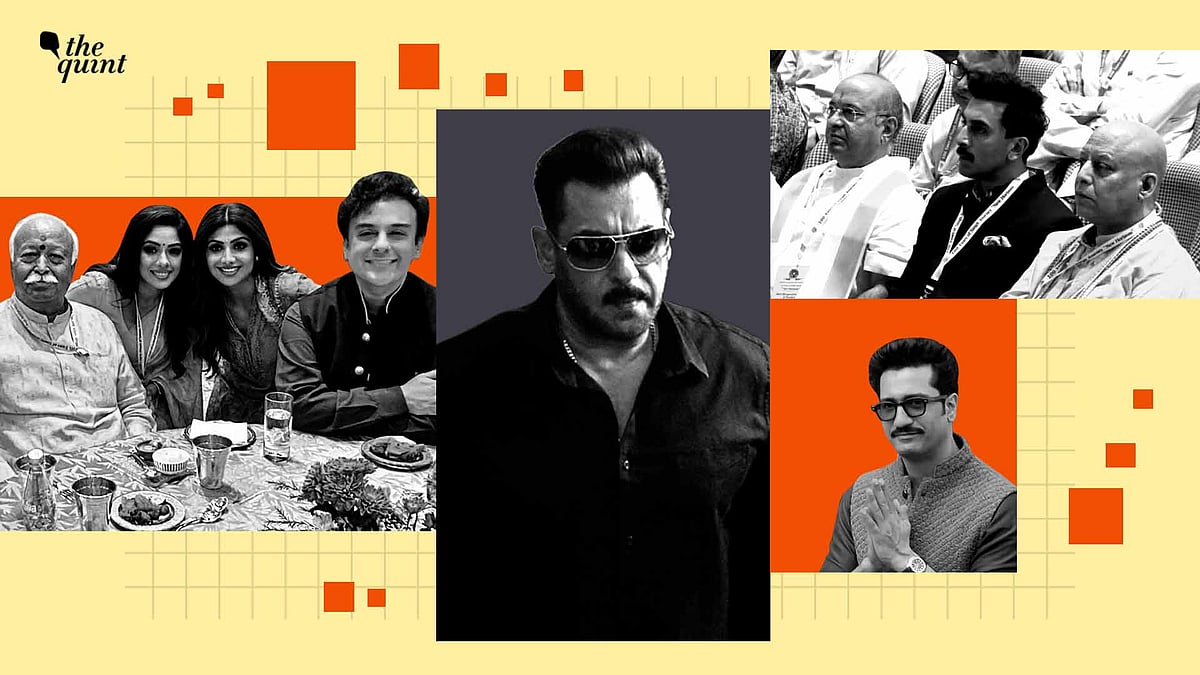
Salman Khan, Ranbir Kapoor, Sanjay Dutt, Vicky Kaushal, and Karan Johar were among Bollywood's who’s who who dropped in to hear Mohan Bhagwat speak at the RSS's centenary celebrations on Sunday, 8 February. The RSS sarsanghchalak's allusions to Salman Khan's sartorial appeal among the youth dropped hints on why the RSS wanted him in attendance.
Ranbir Kapoor at the RSS's centenary celebrations in Mumbai on Sunday, 8 February.
(Photo Courtesy: RSS)
Now, it’s normal to attend meetings called by the RSS. It’s also normal to go to an RSS event. That fear of backlash from RSS-baiters—as well as concerns of gaining the "communal" tag—is now gone. That, at least, is the message Bollywood's leading lights sent out as they turned up in full force to hear Bhagwat speak in Mumbai.
RSS: Backstage to Spotlight
The RSS is commemorating 100 years of its existence, and as it steps into a new century, it has seemingly set itself some new perception goals.
The Mumbai event came as a concluding tour for Bhagwat, who had launched the lecture series in New Delhi last year. Over the months, Bhagwat went to Bengaluru and Kolkata. The broad message from his lectures is essentially that he wants to change the perception of the RSS among the people.
The sarsanghchalak has sought to counter the biggest and most persistent perception of the RSS—that it acts as the remote control of the Bharatiya Janata Party (BJP)—by stressing that the political offshoot is an autonomous entity. This, he seeks to assert, possibly to insulate the RSS from brickbats from the shortcomings of the BJP.
(From right to left) Shilpa Shetty, Rupali Ganguly, and Mohan Bhagwat at the RSS's centenary celebrations in Mumbai on Sunday, 8 February.
(Photo Courtesy: RSS)
Closed-Door Meetings with Muslim Intellectuals
Ahead of the Mumbai outreach, Bhagwat held a number of closed-door meetings with influential intellectuals from the Muslim community. This exercise has gained intensity in the aftermath of the Supreme Court's verdict that paved the way for the construction of the Ram Temple in Ayodhya. The Ram Janmabhoomi movement remains the only official involvement of the RSS for a Hindu temple cause. Bhagwat has already said that the RSS will not take up any other temple cause.
Bhagwat’s reiterations of “all Indians are Hindus” perhaps explain Muslim community outreach.
Thus, Bhagwat may be aiming for a future when Muslims shed the shades of their own cultural identity by asserting different (read majoritarian) identities and socio-cultural outlooks.
The Sanju-Sallu Bhai Duality
In late 1980s and the 1990s, actors like Salman Khan and Sanjay Dutt, who had inherited the secular legacy image of Bollywood, majorly influenced the youth. Even though the two actors are now in their 60s, they still command the attention of Gen Z—the segment that the RSS is now paying increasing attention to in its programmes. They still command icon status, even as new-age actors fail to gain the stature of their scales.
Let's not forget that it isn't just the older actors but also those among the newer lot like Ranbir Kapoor and Vicky Kaushal, as well as even "modern" celebrities like Karan Johar, who showed up in attendance, amplifying its image as a "progressive" commune for artists.
Why the RSS Needs Bollywood
While only a small fraction of the filmmaking community is currently committing to the cause of the RSS, Nagpur wants the tribe to gain more strength in the coming days. And it seems to be in a hurry.
If the last 100 years were spent in laying down a strong foundation for the RSS to command the socio-cultural leadership of India, it now wants to speed up achieving its stated goals. These include the well-publicised pancha prana—social harmony, family values, environmental protection, self-reliance and culture, and civic duty.
It understands the importance of enlisting socio-cultural icons to push forward its objectives. The saffron functionaries argue that Bollywood had been at the forefront of shaping India’s secular character through films and icons in the past. If Bollywood is co-opted, the RSS' influence may change the outlook of the film industry.
Thus, in place of a large show of strength at the district or the city levels, RSS functionaries fanned out in smaller numbers to slums, villages, clusters, and kasbas. The instruction was clear—direct outreach with each household, and presence in each habitation.
The RSS, thus, is aiming at a major expansion—not just of shakhas but of committed members. For this, it has spelt out programmes at district levels for a full one year—catering to the needs of each section of the society.
If the selected habitation is short on medical care, they put up a health camp each month. If there is an education gap, then another camp is conjured. The list goes on.
It is clear that the Sangh is now eyeing a strong presence across the country. This particular goal has gained urgency amid the organisation's assessment that social conflicts arising due to socio-economic or other problems may test the strength of Hindu unity.
And Nagpur is already seeing signs of that rupture in some parts of the country.
(The author is a senior Delhi-based journalist, who for over two decades has tracked the RSS and the BJP for India’s leading English dailies. This is an opinion piece and the views expressed are the author's own. The Quint does not endorse or is responsible for them.)
- Access to all paywalled content on site
- Ad-free experience across The Quint
- Early previews of our Special Projects
Published: undefined