
10 Years Later, Rohith Vemula’s Fight Remains Dalit Students’ Reality
Nothing will change until society and academia decide to preach, propagate, and practice the ideas of Babasaheb.
advertisement
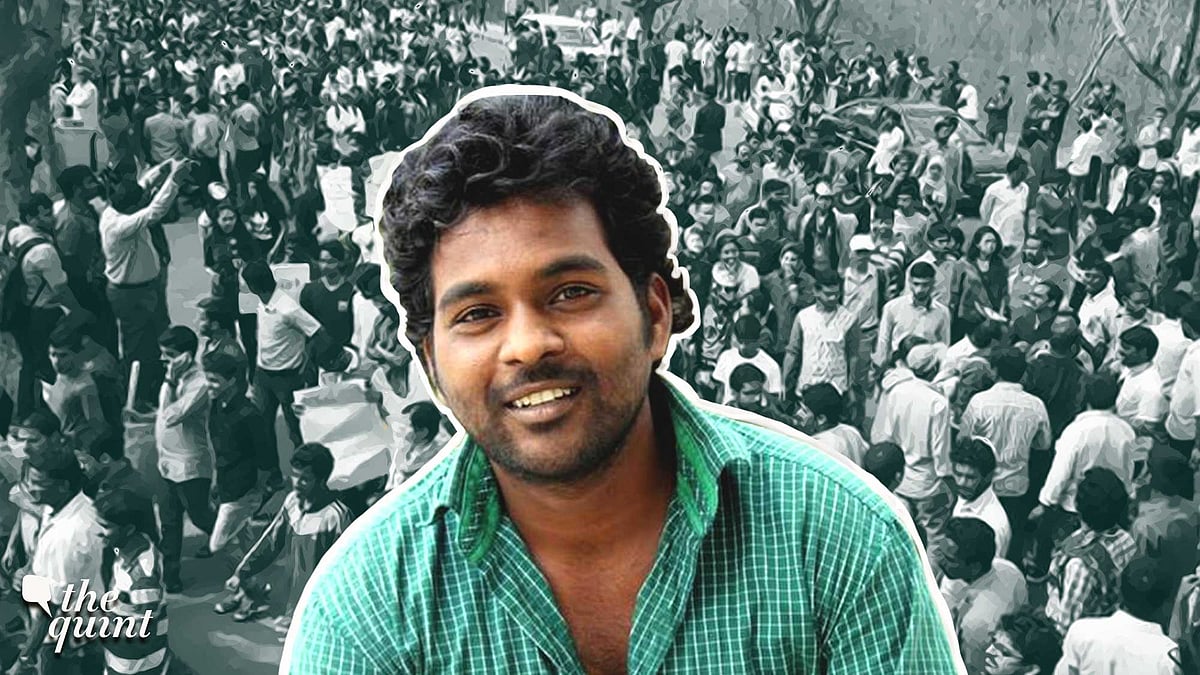
Exactly 10 years ago, Rohith Vemula, a 28-year-old Dalit student and PhD scholar at the University of Hyderabad, died by suicide.
Along with him, four other students had been expelled for raising their voices against their suspension, a practice that had become rampant in the university. Their access to the hostel, mess, administrative buildings, and common rooms were revoked—and their scholarships were put on hold. Rohith, along with his friends, protested against this act of injustice in the open, with a photo of Babasaheb Ambedkar by their side.
But even in the face of widespread outrage and sustained agitation, the university refused to revoke their expulsion. At last, Rohith could not take it any longer.
An Ambedkarite, Rohith was a voice of reason who was vocal on social issues. His death was not merely a personal tragedy, but a case of institutional failure.
Rohith’s death created much furore and sparked a spate of protests across various educational institutions in India. Students and citizens took to streets in opposition to such instances of caste-discrimination-related deaths—and criticised this very visible act of apartheid. Professors, who were critical of the university's complicity in driving Rohith to his death, were suspended. Some others resigned in the face of such a brutal case of discrimination.
In spite of these acts of defiance and dissent, and much noise and agitation, a crucial question remains: what came of these struggles? What has changed in the decade since Rohith Vemula’s death?
From Protest to Punishment
What ensued was a deliberate reframing of caste and the discrimination it produces—transforming it from a lived social oppression into a contested political question.
The reason for this was his oppressed caste background, one that left him bereft of socio-economic capital and political means to survive the casteist atmosphere of Indian educational institutions. This lack of resources made him vulnerable to attacks on his character and mental health, followed by coercive attempts to delegitimise his identity.
Ten years since Rohith’s death, little has changed in the plight of marginalised students in Indian educational institutions. According to a report in The Wire, between 2019 and 2021, 98 Dalit students died by suicide across various educational institutions in India—a number so jarring it should have awakened the consciousness of the society. But the answer is one of negation. In 2019, Dr Payal Tadvi, a 26-year-old student belonging to a tribal community, died by suicide at the hostel of a government-run hospital in Mumbai. Dr Tadvi was repeatedly harassed by her seniors with caste slurs. The case lingered on with no delivery of justice.
Dr Payal Tadvi was repeatedly harassed by her seniors with caste slurs. The case lingered on with no delivery of justice.
In January 2025, the Supreme Court of India ordered the University Grants Commission (UGC) to submit a report on the instances of caste discriminations in Indian educational institutions. What came to light was an astonishing fact.
In the academic year 2023-24, 1,503 instances of caste discriminations were recorded across 3,522 institutions in India, out of which only 1,426 cases were followed up with further procedures.
The Numbers That Refuse to Disappear
Caste is the social structure on which the Indian society rests, shaping all aspects of life, including politics. Much of the politics in India is governed, driven, and affected by its society. It is a sum total of this very dual character of caste that marginalised students don’t have access to resources, privileges, and capital.
Although reservation is a constitutional right, it is routinely ignored in elite institutions such as the IITs and IIMs, which have been long regarded as the bastions in the field of science and technology.
With these many hurdles, the process of access to educational spaces in India thus in itself become a punishment.
In a caste-driven society like India, one’s caste decides who will be able to avail education. It is in this aspect that the marginalised students fall short of, for their disadvantaged caste location puts them up for endless struggles and taunts to get an admission to these prohibited campuses.
Meritocracy as a Myth
One needs aesthetic, ideas, language and a refined taste to succeed in Indian academia. Such an ideal situation is only possible in the case of a person who has grown with an excess of resources, for its abundance has provided them with time to engage in creative endeavours.
But for the marginalised students who have had to grow up in the face of the absence of such socio-political capital, caste capital or socio-economic resources, the struggle never seems to end, even after entering educational institutions.
What ensues upon entering such institutions is the repeated taunts and questions on their merit, worth, and eligibility. Casting such aspersion on Dalit students comes from a place of privilege for they are expected to parrot the realities of their upper caste peers while being forced to distance themselves from their lived realities.
It is in order to provide a level-playing field to the marginalised students, reservation must be followed in educational institutions in awarding admissions to students.
Even when marginalised students manage to enter such spaces, they face caste-based discriminations. Some institutions flout reservation policies altogether. Others deliberately award lower marks in vivas to marginalised students compared to their theory exams. Dalit voices are subjected to moral policing, surveillance, and gentrification, while upper-caste student organisations linked to ruling parties face little scrutiny.
Such alarmist behaviour isn’t warranted when upper castes and ruling dispensation led student organisations create unrest, insecurity, and division within campuses, for they comprise of the same community that is supposed to grant them permission to exist.
When Academia Mirrors Brahmanical Power
These acts have been an everyday reality for marginalised students. The Indian academia questions them on their eligibility and merit, while the academia fraternity directs them to think on its own privileged line, all three meanwhile denying the all-encompassing character of caste and its aftermath transmitting to other aspects of life.
Such tools of coercion and moral policing have been used as institutional warfare, wielded by the state as a warning to keep in place, and solidify and rigidify caste enforcement in academia.
But what if the entire academia consists of only the upper castes?
The academia, which on paper is an institution that is the very symbolism of democracy, becomes in practice exclusionary, divisive, and discriminatory. For example, the report cited earlier indicates that less than 3 percent of those teaching at the IITs across the country were from the reserved category, namely the ST and the SC community.
Central universities across the country had as many as 313 professor-level posts sanctioned for candidates belonging to Other Backward Classes (OBCs), but appointments were made for only 2.8 percent of these posts as of August 2020. No ST and OBC faculty at IIT Bombay were recruited in 2023.
The accompanying guilt and fear of being blamed for hoarding resources and social capital prohibits them from actively pursuing the end to such forms and ways of discriminations. As such this passivity ensures and warrants their silence and drives them to act as enablers of caste discriminations in campuses.
For example, in 2021, Jawaharlal Nehru University (JNU), one of India’s premier educational institutions, was accused of awarding less marks in viva to marginalised students when compared to their theory marks. In 2023, the Ambedkar Students Association of University of Hyderabad, through an RTI, revealed the discrepancy and deliberate inconsistency in awarding marks and passing marginalised PhD students.
These instances create an air of unease and divisiveness. This is but a brahmanical character of a society based on caste that has also managed to translate its application to the stakeholders of educational institutions in India.
\With the influx of orthodoxy and conservative dogmas of the Hindu religion in Indian politics, instances of atrocities have seen an exponential increase. It is but shameful that such atrocities has been through the support of the ruling party, fuelled by its student wing ABVP, and grassroots organisations likely the RSS and the VHP.
Instances of deliberately trying to create social unrest and division are heavily endorsed by the leaders. At the same time, anti-caste, Left-oriented, and Ambedkarite organisations repeatedly face crackdowns, sanctions, unlawful arrests, and policing of behaviour and psyche of the marginalised community.
Stuck in such a delicate situation, where allyship and support of other entities and communities becomes a key factor and way of protesting against injustice in India, the future looks bleak.
Ten Years Later, Still Waiting for Justice
Meanwhile, Ambedkarite spaces once led by Dalits have been co-opted by upper-caste groups, sanitised of their radical anti-caste politics, and stripped of Dalit leadership. The struggle has been depoliticised, diluted, and appropriated.
By hijacking the last remaining spaces exclusive to Dalits and dedicated to the cause of and propagation of ideas of Babasaheb, Periyar, Mahatma Phule, and other leaders, the upper castes have brahmanised these environments by making the existence and appearance of the marginalised invisiblised.
Ten years after Rohith’s death, not much has changed. An agitation that had started for Rohith has since only managed to itch out two Bills in the Parliament, with no chances of being enacted so as to come to curb the silent epidemic of the death of marginalised students in Indian academia.
For a larger section of society, only in death could Rohith's life find its merit, value, and worth. But what of his life and existence? Nothing significant will change until and unless society and academia together decide to preach, propagate, and practise the ideas of Babasaheb. But is it ready to do so? Perhaps some day, but surely not in the near future.
(Sidharth Gautam is a student, currently pursuing Masters of Arts in Sociology from Jamia Millia Islamia. Chinmayee Panda is a student of literature, with interests in society, culture, language, and politics. This is an opinion piece and the views expressed are the author's own. The Quint does not endorse or is responsible for the same.)
- Access to all paywalled content on site
- Ad-free experience across The Quint
- Early previews of our Special Projects
Published: undefined