
‘His Lens Changed How I See the World’: Remembering Raghu Rai
What made Rai great wasn't just his eye for headline-making images, but also his embrace of fast-changing technology
advertisement
As you reach for words to frame Raghu Rai’s place in history, you are struck by the inadequacy of it, because for many of us, he embodies the very spirit of photography in India.
He was already a magnum star when I first met him as a student of journalism, a friend in the industry when I reviewed his book on Delhi for CNN-India and then, an unparalleled icon when I had him meet my son during his last and final retrospective show at the Kiran Nadar Museum of Art (KNMA) in New Delhi in 2024.
A Master Who Evolved With the Lens
What always made Raghu Rai great was not just his eye and mind for capturing headline-making images for the news, but also the way he embraced fast-changing technology in photography.
My first memory of meeting him was for a college interview 25 years ago. I entered his studio, buzzing with energy and scrolls of rolled-up photographs—some at least five feet long.
These were his black-and-white images of Banaras, taken over the years. “Come, catch all the action. Those older images were taken in the camera roll. The more recent ones here are from my digital camera”, he said in all humility to a younger me, just starting out in life.
Revisiting Delhi Through His Lens
I am reminded of another beautiful afternoon we spent together reviewing his latest book in 2009. It was a collection that celebrated 40 years of him capturing Delhi through his lens.
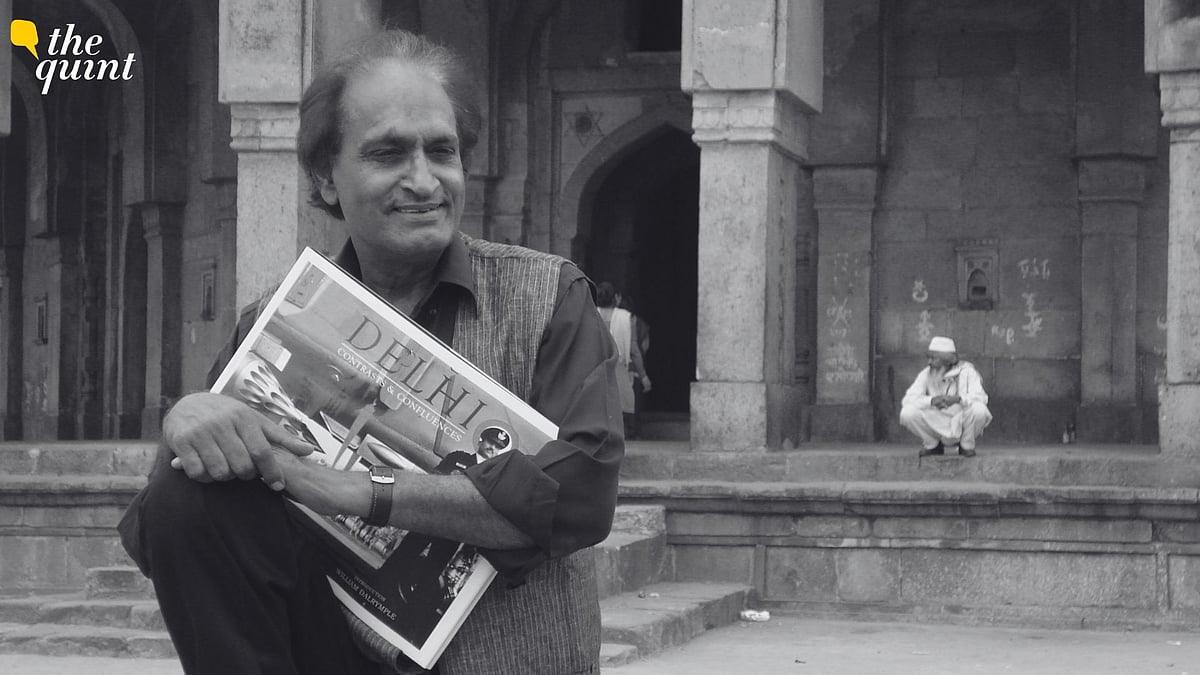
He suggested we shoot against the backdrop of Adham Khan’s tomb in Mehrauli, overlooking the Qutub Minar, since that defined the city so well. The big difference for him in this shoot was that I was doing it for television.
Raghu Rai with Sahar Zaman in Delhi's Mehrauli.
(Photo: Special Arranegement/Sahar Zaman/Altered by The Quint)
I was amazed at his patience and keen observations, since TV requires more retakes, and the noise on a crowded street can make recording a conversation quite exasperating. But he laughed, “Maybe I should have selected a quieter place”.
He loved the way I juxtaposed his old images of quaint roads and cycle rickshaws from the book over visuals of modern moving cars and auto-rikshaws in today’s congested traffic. “I didn’t expect such an artistic book review”, he happily confessed.
Seeing the World Through Rai’s Lens
My last meeting with him was in 2024 during the spectacular launch of his retrospective show with an overwhelming body of work of almost half a century.
This one was extra special because I had the chance to introduce my son to a genius.
The election series, Indira Gandhi portraits, Mother Teresa at her ashram, artist portraits, aftermath of Bhopal gas tragedy, street photographs, faces of India, etc. His lens was part of my life experiences.
Unknowingly, I had trained my eye to see a frame as Rai would photograph.
(Sahar Zaman is an award-winning author & journalist. She is the Founder Director of Hunar TV and an advocate of India’s Orange Economy.This is an opinion piece, and the views expressed above are the author’s own. The Quint neither endorses nor is responsible for the same.)
- Access to all paywalled content on site
- Ad-free experience across The Quint
- Early previews of our Special Projects
Published: undefined