
Why CEC Appointment Law Merits Scrutiny Amid Rising Fears of Executive Overreach
One of the most prominent censures was the deliberate elimination of the CJI from the selection committee.
advertisement
[A two-judge bench of the Supreme Court on Wednesday, 23 September referred petitions challenging the 2023 law on the appointment of the Chief Election Commissioner (CEC) and other Election Commissioners (ECs) to the Chief Justice of India. The following article, which explains what the controversial law was, has been updated and republished in light of the petitions. It was first published in September 2023.]
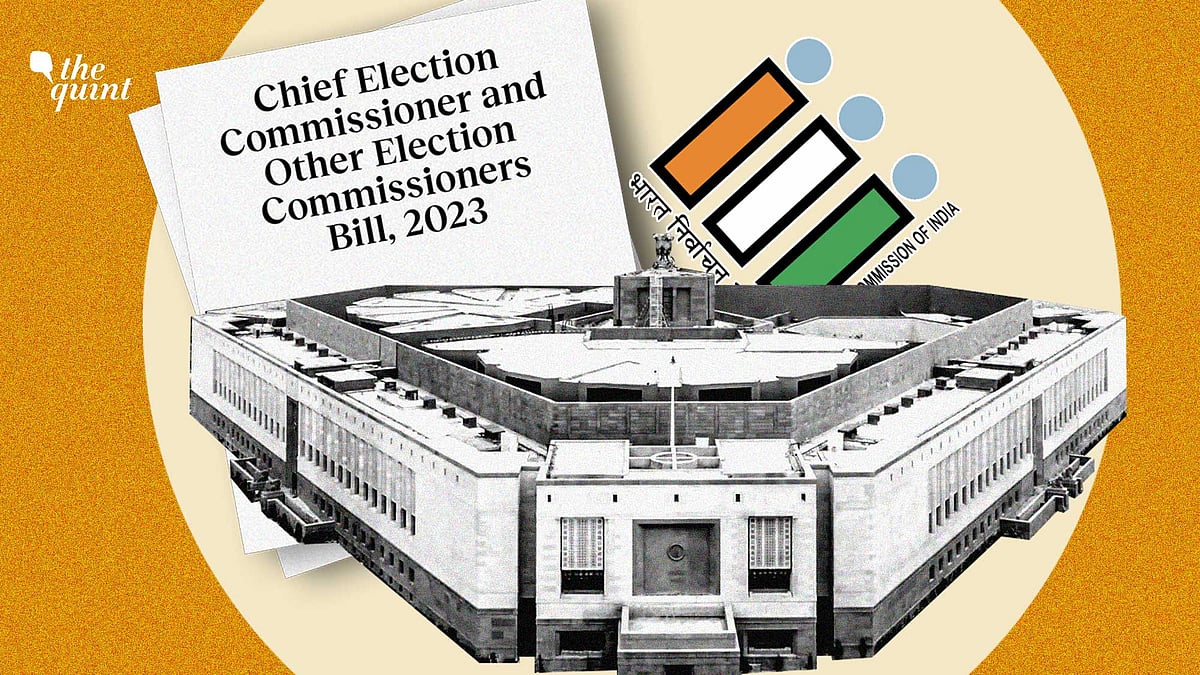
The Chief Election Commissioner and Other Election Commissioners (Appointment, Conditions of Service and Term of Office) Bill, 2023 was a manifestation of a long-drawn demand for a legislative framework to determine the appointments to the Election Commission from all quarters of civil society.
However, in a rather interesting turn of events, while the Bulletin for the Special Session of the Parliament mentioned the Bill, it remained conspicuous in its absence from the agenda of the first sitting of the Special Session held on 18 September 2023. It wasn't surprising—given that certain provisions of the Bill had stirred the hornet’s nest evoking strong opposition and criticism.
The pushback on the draft of the Bill was hinged upon the plausible dilution of the independence of the Election Commission, given that the selection committee was likely to be an extension of the Executive. The Bill did run into major risks of Executive overreach and influence, but perhaps the exclusion of the CJI wasn’t really the core problem.
The Salient Features of the Bill
As the first legislative attempt to realise the constitutional mandate of Article 324, the Bill in itself was salient.
Thus, this Bill in fact brought some semblance of a constitutional safeguard to the opaque process that was being followed thus far.
One may attribute this to the strong diktat of the Supreme Court in its March 2023 judgment that formed a temporary committee comprising the Prime Minister, the Leader of the Opposition, and the Chief Justice of India till the time a law to this effect was passed. Accordingly, the Bill laid down the process of selection and removal of the CEC and ECs and their salaries, transaction and disposal of businesses.
The Bill stated that the CEC and ECs will be selected by a selection committee consisting of the Prime Minister, the Leader of the Opposition, and a Cabinet Minister who would consider eligible candidates from a pool recommended by a Search Committee comprising bureaucrats, with expertise in election matters and not below the rank of a Secretary to the Government.
Yet another interesting facet that the Bill brought in was the levelling of the salary of the CEC and ECs at par with that of a Cabinet Secretary.
Now, the question that arose was whether the Bill adhered to the judgment in its letter and spirit as well as the constitutional vision of Article 324. The popular perception was that it didn't, especially by virtue of removing the CJI from the ambit of selecting the CEC and ECs, thereby according the government complete authority to play favourites.
The Problem With the 2023 Law
Besides the absence of mandated unanimity, two of the most pressing issues in the Bill revolved around the perceived designation of the CEC and the ECs—and the potential overreach of the selection committee in terms of going beyond the recommendations of the search committee.
Dilution of the stature of the members of the Election Commission
The salary stated in the Bill for CEC and ECs had been expressed at par with that of a Cabinet Secretary which earlier, according to the 1991 Act, was at par with that of a Supreme Court judge. The amount effectively remained the same but the titular perception diluted the dignity of the office of the CEC and the ECs, and one wondered whether it implied a sense of answerability towards the Executive.
Power to select anyone outside the recommendations of the search committee
Section 8(2) of the Bill granted the selection committee to appoint anyone beyond the recommendations of the search committee. The search committee had been designated to include competent officers with experience in electoral matters and who were not involved in any political parties, unlike that of the members of the selection committee.
The lettering of the Bill unequivocally established the dominance of the bureaucrats, especially IAS officers in the search committee and rightfully so, given the dynamic nature of their role with respect to the conduct of elections.
Hence, the conduit to facilitate lateral entries without clarity around the qualifications of the “other candidates” became a catchment area for executive overreach over the competence of the search committee. While disputes over candidatures was a fairly plausible scenario, the Bill was eerily silent on any dispute-resolution processes. Parallelly, the blanket warrant to consider any candidate beyond the recommended pool of the search committee further added to the quandary.
In the context of the tilted majority in the composition and powers of the selection committee, a scenario where overruling an eligible candidate to appoint laterally without established grounds became common.
On the Absence of the CJI
The basic tenet of why any representative of the judiciary must be kept away from any executive chores was because of the constitutional principle of separation of powers. The selection of members of the Election Commission squarely fell outside the purview of the judiciary since it did not have expertise in electoral matters. Moreover, the constitutional process of appointments and removal of members of the Election Commission was subject to judicial review.
Moreover, on the question of accountability and undue influence of the government in the current composition, it must be noted that this composition was in fact an encouraging step to bring in some degree of transparency and safeguards in the process which earlier was predominantly in the hands of the government.
However, the structure of the selection committee did not fully warrant a fair selection process either. This was because despite the presence of the Leader of the Opposition, the Prime Minister and the Cabinet Minister’s presence tilted the power dynamics in the favour of the ruling party.
In fact, the presence of the CJI as a member of the judiciary, and not an elected representative, could not be considered a talisman for securing fairness and transparency.
That Article 329 of the Constitution explicitly debarred the court from interfering in electoral matters, except when a petition is brought before it, emphasised the fact that the two institutions must be kept separate.
Thus, the Bill was a welcome step towards streamlining free and fair elections in India, but not without caveats.
(The Bill was passed in December 2023 after a brief discussion in both Houses of Parliament.)
(Yashaswini Basu is a Bangalore-based lawyer. She holds a law degree from SOAS, University of London. She tweets at @yashaswini_1010. This is an opinion piece and the views expressed are the author’s own. The Quint neither endorses nor is responsible for them.)
- Access to all paywalled content on site
- Ad-free experience across The Quint
- Early previews of our Special Projects
Published: 26 Sep 2023,10:25 AM IST