PM Modi to India Inc Captains: 'Where is the Pay-off for My Largesse?'
Modi's rebuke is unlikely to lead to any change in Indian industrialists’ behaviour, writes Subhash Chandra Garg.
advertisement
In a now-viral stinging rebuke to the captains of Indian industry, Prime Minister Narendra Modi praised his government’s record—the highest rate of GDP growth; 50 crore people lifted out of poverty; and big rise in exports—and in the same breath, blamed India Inc for not creating jobs and raising wages.
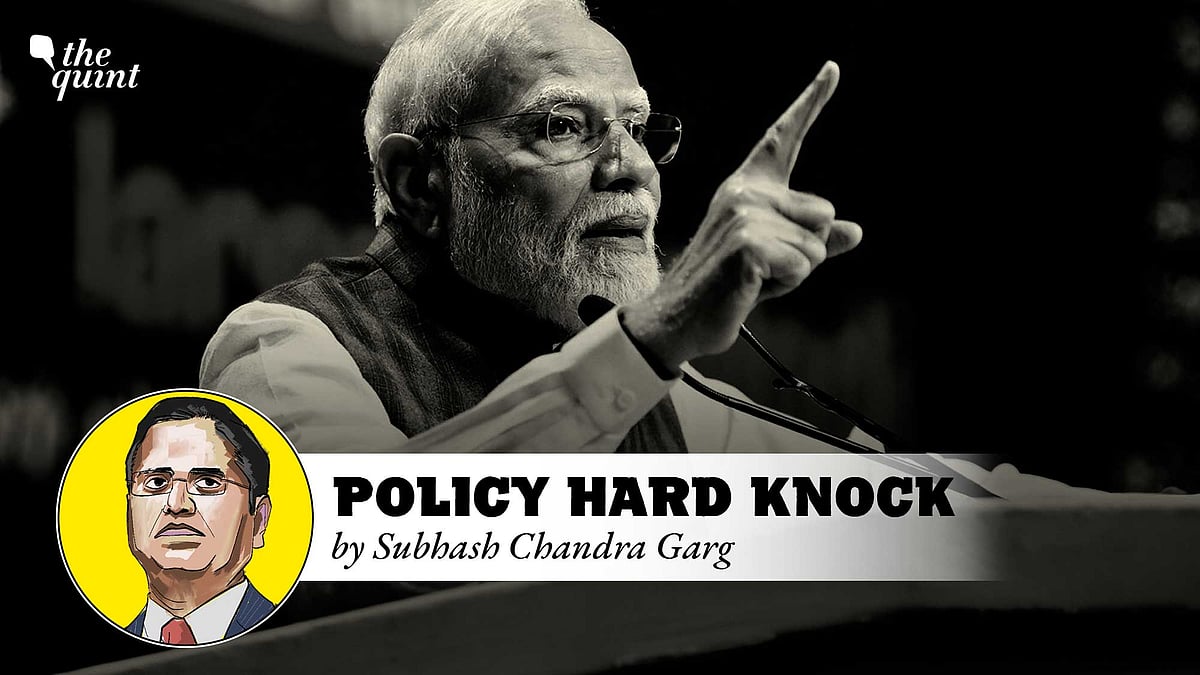
Delivered in his characteristic taunt-laced Hindi at the FICCI centenary event on 19 November, PM Modi said: "I know you won’t clap. I know it very well, because your appetite is so huge that no matter how much you are fed, your stomach is never full."
"I reduced corporate taxes from 30 percent to 22 percent for you. I exempted income tax up to Rs 12 lakh. What did you do? Did you increase your employees’ salaries? Did you increase the number of employees? No. You only want 'Modiji, you do it, we will see'," he added.
Then he asked the all-important question: "Will it go on like this?"
There's a big contradiction here. Does PM Modi recognise that India’s economic growth (assuming the GDP data are true) under his stewardship has been a jobless growth?
Tax Cuts, Corporate Profits, and Employment
In 2015, the Modi government had committed to bring basic corporate tax down from 30 percent to 22 percent. Until Budget 2019-20, 99 percent of companies had come under the 22 percent tax regime.
Outside the Budget cycle—and with intention to please US President Donald Trump and American investors just before PM Modi was to share the big stage with Trump at the 'Howdy Modi' event—the government unexpectedly, in October 2019, reduced corporate tax across from 30 percent to 22 percent. The government also announced to tax new manufacturing companies at an ultra-low 15 percent rate.
Corporate profits and corporate tax collection were very low in 2019-20. Both started booming 2020-21 onwards, despite the adverse economic consequences of unimaginative COVID-19 lockdowns clamped by the Modi government. The employees' count and wages, on the contrary, suffered as the companies automated and digitalised more processes.
The cut in GST rates last year also boosted corporate profits (corporate profits are up about an average 25-30 percent in the second quarter of 2026-27 year-on-year).
The advent of AI is making IT companies, banks, and others to layoff employees, instead of recruiting more. This problem is being finally acknowledged by PM Modi publicly.
Industry Not Listening
PM Modi has been presenting India as the best investment destination for the foreign investors and, along with the Finance Minister, egging the domestic industry to invest in India repeatedly over the last seven years.
The choice of words speaks clearly that he wanted to chide Indian industry for neither investing in India nor creating employment. It also seems clear that he has begun to look for the fall guys for India’s sad state of economic affairs.
The rebuke, however, is unlikely to lead to any change in Indian industrialists’ behaviour. The investment and jobs/salaries decisions are not driven by corporate tax cuts; cuts in personal income taxes; or the GST.
The investment decisions are primarily driven by the profit-making opportunities industrialists see. There are primarily two types of such profit-making opportunities in today’s economic world:
First, three new industries and services—(1) digital technology industry (chips, laptops, servers, network, data centres, and other digital devices/ processes); (2) energy transition (solar, wind, hydrogen, batteries, and electrical vehicles); and (3) AI-based services, including AI agents.
Second, traditional industries (steel, cars, cement, food, textiles etc) where demand exceeds supply.
China and, to a lesser extent, the US, hold all cards in this space. Quite unintuitively, the Modi government does not allow Chinese companies to make and Indian industry to receive Chinese investment. The US is also becoming increasingly reluctant to share AI and other digital technologies.
The result is obvious. Indian industry will not make any worthwhile and competitive investment in these sectors. India’s imports from China have kept growing as a consequence. PM Modi may keep lamenting. Industry will neither willingly clap nor make investment.
The traditional industry, which PM Modi mostly referred to in his address to FICCI, faces a very unique situation today. There is global overcapacity in almost all these industries today. With many advanced markets being increasingly closed on environmental or security considerations, Indian industry will not be able to compete against more efficient and cheaper surplus producers like China and Vietnam. As a result, they are actually cutting down on new investment in steel, aluminum, and even textile.
The last sentence, ‘Modiji, you do it, we will see’, perhaps captures PM Modi’s expectations as well. Industrialists will keep showing up to listen to him but will not risk their profits by making investments or hiring more people.
Personal and GST Tax Cuts Ill-Thought Gambles
The personal tax cut in Budget 2025-26, just before the Delhi elections, was to please the vocal middle-class taxpayers to vote the Bharatiya Janata Party (BJP) into power. The voters, with the assistance of the Election Commission of India, delivered the Delhi Assembly to PM Modi and the BJP.
The personal income tax cut did not accrue any benefit to companies. They did not earn any extra profit because of it.
The companies hire employees for the skills they have for doing the work they are needed for. Remuneration paid to any employee depends upon their skillsets and the demand-supply for that type of talent.
This situation keeps changing.
PM Modi’s tax cuts had no impact whatsoever on the hiring and the wages paid by the corporates.
The GST cuts brought down the cost of goods the companies sold. They could have passed on the tax cuts to the consumers. There was no statutory binding on them to do so in the "Double Diwali Bonanza" PM Modi announced last year from the ramparts of the Red Fort.
There is enough evidence that most companies chose to retain the GST cuts benefit with themselves. The growth in corporate profits in the second quarter of 2026-27 is the best evidence. The same quarter in 2025-26, before the GST cuts came into effect in late September 2025, was a very poor quarter for the companies. The GST cuts did not raise demand large enough for them to think of establishing new production facilities.
Is There Another Reason?
The political scene is shifting.
The Rajasthan panchayat elections have delivered a massive defeat to the BJP. The Election Commission is under severe pressure to undo the excesses and irregularities of the Special Intensive Revision (SIR) and other electoral roll malpractices. The government has not been able to muster enough MPs to pass the Delimitation Constitution Amendment Bill despite engineering many defections.
Was this realisation showing up in PM Modi’s address to FICCI? Maybe.
But chiding and putting blame on industrialists will not work. India has to assess its industrial and entrepreneurial strengths and weaknesses to craft a path that can deliver real growth and employment. Tax cuts is not a very major piece of that jigsaw puzzle.
(Subhash Chandra Garg is the Chief Policy Advisor, SUBHANJALI, and Former Finance and Economic Affairs Secretary, Government of India. He's the author of books such as 'The $10 Trillion Dream Dented, 'We Also Make Policy', and 'Explanation and Commentary on Budget 2025-26'. This is an opinion piece, and the views expressed above are the author’s own. The Quint neither endorses nor is responsible for the same.)