
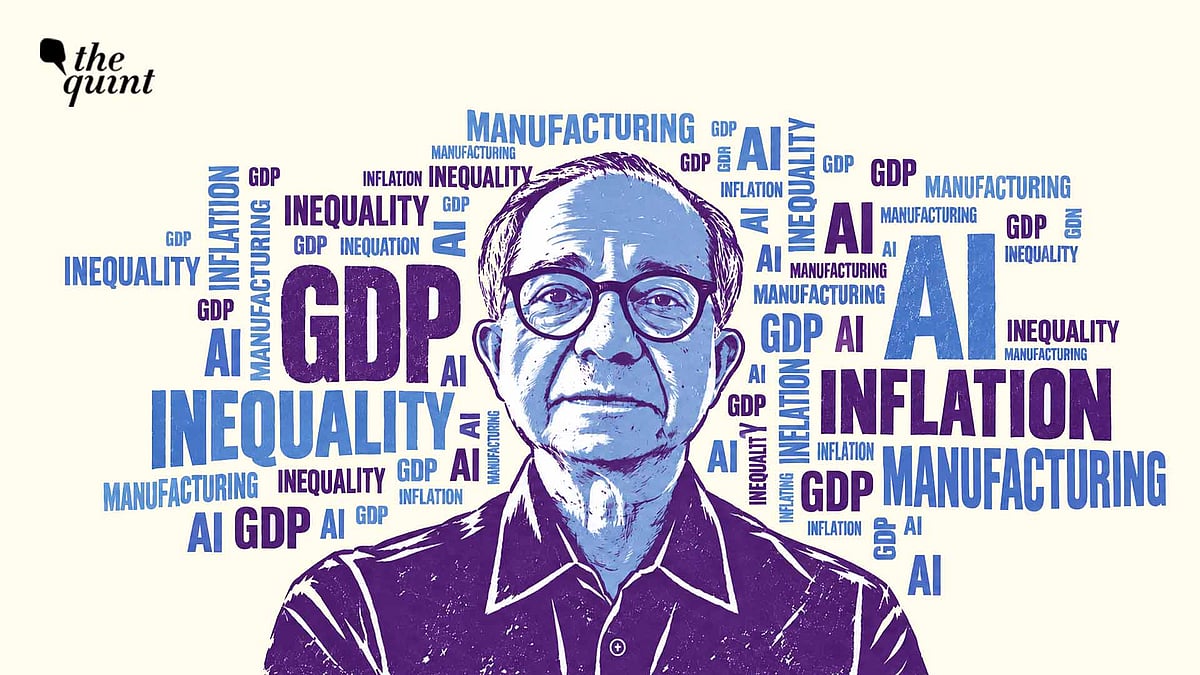
Kaushik Basu Interview: 'India's GDP Is Doing Fine, an Average Indian Is Not'
India has the potential to expand the manufacturing sector if the right policies are in place, says Kaushik Basu.
advertisement
India’s economy appears to be telling two stories at once. Headline GDP growth remains robust, with the latest figure at 7.8 percent, even as questions persist over what that number captures—and what it does not. Beyond the debate over statistics lie more immediate concerns around jobs, inequality, and whether rapid economic growth is translating into better lives for ordinary Indians.
Few economists have observed India’s economic trajectory from as many vantage points as Kaushik Basu. A former Chief Economic Adviser to the Government of India (2009-12) and former Chief Economist of the World Bank (2012-16), Basu has been closely involved with economic policymaking in India and internationally.
His latest book, The Indian Economy: Navigating a Global Turning Point, raises particularly timely questions. India is navigating not only shifts in the global economic order but also the rapid advance of artificial intelligence (AI).
AI is already changing the nature of work and, as Basu argues, could eventually narrow the window India currently has to expand manufacturing and create jobs.
In an interview with The Quint, Basu discusses what India’s changing economic landscape could mean for its future, as technology reshapes work and global economic certainties begin to shift.
‘There Is a Drop in Credibility of Indian Data’
India’s GDP growth has been pegged at 7.8 percent. What does that figure actually tell us? Where does the controversy around it lie, particularly when it comes to base revisions and the way inflation is accounted for?
I do not have enough information on the statistical details of the government’s official figure of 7.8 percent GDP growth to be able to comment on its validity and to take a hard line on the controversy.
The controversy arose from the charge, levelled by some critics, of strategic base revision. Base revision, unless it is done professionally, can be used to give a boost to the latest growth rate. Growth is calculated based on two numbers: GDP now and GDP one year ago. If you revise the GDP figure of one year ago—by saying that it needed some correction—and lower it, today’s growth rate will look higher, without actually having to raise GDP. This is the criticism that some people have made.
The other source of controversy comes from inflation. If you take the nominal GDP of two consecutive years—that is, the total amount spent by people on various goods and services—and then calculate growth, this will give you the nominal GDP growth. This consists of two parts: inflation and real growth in GDP. So, to calculate real GDP growth from nominal GDP growth, you have to remove the part that reflects inflation. Here again, if you can show that inflation was lower than it actually was, you can make real GDP growth appear higher.
As I said, I cannot comment on who is correct in this controversy about the real GDP growth being 7.8 percent. There is, however, an interesting matter concerning inflation.
Even if we cannot conclusively judge the validity of the 7.8 percent figure, does the controversy surrounding it point to a larger problem of credibility and public trust in India’s statistical system?
While, as I just said, I cannot comment on the validity of the statistics behind the latest GDP figure, what we can all see is that there is a drop in credibility of Indian data.
This is sad because India was known for the excellence of its statistics, and the high professionalism that went into collecting data. When I was the Chief Economist of the World Bank and data poured in from around the world, there was a lot of appreciation for the high quality and transparency of the Indian data. No one levelled the charge that political interests had tampered with them, as happened in many developing countries. Unfortunately, in recent times, this credibility has eroded and the controversy about India’s latest GDP growth figure is a reflection of that.
‘Youth Unemployment Is the Big Problem India Faces Today’
In your latest book, you note that India’s GDP continues to grow even as youth unemployment remains high, while AI is making some traditional forms of labour redundant. Are we entering a period where India can achieve strong economic growth without creating enough meaningful work?
The high level of India’s youth unemployment is indeed the big problem that India faces today. In 2025, 17.7 percent of India’s youth were unemployed. That is, for those youngsters who were looking for work (so we are not here talking of college students), over 17 percent were not finding any. This is extremely high and needs urgent policy intervention.
There is no doubt that a part of the problem is global. The rise in digital technology and AI is causing the demand for labour to drop. But India’s wage rate is still low enough that, with good policy, we can get around this problem. We are seeing some other lower-middle-income countries, like Vietnam, doing very well. Youth unemployment in Vietnam is 6.4 percent.
‘Creative Thinking and Innovation Will Be the Critical Driver’
You argue that this global turning point calls for “new economic policies” as well as new laws and regulations. What should India be prioritising now, particularly when it comes to innovation, inequality and manufacturing?
It is the global turning point and the challenge of how India should navigate this that led us to organise the conference. We brought in leading economists, policymakers, and prominent corporate leaders to the Cornell [University] campus to discuss this. And the book is, I am happy to say, a product of this meeting of minds. The book discusses several ideas that should be prioritised by policymakers.
I personally feel that creative thinking and innovation will be the critical driver. India’s early investments in higher education, the IITs, research institutions like the Indian Institute of Science, Delhi School of Economics, and the Indian Statistical Institute were the biggest pillars of growth. This sector for research and education is beginning to slack off. We must turn this around. Luckily, our book emphasises this. The chapters by Narayana Murthy and Naushad Forbes dwell at length on the importance of innovation.
In my view, the extreme inequality we are seeing in India today needs to be curbed. High GDP growth is of no value to ordinary citizens if it all accrues to a few people. The chapter by Viral Acharya and Rahul Chauhan documents the rise in industrial concentration in India, and the importance of policies to promote competition.
Finally, I believe India has the potential for enormous expansion of the manufacturing sector if the right policies are in place. This opportunity will not last for long, since digital technology and AI will eventually encroach on this space. But if we act now, we can turn around India’s economy. Do read Chapter 5 of this book, which meticulously discusses India’s manufacturing potential.
Does India Need Another 1991?
India’s economic direction changed fundamentally with the 1991 reforms. At today’s global economic turning point, does India need another reform moment of that scale? If not, what does it need instead?
I don’t think India needs a “reform moment” like in 1991. What India needs is to recover the professionalism in policymaking for which India was once known. We must not allow slogans and headlines to take the place of statistics and hard decisions.
‘It Is Sad to See India’s Democracy Receding’
The book describes India as an exception among newly independent nations because of its investment in democratic institutions and its adherence to democracy. How do you view that legacy in the context of India today and its position on the global stage?
That comment was in the context of what India achieved after the nation’s independence. Among the many nations that were breaking out of the clutches of colonialism, India had the number one spot in terms of its adherence to democracy. This was widely recognised and India was a prominent player on the global stage, from the time of the Bandung Conference [1955] to the G20 policy formulations in which I was actively engaged when I was the Chief Economic Adviser to the Indian government.
It is sad to see India’s democracy receding and India ceasing to be a prominent player on the global stage. There is a lot of careful analysis of governance and democracy in this book, in particular, in the chapter by Anandi Mani.
Thirty years after liberalisation, Indians’ aspirations and expectations are far higher. Has economic policy kept pace with those aspirations, particularly when it comes to jobs, the distribution of wealth, and the quality of life of the average Indian?
The short answer is: No. India’s GDP is doing fine, but the average domestic population—shall we call it ADP?—is not doing fine.
(Pragya Mittal is a Delhi-based editor and writer who makes books and writes about the ideas shaping contemporary India, from culture and literature to the economy and public policy.)
- Access to all paywalled content on site
- Ad-free experience across The Quint
- Early previews of our Special Projects
Published: undefined