Now Is the Time To Build a Global Movement for Indian Democracy
In the diaspora, we can draw global attention to the human rights crisis in India, writes Ria Chakrabarty.
advertisement
On Friday, July 17, Washington, D.C.’s air quality was among the worst it’s ever been – a stunning 250 on the Air Quality Index. 48 hours earlier, a colleague and I had decided to organize a protest as quickly as possible in solidarity with the students protesting in Jantar Mantar.
We didn’t want to wait – Sonam Wangchuk and a handful of the students were three weeks into a hunger strike. The day before our protest, we wavered. DC’s air would be unbreathable. The health authorities in the district warned residents not to spend more than thirty minutes outside.
Since then, the Indian diaspora around the US and the world has put together protests organically. Some of them, like the first one we held in DC, were small. Others, like the one in London, were massive. Hindus for Human Rights has helped organize protests in at least ten cities around the world so far. We’ve received questions about organizing protests in many more cities. There are several others we only learn about after they’ve taken place. Indians in every corner of the planet are desperate to rally in solidarity with India’s youth.
For some, it may seem strange, or even dangerous, for a US-based organization to rally around what’s supposed to be an “internal matter.” But we decided to help organize protests because HfHR’s membership asked us to. We are responding to a hunger among Indian Americans to show some kind of solidarity and support with their loved ones in India. Some of these people are Indian citizens. Others are not.
For those of us in the diaspora, we have a fundamental duty to show solidarity with our Indian brethren. These protests have demonstrated that people across faith, caste, and geography want a government that cares about the futures of its young people. They want a government that upholds the promise of a sovereign, socialist, secular, democratic republic. Our job is not to speak over the protesters, but to amplify their voices to people outside of India.
For our critics, this doesn’t seem to matter. They allege we are distorting the picture of what’s going on in India, perhaps on behalf of India’s opposition. Of course, these protests have been decidedly non-partisan. The diaspora covers people of all political persuasions, and they have rallied for a particular cause, not for any political party.
More importantly, the protests in the diaspora have not called for any change in government beyond the change in the Minister of Education, as called for by the protesters in India. And these protests have not advocated for anyone to form a new government. Rather, they have focused on the brutality that Indians have faced and the urgency for the government to listen to the people in the streets.
Our protests reflect a truth in our community — people in the diaspora care deeply about what happens in India. Despite what Hindutva groups want to portray, many people are invested in fighting for Indian democracy, no matter where they are in the world. This means protesting alongside citizens inside India as they demand that their government listen to their voices.
In the diaspora, we are safe from intimidation, despite the Indian government’s best efforts. And we can draw global attention to what is happening to human rights in India.
When Sonam Wangchuk began his hunger strike, students across India were already facing police brutality as they protested the education system. Three weeks into his hunger strike, the diaspora rallied in support of Wangchuk and the students on hunger strike. While Wangchuk ended his strike, the students continued to protest. Even as the CJP called off its protests, others may continue to rally to demand accountability from the government. And since the diaspora rallied in support of the students, they also brought the world’s eyes to the protests.
Young people have faced lathicharges and water cannons, and the diaspora played a role in helping get the world to pay attention. As videos from India circulate around the world, people in the diaspora share them with their parliamentarians and news publications. We are creating a cascade of attention that will help ensure that the Government of India cannot repress the voices inside India. Other governments listen to the Indian diaspora, and we will make sure they force the Indian government to listen to Indians inside the country.
Indeed, the Government of India knows the power of the diaspora. After all, political parties operate overseas wings to various levels of success. But even more than that, they intimidate people in the diaspora who uplift the criticisms that are hard for Indians to elevate in an increasingly repressive country.
When we held our small protest in DC, we noticed a photographer had appeared on the scene without telling us who he was working for. We couldn’t get any details from him, so we asked a US Secret Service agent who was at our protest to monitor, since we were protesting across the street from the Indian Embassy. The agent spoke to the photographer and told us that the photographer was there on behalf of the Indian Embassy. Clearly, the Embassy had got a photographer to surveil and intimidate us.
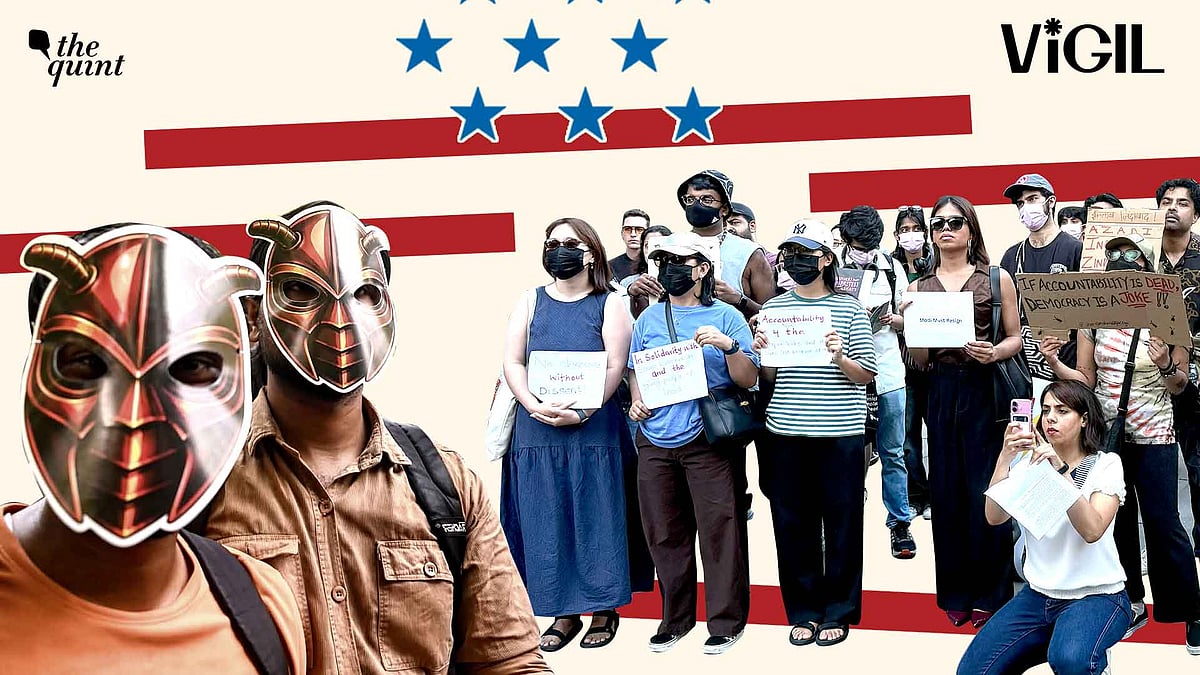
That could have been the end of the wave of protests across the country. Instead, on Monday, July 20, we held a protest in New York where more than a hundred people attended. We’ve since held multiple protests with hundreds of people in the US, UK, and Australia.
Protest in New York City on July 20 in solidarity with India's youth protesters
(Photo: Meghnad Bose)
Whenever a large protest happens in India, our community is hungry to show its support for the protesters. We are inspired by the fearlessness of our Indian comrades.
(The author is Senior Policy Director at Hindus for Human Rights. This is an opinion piece. All views expressed are the author’s own. The Quint neither endorses nor is responsible for them.)