
Why Modi Govt is Turning 'Vote Chori' Protests Into a 'Regime Change' Plot
The nervousness of the government is apparent in how it manipulated a speech to create a false spectre of anarchy.
advertisement
The Modi government and the Bharatiya Janata Party (BJP) are suddenly shrieking about “regime change” from every available media forum. But why should a government, which has always celebrated its political dominance and strong control of state institutions, suddenly feel the need to talk about street protests and the Opposition’s mobilisation of mass support as a threat to its survival?
The way government and party spokespersons are being marshalled to level charges of a conspiracy to bring about “regime change” suggests that there may be some fire behind so much smoke.
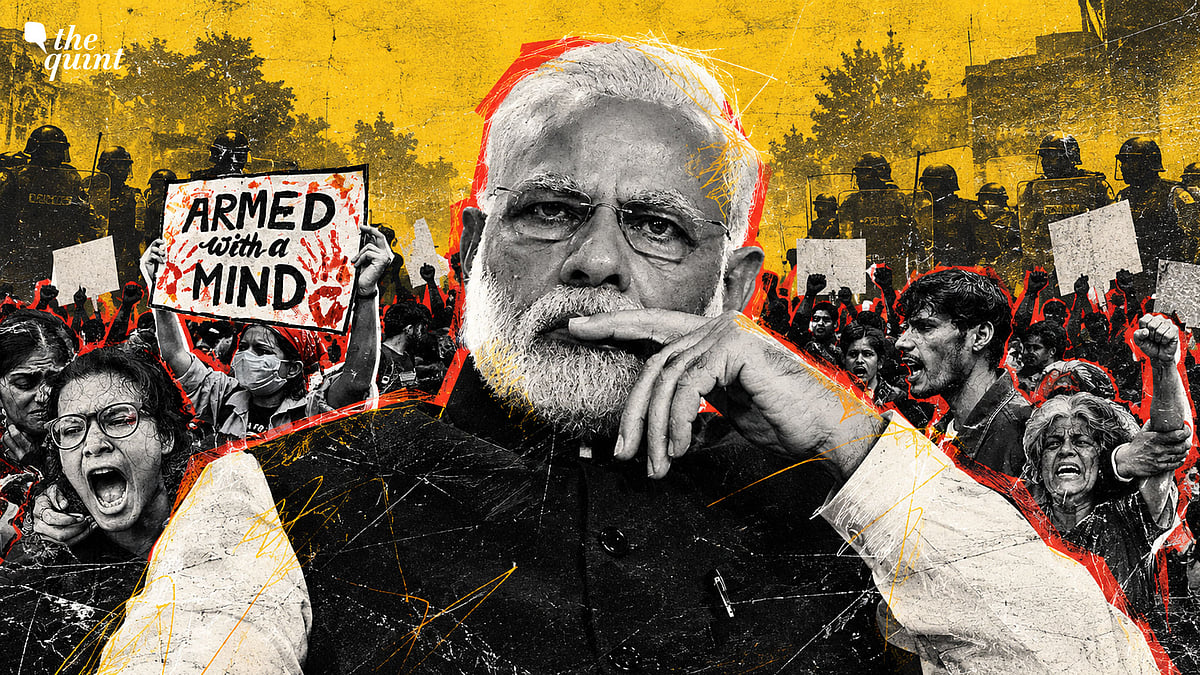
Why has public support for the protests against alleged manipulation of voter rolls to ‘fix’ elections created panic in the government? Instead of answering questions about electoral rolls, voter deletions, and administrative lapses and misdemeanours, as it is expected to do, the Modi government is asking people to judge the protestors by the intentions it has ascribed to them—of "regime change" through street protests.
Regime Change a Possibility?
The Opposition has called out the hype, saying that “regime change is entirely normal in democracy”—and that it is the fundamental duty of the Opposition to “oppose in politics, expose in parliament, and depose in elections.”
The analogy made with Bangladesh is meant to frighten the people as its student-led uprising gave a fresh lease of life to right-wing political forces, especially the Islamic fundamentalists. However, the bogey that street protests can bring Islamic forces to power in India is completely ridiculous. And right-wing, Hindutva forces are already in power in India.
The analogy is also being falsely used to malign left-wing youth leader Neha Bora who is being quoted out of context from a recorded message they sent to Bangladesh’s Socialist Students’ Front.
The nervousness of the government is apparent in the way it has manipulated a recorded speech and used it both selectively and out of context to create a false spectre of anarchy.
If the Modi government is confident of its democratic legitimacy, then it should be able to answer allegations of electoral roll manipulation. Nor can it denounce its opponents for demanding its removal through constitutional means.
Just as in monarchist UK, the Opposition often refers to itself as “His Majesty’s Loyal Opposition,” the Indian Opposition is loyal to the Constitution of India. Not one Opposition leader during the ongoing protests claimed that street violence should be used to bring down the Modi government.
Yet, a government increasingly preoccupied with its own survival has deliberately set out to confuse the survival of the State with the survival of individual political leaders.
Whether there will be regime change before 2029 when the general elections are due—through parliament or through elections—remains to be seen. But clearly, the present government is weaker, and the damage is showing.
Shadow of Force
The Modi government’s handling of the protests reflects this. Its punitive approach to protests in Kashmir or against Naxalites shows that this government does not deal with differences of political opinion with negotiations but with force.
By comparison, its treatment of the anti-CEC protests is milder though still unacceptably brutal by standards followed in the rest of India. The pattern here has been one of dispersal, detention, and release, with very few cases of legal proceedings.
This is different from prolonged incarceration or use of lethal weapons, although some pellet gun firing, tear gas, and baton charges were used initially in July in the NEET stir. So, while the government has not abandoned its hard law-and-order approach, it is far more calibrated than in Kashmir or in Naxal-affected areas.
There could be several geographic, local law and other contextual reasons for this. However, it could also be because the government is unsure of itself and fears that a hard approach will further legitimise the protests among the larger public.
More than a dozen Cabinet ministers are in-charge of more than one ministry, some of them with considerable workloads—Ashwini Vaishnav holds three portfolios (Railways, Information and Broadcasting, and Electronics and IT) and so does Pralhad Joshi (Consumer Affairs, Food and Public Distribution; New and Renewable Energy; and Education).
Does this paralysis arise from fear that a reshuffle may expose factional tensions in the government?
Corporate Overlords Key
Another troubling sign for the government is the active wooing of corporates by the Opposition. While the BJP remains the biggest recipient of corporate donations, the Opposition moves are not insignificant; such as Rahul Gandhi removing industrialist Mukesh Ambani’s photo from the background hoarding of his meetings entitled “Destroyers of Democracy”; or the fielding of a Reliance senior executive Dhanraj Nathwani (son of another Reliance executive Parimal Nathwani, independent Rajya Sabha MP supported by the BJP) by the Samajwadi Party.
The response of corporate leaders will indicate whether they still believe in supporting the present political leadership as a long-term bet or whether they are willing to prepare for an uncertain political future.
After all the significance of US Secretary of State Marco Rubio's visit to Mumbai and Jamnagar to meet Mukesh Ambani cannot be understated. It avoids Delhi altogether and External Affairs Minister S Jaishankar has gone to Mumbai to meet him.
That it was the US ambassador to India who first announced that Rubio expected Jaishankar to come to Mumbai to meet him raises questions about who is setting the terms of the visit.
Could the US choosing to deal directly with India’s corporate bosses without the mediation of Prime Minister Modi suggest a recalibration of its political diplomacy and economic diplomacy vis-a-vis India?
Lastly, one cannot help but be intrigued by the enigmatic claim Rahul Gandhi made before the Congress leaders that the forces that brought the Modi government to power are undergoing internal shifts and could result in increased vulnerability for Prime Minister Modi.
Internal resistance and institutional discomfort with the government, which he seems to be alluding to, can only hasten the process of regime change whenever the electoral moment arises.
(Bharat Bhushan is a journalist based in Delhi. This is an opinion piece and the views expressed are the author's own. The Quint does not endorse or is responsible for them.)
- Access to all paywalled content on site
- Ad-free experience across The Quint
- Early previews of our Special Projects
Published: undefined