
Khan Sir and the 'Good Muslim' Test
The new hate trend against Khan Sir shows that even 'good Muslims' may not be good enough for India today.
advertisement
For years, a tacit distinction has been drawn in everyday Indian discourse between "good Muslims" and "bad Muslims". This distinction manifests openly—whether in the media, political rhetoric, or the evolving portrayal of Muslims in cinema. It is also frequently observed within the culture of society at large and among liberal-secular circles, where a selective narrative regarding "good" versus "bad" Muslims repeatedly surfaces.
Certain Muslims are viewed as symbols of nationalism and national unity, portrayed as such in media and political statements. Others, however, are viewed with suspicion and through the lens of religious fundamentalism.
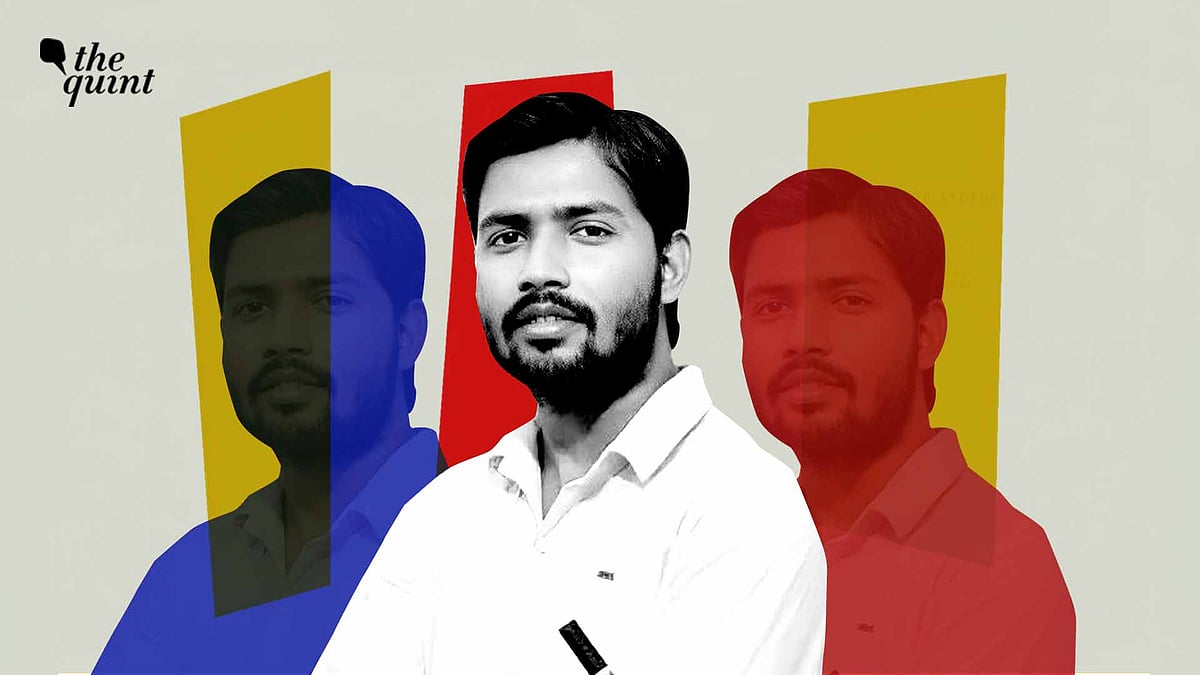
The latest example of this selective acceptance can be seen in the case of Khan Sir, who runs a renowned coaching institute in Patna.
For years, the majority of the population viewed him as a saviour for students in the Hindi belt. But, soon after he made headlines due to the controversy involving another coaching center owner Roshan Anand and the defamation case filed against him by Aaj Tak TV anchor Anjana Om Kashyap, Khan Sir suddenly became Faisal Khan.
The Good Muslim-Bad Muslim Binary
Khan Sir has been quite popular on social media. He's appeared in several TV interviews as well as podcasts. In short, he commands respect as a capable teacher.
Over the years, he has spoken openly about his patriotism; praised the Indian Army, celebrated Rakshabandhan, sang bhajans, and participated in numerous religious events of the Hindu community. No one so far had doubted his virtuous Muslim credentials.
In contemporary Indian politics, this phenomenon serves as a precise example—effectively becoming an unwritten rule within the social and political landscape.
Yet, the reality of modern India goes beyond this. The issue is not merely whom the majority society considers "good".
A far more alarming concern is that the "certificate of goodness" is so fragile that it can be instantly revoked over a minor dispute, leading to attacks not just on the individual's religious identity, but on their entire faith.
Political theorist Mahmood Mamdani in his renowned book, Good Muslim, Bad Muslim, explained how global politics, particularly American foreign policy, categorised Muslims into two groups following the 9/11attack.
"Good Muslims" were those perceived as modern, secular, and aligned with Western interests, and "bad Muslims" were those vocal about their religious identity and culture, often labelled as fundamentalists or viewed with suspicion.
Here, your actions do not define you, your identity does. When a Muslim does appreciable communitarian acts, he is a ‘good Muslim’, but when even a speck of allegation is hurled at him, he becomes the member of an infamous community.
Good but Not Good Enough
Tyranny of time perhaps has even led to the gradual and structural parenting of the society, and blemished the acceptance for "good Muslims" too. Their validation was so fragile and untenable that it could not bear the weight of facts, reasoning, selectivity, and especially structuralism of blame-gaming a certain community.
Saddled with this socio-political weight, the controversy between two coaching centers in Patna led to the all-too-familiar structural war of prejudice against Khan Sir. Legal action was threatened, and the tone of social media and the media changed overnight.
A Collective Burden
A Muslim public figure like APJ Abdul Kalam enjoyed widespread acceptance of the majority. This was largely due to his scientific achievements on Indian soil and other social contributions.
Why did Khan Sir end up on the flimsy and fluctuating list of "good Muslims"?
Was it because he was running low-cost institutes for competitive examinations in the age of capitalism, by democratising education? Or was it because of his unwavering monetary contributions for aid during the COVID-19 pandemic that eventually culminated in the establishment of a hospital in Patna that renders medical services like ECG at Rs 25 and blood tests at Rs 7? Can we call the current anger against Khan Sir a visible perturbation towards eminent Muslims in the public sphere that outgrow the good-bad binary?
To substantiate the fear of Muslims towards the nation’s diaspora, the 2006 Sachar Committee report made two important points.
First, there is a fear within the Muslim community that people always view them as religious fundamentalists and with suspicion. Instead of linking their contributions to India's development, their contribution has been limited to their religious identity.
Second, Indian politicians have consistently used Muslims as a vote bank, securing their votes by threatening their security, while constantly distracting them from their real issues, such as education and employment.
After the Sachar Committee report, no thought was given to society or action was taken to lift Muslims out of poverty and create an educational environment for them. Some political parties labelled this as appeasement (i.e., taking unfair advantage of Muslims).
Performing 'Secularism'
Muslims are often put on trial during controversies, demanding proof of their patriotism, sometimes through political rhetoric, sometimes through heated media debates, and sometimes through new trends on social media. In today's India, Muslims are even stopped by extremists on trains and on streets and asked for proof of their patriotism.
Renowned political scientist Zoya Hasan testifies that now, simply having a voter ID or passport, does not make one a full citizen; now one has to prove their loyalty recurrently to the State.
Delhi University Professor Apoorvanand believes that the definition of a "good Muslim" has become so narrow that only those Muslims who completely conceal their religious identity, such as beard, Hijab, topi (scull cap), offering namaz etc. would be considered 'good'.
If anyone speaks out for their rights while expressing their religious identity, they will be immediately branded as fundamentalist and anti-national.
Secularism, in the real sense, is being regardful of other religions, not always implying being participatory, especially when it is the requisite to prove oneself as a "good". This symbolises a moment when acceptance becomes conditional and equality stands demolished, just like hopes and homes.
(Azam Khan is an independent researcher and writer based in Uttar Pradesh. His work focuses on the experiences of Muslims, Dalits, and other marginalised communities in post-Independence India. Adeena Navaid, is a law student and part-time writer who actively writes on legal, social, and feminist issues. This is an opinion piece and the views expressed are the author's own.)
- Access to all paywalled content on site
- Ad-free experience across The Quint
- Early previews of our Special Projects
Published: undefined