
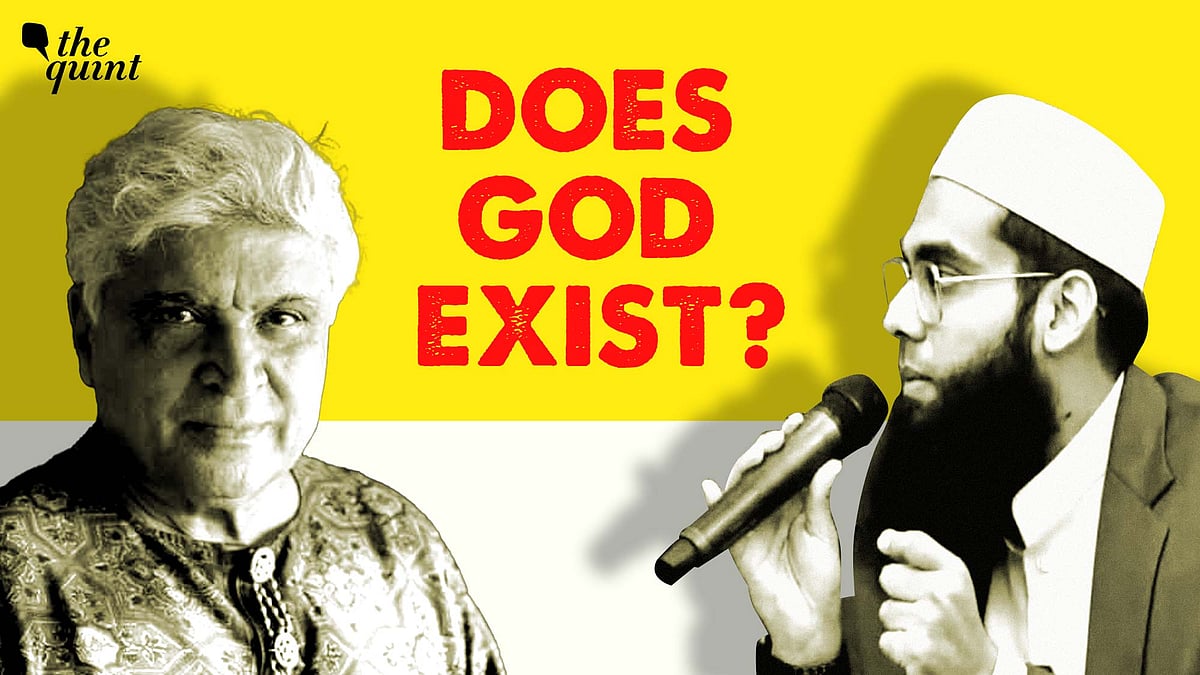
Javed Akhtar vs Mufti Shamail Nadwi: Who Won the Debate on 'Does God Exist'?
A false binary is being created between Javed Akhtar and Mufti Shamail Nadwi. Here's why the debate was significant.
advertisement
The debate on the existence of God between poet Javed Akhtar and Islamic scholar Mufti Shamail Nadwi has received over 10 million views on the YouTube channels of Lallantop and Mufti Shamail Nadwi combined, and it continues to dominate discussions among certain sections of social media.
So who won this debate - Javed Akhtar or Mufti Shamail Nadwi?
I had the opportunity to watch the debate live on 20 December at the Constitution Club in Delhi. But since I have a clear position on the existence of God, it wouldn't be fair to give my opinion on who "won".
Instead, this article will make two arguments.
First, the question of "who won" is itself wrong, and the binary being created between the two speakers is false.
Second, the real political significance of the debate actually lies elsewhere.
Javed Akhtar's Politics
Javed Akhtar and Mufti Shamail Nadwi may belong to diametrically opposite schools of thought on the existence of God, but both are rooted in the North Indian Muslim milieu.
Mufti Shamail belongs to Darul Uloom Nadwatul Ulama in Lucknow, an Islamic seminary founded in 1898. The specific nature of this seminary is important to our argument, and we will come to it in the next section.
Javed Akhtar, too, belongs to a lineage of Islamic scholars. His great-great-grandfather, Fazl-e-Haq Khairabadi, was a religious scholar and freedom fighter who died in British captivity in the Andamans. However, Akhtar's ideological influence comes largely from his father Jan Nisar Akhtar, who was part of the Progressive Writers' Movement.
The politics of the Progressive Writers' Movement wasn't rooted in Islam but it was a product of the political flux among Indian Muslims in the 1930s and 1940s, especially in Aligarh Muslim University (AMU). While a section of these writers supported the creation of Pakistan and moved there in 1947, many stayed back and became key figures in progressive and Left politics in Independent India.
Like the progressive writers, Akhtar has always had strong opinions on what Indian Muslims must do. Whether one agrees with his opinions or not, Akhtar's politics cannot be taken away from the Indian Muslim context.
Mufti Shamail Nadwi's Background
Throughout the debate, Akhtar remained respectful of Mufti Shamail Nadwi and Mufti Yasir Wajidi who was also present at the event and they reciprocated this sentiment. In fact, after the debate, Akhtar said with a laugh, "Now I am going to have lunch with the Mufti and the Senior Mufti".
For more proof on the nature of discourse in Hindutva events, check this report from a recent conclave in Delhi.
The debate between Javed Akhtar and Mufti Shamail Nadwi was organised by the Kolkata-based Wahyain Foundation, headed by the Mufti himself, and the Delhi-based Academic Dialogue Forum. Darul Uloom Nadwatul Ulama, of which he is a product, was founded in 1898 specifically with the aim of integrating the modern education of AMU with the traditional teaching of Darul Uloom Deoband.
Therefore, the culture of integrating different approaches and of encouraging debate is integral to the seminary. For Mufti Nadwi, this approach was further strengthened with his stint at International Islamic University Malaysia where religious studies is taught along with sciences, medicine, law, management etc. The Mufti's Wahyain Foundation also claims to teach "modern education with an Islamic paradigm".
The decision to hold a debate with Javed Akhtar stemmed from the same philosophy of integration.
In fact, if one sets aside the theological aspects of the debate and focuses purely on the politics, Akhtar and Mufti Nadwi seemed to agree on a few fundamental things: both were pained by what's happening in Gaza and both seemed to pitch themselves against dominance of right-wing politics in India.
Political Significance of the Debate
At a time when Islamophobia is rising in India and other parts of the world, holding such a debate in a completely smooth manner was an important statement by the Wahyain Foundation. It was gracious of Javed Akhtar to have agreed to it as well.
It was also symptomatic of a broader churn underway India's civil society.
Many of the spaces and forums for progressives in universities and cultural centres are increasingly coming under the control of people aligned with the BJP and the RSS.
Then, holding events has become difficult for progressive bodies due to insufficient funding and paucity of crowds, especially among the youth. As a result, many members of the progressive civil society have increasingly found space in programmes hosted by Opposition parties and Muslim organisations. Frequent events held in Jawahar Bhawan are cases in point as are events organised by Jamaat-e-Islami that often give a platform to progressive voices.
The generational difference was evident even at the 'Does God Exist?' debate.
The ones rooting for Akhtar were mostly older activists and academics while those supporting Mufti Shamail were by and large young. This is just an observation, not a value judgement on either of the two sections.
This difference became even more clear during the audience round of the debate. The ones who expressed disagreement with Mufti Shamail included prominent writer Purushottam Agrawal and poet and scientist Gauhar Raza. On the other hand, the ones who questioned Javed Akhtar were mostly Muslim students and young Muslim professionals.
It does seem that progressive politics is slowly becoming more and more dependent on Muslim forums and Muslim crowds. This was particularly evident during the anti-CAA protests.
The binary between "liberal Muslim" and "conservative Muslim" is a false one especially in present times where Muslims are reduced to their primary identity. Nothing proves this better than the Delhi Riots 'conspiracy' case in which Communist-Atheist Umar Khalid, ex-AAP member Khalid Saifi, ex-RJD member Meeran Haider, independent Muslim thinker Sharjeel Imam, and independent activist Gulfisha were put behind bars under the UAPA. Hany Babu who was an agnostic coming from a Marxist family, discovered Allah in jail.
These binaries are convenient for those who want to continue to use Muslim crowds and subscribers without engaging with the lived experiences of Muslims.
(This is an opinion piece, and the views expressed above are the author’s own. The Quint neither endorses nor is responsible for the same.)
- Access to all paywalled content on site
- Ad-free experience across The Quint
- Early previews of our Special Projects
Published: undefined