
Why India’s Youth Are Turning to AI for Spiritual Answers
The technology is not the guru. It is, perhaps, the banyan tree.
advertisement
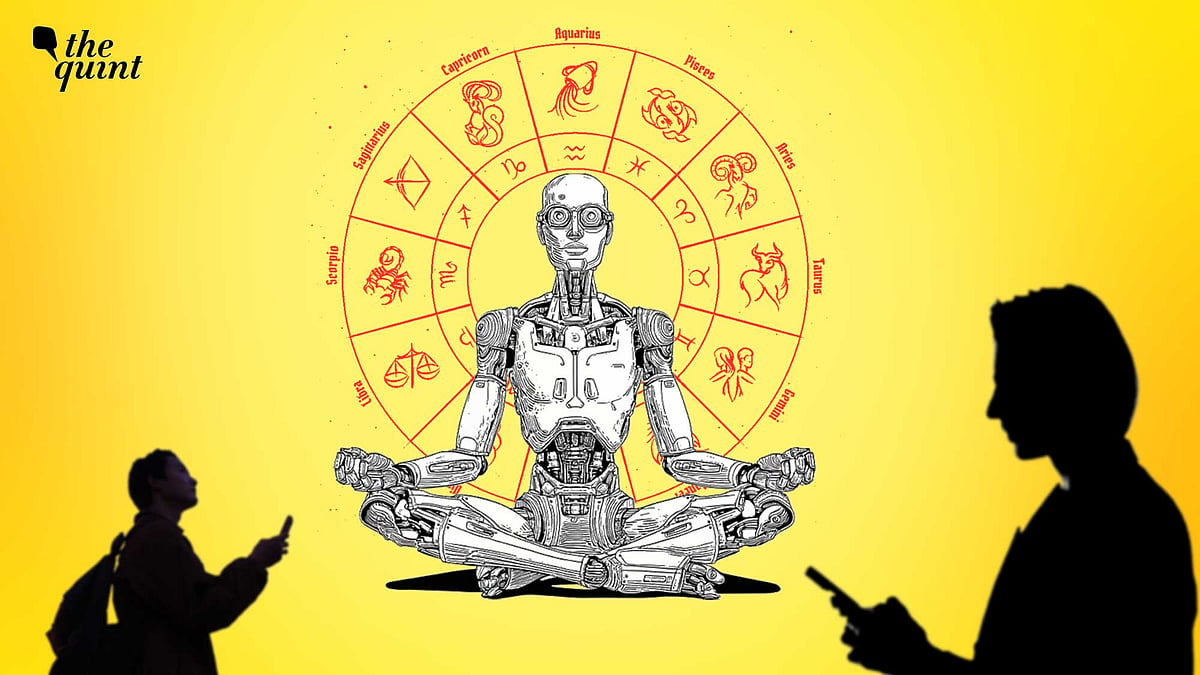
Twenty million Indians a month are asking AI about Saturn transits and the meaning of suffering. This isn’t the death of tradition, it’s the return of its oldest form.
On a Tuesday afternoon in Bengaluru, a twenty-eight-year-old product manager named Divya opens an app on her phone and types a question she hasn’t been able to ask anyone else. Her grandmother is ill. Her career feels like a corridor without doors. Saturn, her astrologer had once told her, governs discipline, delay, and the long reckoning.
“What does Saturn’s transit through my seventh house mean for the choices I’m avoiding?” The AI — AstroSage, one of the fastest-growing spiritual platforms in the country — doesn’t give her a fortune. It gives her a conversation.
This exchange, or something very much like it, is happening twenty million times every month across India. And the question it raises isn’t whether artificial intelligence is replacing ancient wisdom. The question is whether it’s restoring something that was quietly taken away.
When Questions Lost Their Place in Religion
India’s spiritual inheritance is, at its core, a tradition of dialogue. The Upanishads are not scripture in the Western sense — they are recorded conversations, students and teachers under trees, argument and counter-argument spiraling toward insight.
The Bhagavad Gita begins not with proclamation but with crisis, and Krishna’s response to Arjuna’s paralysis on the battlefield of Kurukshetra is not a command. It is a question: “Why this weakness at the hour of crisis?” Truth, in the Indian philosophical tradition, has almost always emerged through questioning rather than pronouncement.
This is the vacuum that a generation of young Indians — the 25-to-35 cohort that now drives seventy per cent of India’s spiritual economy revenues, according to Loestro Advisors’ December 2025 report “Faith Forward: Why Spiritual Tech is India’s Next Digital Dharma Rush” — found waiting for them when they arrived at adulthood with their anxieties intact and their inherited frameworks incomplete.
They were not, as a lazy cultural narrative might suggest, secular and indifferent. They were spiritually curious and institutionally underserved.
India’s New Spiritual Economy
The market that has grown up to meet this unmet need is extraordinary in its scale and speed. The same Loestro report identifies over nine hundred startups operating in India’s spiritual technology space. AstroTalk reported revenues doubling to Rs 651 crore and profits rising tenfold to Rs 94 crore in FY24 alone. AstroSage answered one hundred million spiritual queries in ten months.
These are not niche numbers. They are the kind of numbers that signal a genuine cultural shift.
“Is AI the new guru?” netizens have repeatedly asked, usually as a provocation. But the question misses the point. The guru tradition in India was never about veneration of an infallible authority — at its best, it was about the relationship between a questioning mind and a wiser interlocutor.
The guru’s role was not to eliminate uncertainty but to teach the student how to inhabit it productively. What AI spiritual platforms are doing, when they function well, is creating the conditions for the seeker to clarify their own thinking. The technology is not the guru. It is, perhaps, the banyan tree.
The Temple at the End of the Chatbot
The most counterintuitive finding in the emerging data is also, in retrospect, the most obvious. Digital engagement with spirituality is not replacing physical practice. It appears to be fuelling it.
Kotak Securities’ December 2025 analysis documented record attendance by young Indians at Kumbh Melas, surging footfall at Ayodhya’s Ram Mandir, and a measurable uptick in young urban professionals engaging with temple communities for the first time.
This does not mean the spiritual technology sector is without genuine tensions. A significant portion of what nine hundred startups are building is not shastrarth. It is the ancient anxiety about fate dressed in contemporary interface design — the same fatalism, the same passive relationship to one’s own life, the same search for a prediction rather than a framework.
The worst of these platforms are doing precisely what institutional religion did at its least useful: replacing conversation with a predetermined answer, charging for the service. Whether AI is being used to restore dialogue or simply to monetise helplessness is a question the industry has not fully answered.
The Return of the Questioning Seeker
Divya closes her app having received no prophecy. She has been asked, instead, to consider what her Saturn transit might be asking of her rather than doing to her — the distinction between a universe that acts upon you and a cosmos that speaks to your development. She closes the app with a question she didn’t have when she opened it.
This is modest. It is not enlightenment. But it is recognisably continuous with what the Upanishadic tradition was actually doing — using cosmological frameworks not to predict the future but to give the seeker a vocabulary for their own interior experience. The Saturn question was never really about Saturn. It was about patience, consequence, and the long discipline of becoming.
What is not in doubt is the scale and sincerity of the hunger. Twenty million queries a month is not a trend. It is a reckoning. India’s youngest adults are not walking away from the questions that religion evolved to address: What am I here for? What does suffering mean? How do I act rightly when the right action is unclear? They are asking those questions with the same urgency their ancestors did. They have simply, and correctly, noticed that the institutional containers built to hold those questions have been leaking for some time.
The ancient rishis who conducted the Upanishadic dialogues were not attached to the banyan tree as the medium of wisdom. They were interested in the quality of the questioning. By that measure — the only measure that has ever really mattered in India’s contemplative tradition — the twenty million monthly questions being typed into AstroSage are not a departure from what the rishis were doing. They are, awkwardly and imperfectly and commercially, a continuation of it.
India’s youth are not abandoning tradition. They are returning to its most radical and original practice: the practice of asking, out loud, the questions that actually trouble them — and discovering, as seekers always have, that the asking itself is most of the answer.
(Rishabh Pratipaksha is a writer, ex-journalist, and government officer, and the author of three books. Alisha Butala works at the intersection of emerging technologies, climate change, education, and behavioural science. Pranav Dwivedi works at the intersection of artificial intelligence, public policy, and digital governance. This is an opinion piece. The views expressed above are the author’s own. The Quint neither endorses nor is responsible for them.)
- Access to all paywalled content on site
- Ad-free experience across The Quint
- Early previews of our Special Projects
Published: undefined