
If India Wants Stable Ties With Dhaka, It Must Abandon Unilateral Border Tactics
India can't credibly proffer the hand of friendship while its security forces push the unwanted across the border.
advertisement
A border is a line drawn on a map, but it is also a political barometer. For the past two years or so, the 4,100-kilometre frontier between India and Bangladesh has registered little but low pressure.
The fall of Sheikh Hasina’s regime in August 2024 in the face of an uprising plunged relations between New Delhi and Dhaka into a deep freeze. Recently, however, there have been signs of a fragile thaw after another political government led by the Bangladesh Nationalist Party (BNP) came to power after 17 months of an interim administration.
Cross-Border Tensions Persist
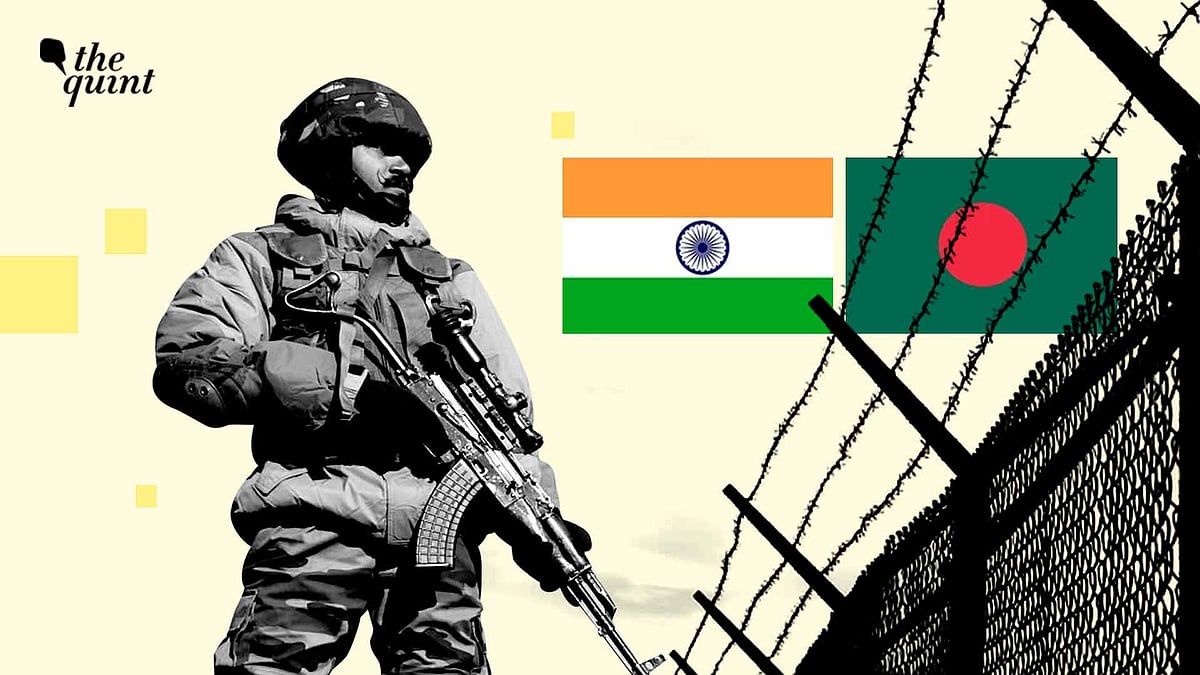
A series of cross-border skirmishes of a different kind is threatening to derail this delicate rapprochement. Over the past few weeks, the Border Guard Bangladesh (BGB) has reported a surge in what Dhaka terms "push-in" attempts—unilateral efforts by India’s Border Security Force (BSF) to herd groups of people across the frontier into Bangladeshi territory.
In a single 24-hour window, the BGB claimed to have blocked 10 separate attempts across multiple border districts, including Lalmonirhat and Chapainawabganj. In some instances, small groups of bewildered civilians, including women and children, have found themselves stranded in the geopolitical purgatory of no-man's-land.
Between mid-2025 and early 2026, some 2,479 individuals were reportedly forced into Bangladesh, with Dhaka claiming that a significant number were subsequently identified as Indian nationals.
New Delhi offers a more sanitised narrative. It insists it is merely managing undocumented migration through standard legal channels, noting that it recently referred some 2,680 suspected Bangladeshis to Dhaka for formal nationality verification.
BJP's Anti-Immigrant Stance
The process of these push-ins cannot be divorced from India’s domestic political theatre. For years, the ruling Bharatiya Janata Party (BJP) used the northeastern state of Assam as its primary laboratory for anti-immigration politics. There, the National Register of Citizens (NRC) and the spectre of the "illegal infiltrator" were potent electoral fuel.
But Assam’s political utility has yielded diminishing returns. Consequently, the BJP’s focus has shifted westward to West Bengal, where immigration from Bangladesh is a highly combustible issue.
For observers in Bangladesh, the sudden spike in border expulsions looks less like routine immigration enforcement and more like performance art for a domestic audience.
The core problem is that India’s domestic political arena is colliding head-on with its regional foreign policy objectives. When Hasina’s Awami League government collapsed, New Delhi lost its most reliable ‘partner’ in South Asia.
For over a decade, India had invested all its diplomatic capital in a single basket, leaving it flat-footed and viewing the new political dispensation in Dhaka with deep suspicion. Trade languished and diplomatic frost set in.
The recent turn toward pragmatism was therefore born of necessity. Both capitals appeared to realise that they were structurally codependent. India needs Bangladesh for transit to its landlocked northeastern states and as a buffer against regional instability; Bangladesh needs India for trade, electricity, and water-sharing.
Yet this fragile reconciliation is being systematically undermined. Every uncoordinated push-in reported in the Bangladeshi press stokes a virulent anti-India sentiment that is never far from the surface in Dhaka.
India Must Stick To Bilateral Norms for Illegal Immigrants
Dhaka’s official position is legally robust and difficult for New Delhi to counter. Bangladesh does not deny that its citizens migrate illegally, nor does it refuse to take them back. Its argument is simple: if India believes an individual is an illegal migrant, it should use the established bilateral mechanisms for verification and formal repatriation.
What it rejects is the uncoordinated, undocumented dumping of human beings over a wire fence. For the authorities in Dhaka, this is no longer just a migration issue; it is a fundamental challenge to Bangladeshi sovereignty.
Now under the stewardship of the BNP and a more nationalistic civil society, Dhaka is pivoting toward a more muscular, autonomous foreign policy. It is actively seeking to diversify its strategic partnerships, look toward Beijing and Washington, and reduce what it views as a humiliating over-dependence on New Delhi.
If India’s strategists believe that border coercion or strong-arm tactics will force Dhaka back into its orbit, they are miscalculating badly. Such manoeuvres achieve the exact opposite.
They shrink the political space for any Bangladeshi leader to be seen cooperating with India, while providing ample justification for Dhaka to accelerate its strategic decoupling from New Delhi.
But statecraft requires alignment between what diplomats say in New Delhi and what border guards do in West Bengal. India cannot credibly proffer the hand of friendship while its security forces are seen as pushing the unwanted across the border.
The current diplomatic thaw is superficial and entirely reversible. Every incident on the frontier chips away at the scarce capital of goodwill that diplomats have painstakingly rebuilt. If India desires a stable, predictable relationship with a post-Hasina Bangladesh, it must abandon unilateral border tactics that Dhaka perceives as coercive.
New Delhi must learn to treat its neighbour as a sovereign equal rather than a satellite state destined to live in its shadow. If it fails to do so, the border will continue to sabotage Indian diplomacy faster than its diplomats can repair it.
(Faisal Mahmud is a Dhaka-based journalist. He was posted as the Minister (Press) of Bangladesh High Commission during the interim government’s period. This is an opinion piece and the views expressed are the author's own. The Quint neither endorses nor is responsible for them.)
- Access to all paywalled content on site
- Ad-free experience across The Quint
- Early previews of our Special Projects
Published: undefined