Gandhi in Cartoons: Why Democracies Need Humour to Thrive
A democracy keeps its proportion when power can be caricatured, in cartoons, reels, comedy and slogans.
advertisement
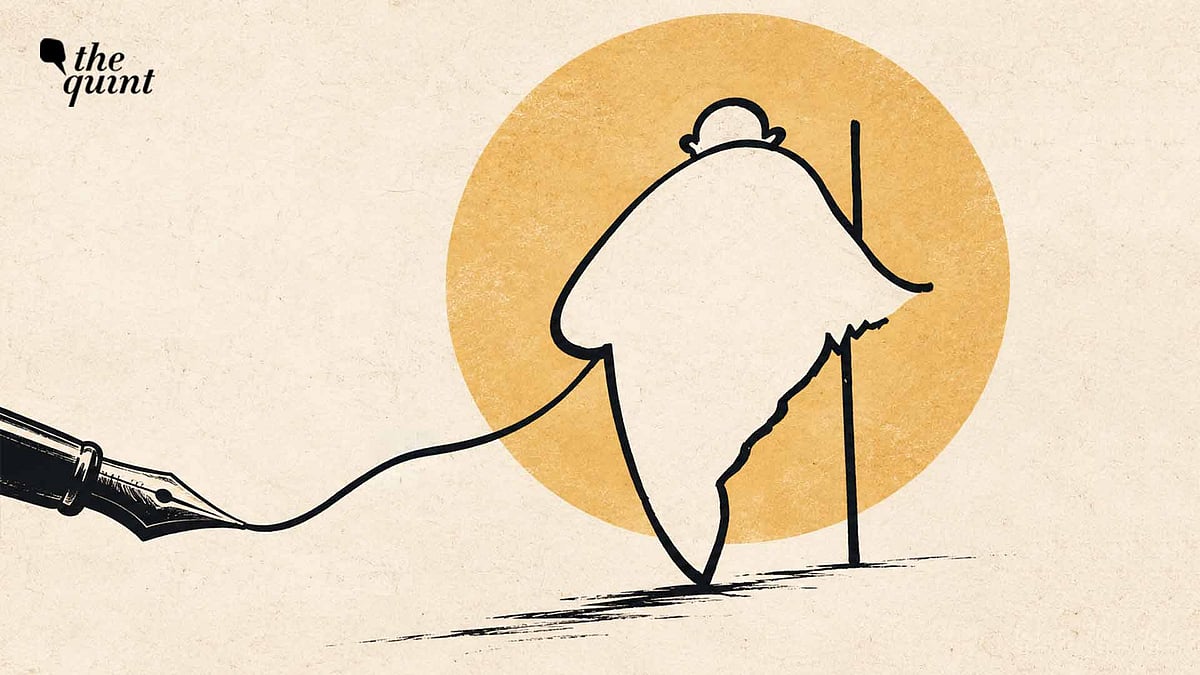
On Gandhi Jayanti, a small Indian postage stamp offers a sterner lesson in democracy than the familiar rituals of official tribute. Issued in 2000 to mark 50 years of the Republic, it bears an unmistakable caricature of Mohandas Karamchand Gandhi, rendered with the apparent ease of a few decisive strokes.
The familiar figure emerges at once: a round head, famously generous ears, a bowed body and a walking stick. His slight, draped form also hints at India's outline, letting a handful of black lines contain a man, a movement, and a nation.
The cartoon frees Gandhi from the stillness of sculpture and secures his place in India’s moral imagination. No crowd rises in applause, nor does any government slogan instruct the viewer to revere him. Gandhi appears in motion: spare, vulnerable and sustained by a moral discipline that transformed physical frailty into public strength.
The irony in the stamp carries weight. The Republic chose a cartoonist’s line to honour the Father of the Nation, placing a caricature into circulation, passing through post offices and official counters, across cities and villages, and eventually into ordinary hands. The choice reflects a democratic assurance now in shorter supply: Gandhi could be revered and still be laughed with.
This confidence matters in an age when public space for caricature is narrowing. At the same time, political leaders appear enclosed by giant screens, colossal cut-outs, choreographed crowds and platoons of image-managers. The stamp offers a quieter, harder challenge. When the flags are folded, the music stops, and the cameras leave, authority must rest upon what cannot be staged: a line, a staff and a person still walking.
The Room That Laughed
Political caricature, whether in cartoons or in today's memes and reels, strips authority of its costume in a few lines, leaving power exposed beneath the ceremonial fabric. I first saw that truth at my birthday party in 1976, during the Emergency.
NK Ranga, my parents' friend from their Allahabad University days, was there. So was K Shankar Pillai, India's great political cartoonist and my mother's mentor. Someone brought out paper and pencils for the children, while the adults drifted into conversation.
Shankar Pillai began with an egg-shaped face, added two ears, and Gandhi appeared. A trembling stroke settled into a tightrope. Gandhi stepped onto it, accompanied by a sharp-nosed Mrs Indira Gandhi. Nothing needed to be explained. The joke was already alive in the room.
While the children's unguarded laughter filled the room, adults joined more softly, knowing that rooms could carry words beyond their walls. During India's Emergency, newspapers had become circumspect, and critics were vulnerable to detention. People had learnt that speech could travel further than its speaker intended, while humour had become a small act of nerve.
The cartoon made power ridiculous without suggesting that power was harmless. A Prime Minister became a sharply drawn nose, and Gandhi became a frail figure balancing above a fall. For a moment, the republic's official gravity lost its footing.
It worked like Vamana in Indian myth: a dwarf who asked the proud King Mahabali for three steps of land. The king granted such a slight request. Vamana then grew into a colossal cosmic figure: Trivikrama, spanning earth and sky; the third step brought the ruler low.
A cartoon may begin with a single line; by the time power recognises its measure, the line has already become a reckoning.
The Measured Line on Political Leaders
Ranga drew many cartoons of Gandhi, several of them signed by Gandhi himself. He caught Gandhi in swift calligraphic strokes: enlarged ears as a comic signature, the upright walking stick a small mast of principle. The figure is nearly a doodle, yet it carries a moral weight that statues and ceremonial portraits often drop. These images now have the force of a democratic fable: a political leader who could receive his own caricature without mistaking laughter for an assault on authority.
Ranga’s spare economy survives in new forms of public speech. It appears in memes, protest chants and brief reels, where a few words can prise open a wound that official statements keep carefully bandaged. One recent example emerged when young women protested sexual violence, harassment and unsafe public spaces. They carried their anger in a chant: “Ek kachori, do samosa… in mardon ka kya bharosa?”—“One pastry, two pies; how can one trust these men?”
The 18th century English poet Alexander Pope used satire through the opposite artistic movement in The Rape of the Lock. He dressed the theft of a lock of hair in the armour of epic war: gods, heroes, ritual and catastrophe. His grand machinery exposed the vanity of small people demanding a large stage.
Ranga’s cartoon travelled in reverse. A world-historical figure came down to the smallest visual vocabulary, while his moral stature remained standing. Pope inflated triviality until it burst; Ranga pared greatness to the bone and found it still alive.
The confidence Gandhi displayed is scarce among political leaders today. The preferred image is enlarged until the citizen disappears: giant screens, towering cut-outs, choreographed entrances and the manufactured weather of deafening applause. When democratic questioning arrives as a cartoon, stand-up comedy, reel or meme, exposing the gaps in governance that official imagery conceals, the questioner is often made to pay for puncturing the manufactured stature of invincible political leadership.
Ranga’s cartoon art now belongs to historical recall. The women’s protest chant is one contemporary expression of the same democratic art: concise, irreverent and difficult to contain. Both bring power back within hearing, measure and doubt.
The question survives the applause: when the screens go dark, who remains?
The Cartoon in Motion
The political reel of the present is the old cartoon set loose on screen. It works with the same sharp economy of juxtaposition, timing, exaggeration and collision between official language and visible fact. A claim of clean elections meets the shadow of a manipulated voter roll; promises of women's safety cut against accounts of sexual abuse; assurances of educational opportunity dissolve before students facing leaked papers, cancelled examinations and a system that has misplaced its own future. The reel delivers in seconds what cartoon art once placed within a few strokes: the polished official portrait meets the visible fact, and the frame begins to crack.
The speed of the online content recalls a line from the Ramcharitmanas, the 16th century North Indian epic in which the poet Tulsidas retells the story of Rama and includes a harsh political truth. Hanuman, the monkey-warrior and Rama's devoted messenger, is captured in Lanka. His enemies set his tail on fire to humiliate him. The punishment outruns its makers:
Hanuman ki poonch mein lagan na pai aag,
Lanka sigari jal gai, gaye nisachar bhag.
"Before the fire had properly caught Hanuman's tail, all Lanka burned, and the demon host fled."
The student protests in New Delhi on 20 July 2026 moved through this visual grammar. Memes and reels travelled with streets, placards, bodies, photographs, slogans and rapidly shared clips. Anger reached public memory before official language could cushion it. One image of a citizen's condition could puncture months of manufactured competence. A viral cartoon, meme or reel does not burn a city; it burns through the varnish of political display.
The Lies Lines Can Tell
Online lampooning has a darker twin. The printed cartoon wore its exaggeration in daylight: a human hand drew the line, selected the target and remained answerable for the question raised. Its place in a newspaper or magazine made its artifice clear. A slogan, meme or reel now moves faster, but can enter public life with fabrication dressed in the calm clothes of evidence. A meme grounded in verifiable fact can expose power; a manipulated clip can poison public truth before correction has laced its boots.
An algorithm can produce a thousand images without the human stake of cartooning. It cannot feel the danger of drawing power during an Emergency, hear the pause around a risky joke or recognise the old wound reopened by a stereotype. It risks no reputation, answers to no target and leaves no conscience at the end of the pen.
Human authorship must remain visible. Synthetic political imagery must be clearly marked, and fabrication must never pass as evidence. Satire needs freedom; democracy needs facts.
The Right to Laugh
Cartoon art increasingly belongs to an older archive, but its democratic work is urgently alive. Its present forms are the meme, the reel, the protest chant and the brief comic sketch. Each returns power to the scale of ordinary sight, where it can be heard, measured and doubted.
A healthy democracy requires leaders with the confidence to survive a small drawing or a message on a reel or meme, and just as Gandhi signed caricatures of himself and understood the distinction: laughter did not lessen moral authority; it revealed whether authority had substance beneath the portrait.
A leader who cannot endure a caricature has mistaken an image for power.
(Dr Navina Jafa is Vice President, Centre for New Perspectives. She can be reached @navinajafa. This is an opinion piece and the views expressed are the author’s own. The Quint neither endorses nor is responsible for the same.)