France Cannot Defend Its Republic Without Fixing Its Schools
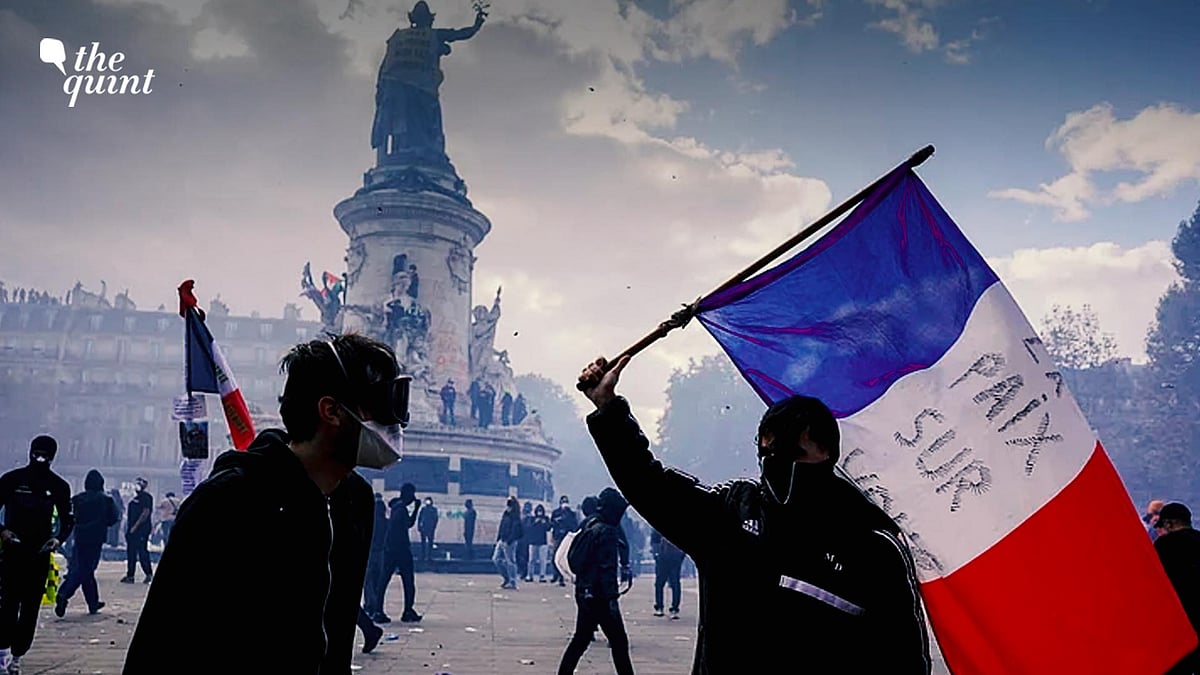
In the largest mobilisation since May 1968, French youth demanded an education that is their constitutional right.
advertisement
The familiar conversation between an Englishman and a Frenchman may once have begun with the weather. Today, the events unfolding in France provide a rather more compelling subject of a republic so devoted to order repeatedly finding itself on the edge of disorder.
Interestingly, there is something deeply paradoxical about France. It is a country associated with etiquette, intellectual refinement, and a certain formality in social relations. Yet it is also a country in which the street can become an arena of political confrontation with astonishing speed. Strikes, barricades, demonstrations and the spectacle of a state challenged by its citizens all belong to its historical imagination.
The revolutions of 1830 and 1848, the Paris Commune of 1871, and the student and workers’ revolt of May 1968 each reopened the question of who had the right to govern, and on whose behalf. The French street is therefore a political institution, an alternative forum in which the legitimacy of established institutions can be contested.
This history should not be romanticised. The destruction of public property, the burning of buses, and the looting of shops cannot be defended simply by invoking the language of revolution. Such violence often injures the very citizens whose interests a movement claims to represent. Yet the temptation to treat disorder exclusively as a failure of discipline is equally dangerous. It allows governments to condemn the spectacle without addressing the conditions that produced it.
Laïcité in Practice
The present unrest, which began with student grievances over overcrowded classrooms, teacher shortages and deteriorating school facilities before widening into anger over the cost of living and public services, raises a fundamental question: What has happened to the French republican ideal, and why is its educational promise becoming a source of such profound discontent?
Education, as is well known, has occupied a privileged place in the French conception of the republic. The secular public school was intended to create citizens rather than subjects, to emancipate minds from inherited assumptions and to establish a common civic culture that transcended religious affiliation and social background.
The principle of laïcité, or secularism, was central to this project. The school was to belong to the republic, not to the Church, and the child was to enter a public world in which citizenship mattered more than inherited ethnic distinctions.
But the existence of a universal educational system does not guarantee equality of educational experience. France possesses institutions of extraordinary intellectual distinction, including its prestigious grandes écoles and elite universities. Alongside them, however, are schools in disadvantaged suburbs where teachers struggle with shortages, and inadequate facilities. The contrast understandably is between the promise of a common republic and the unequal circumstances in which its citizens encounter it.
Private and Catholic schools complicate this picture further. They are a part of the French educational landscape, but their place in a republic committed to secular public education raises enduring questions about social selection, access, and the meaning of a common civic inheritance.
Education as the State's Responsibility
The question, therefore, is whether the state is fulfilling its republican educational tradition. At the centre of this predicament stands the teacher. The authority of the teacher has historically been closely connected with the authority of the republic itself. To teach was to participate in the formation of citizens, to transmit knowledge, and to cultivate the capacity for independent judgment.
Today, teachers in under-resourced schools may find themselves expected to perform this demanding task without adequate institutional support. The erosion of professional authority is a problem of working conditions, social inequality, and the failure to provide schools with the resources their responsibilities require.
A classroom cannot function if teachers are unable to teach, but neither can education fulfil its democratic purpose if obedience becomes its highest virtue. Students must learn to question authority, including political authority. They must also learn that disagreement requires argument, and that freedom entails responsibility. The task of education is to hold these principles together.
Yet May 1968 should not be converted into a reassuring myth of revolution followed inevitably by progress. The upheaval helped change French social and cultural life, but it did not abolish class distinctions or educational inequality. Nor did it resolve the tension between institutional authority and individual freedom.
Its lesson has taught generations in the post-sixties that protest can expose a crisis, but only sustained political and educational reform can address it.
A Revolution's Aftermath
There is a further danger in the present moment which countries across the world must pay heed to. When schools become sites of confrontation, political actors can turn legitimate student grievances into instruments of their own struggles for power. The government can reduce dissent to a law-and-order problem; opposition movements can present every failure of the state as proof that the entire political system has forfeited its legitimacy.
The far right can exploit images of burning buildings to advance a politics of discipline and exclusion, while sections of the radical left may see in the streets an opportunity to mobilise discontent. But we need to admit that neither the appropriation of student anger nor the indiscriminate criminalisation of protest will bring home a remedy.
President Emmanuel Macron's appeal to national unity and his condemnation of violence must be understood in this context. A republic has an obligation to protect citizens, public institutions and the freedom to go about their lives without fear.
But the invocation of the nation cannot, by itself, restore public confidence. Personifying France as a shared national inheritance may carry rhetorical force, yet the republic must not be taken as merely an abstraction to be defended. It is also a set of obligations to educate children, sustain public services, open equal opportunities and nurture an engaged citizenry.
There may be a temptation to hope that, as after May 1968, the crisis will eventually subside and leave behind a more responsive educational system. But history offers no such guarantee. Revolutions do not automatically produce reform, and the restoration of order does not mean the end of discontent.
The enduring question for the French republic is whether it can listen to its citizens without being paralysed by their anger. Its schools are the most revealing place to begin. If they can no longer persuade young people that the republic offers them a future, the crisis will extend far beyond the classroom and the street. It will become a crisis of political legitimacy itself.
(Shelley Walia is Professor Emeritus at Panjab University, Chandigarh, and a former Senior Fellow at the Rothermere American Institute, University of Oxford. He has been writing on political, cultural, and international affairs for nearly four decades. This is an opinion piece and the views expressed are the author’s own. The Quint neither endorses nor is responsible for them.)