
'Jo Bachay...': Fawad Khan's Popularity Tests the Limits of Indo-Pak Jingoism
If Fawad is guilty of anything, it's his ability to make audiences—Indians included—swoon, writes Harinder Baweja.
advertisement
Can patriotism—actually, let’s call it nationalism—be boxed into a television screen? Can it even be policed by our political masters, who now want content emanating from Pakistan to be banned?
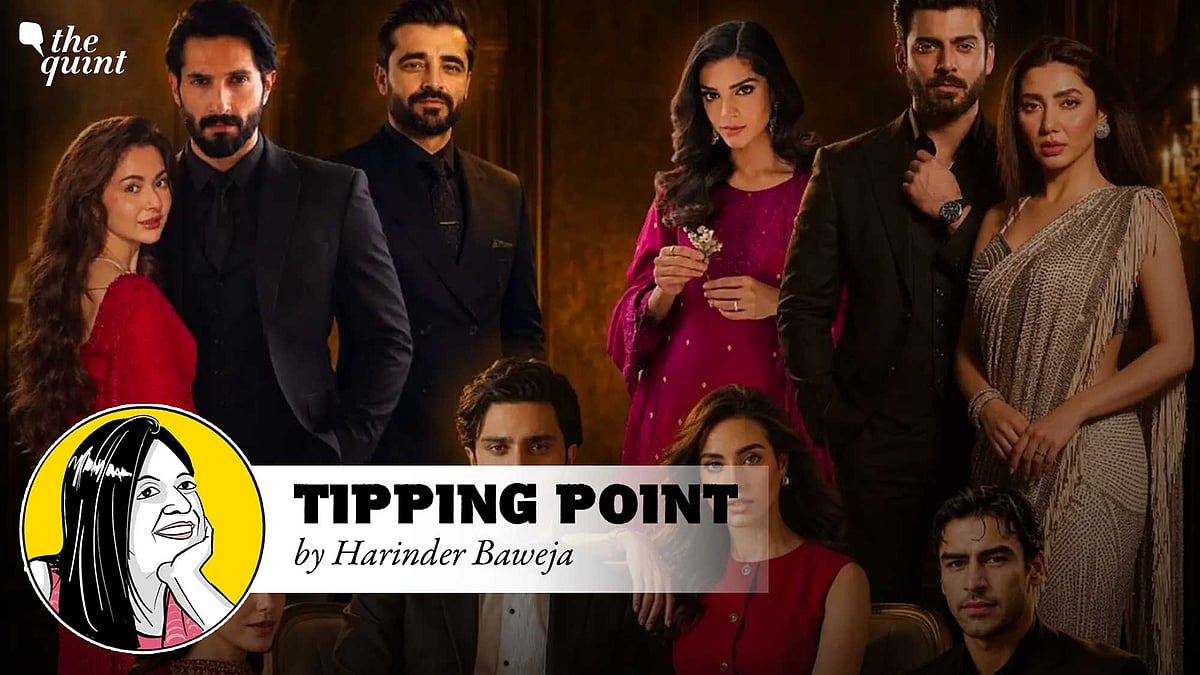
The line of control has truly been crossed with the latest government diktat that forbids Netflix and other OTT platforms from screening Pakistani content in India. The provocation: a promo of a web series, titled Jo Bachay Hain Sang Samait Lo. Starring the hugely popular Fawad Khan and Mahira Khan, among others, the series is slated for a release on 4 December.
Ahead of the much-anticipated release, the Ministry of Information and Broadcasting reminded the screening platforms of its 8 May 2025 advisory, which said, “In the interest of national security, all OTT platforms, media streaming platforms and intermediaries operating in India are advised to discontinue web series, films, songs, podcasts and other streaming media content, whether made available on a subscription-based-model or otherwise, having its origins in Pakistan with immediate effect.”
The 'Crimes' of Fawad Khan
Are Pakistani actors and singers suicide bombers or are they simply putty in the hands of a government that has redrawn the security matrix to script a muscular narrative that furthers their political agenda of divide and rule?
If Fawad Khan is guilty of anything, it is his ability to make audiences— Indians included—swoon. He does that with the intensity in his eyes and not a single word uttered. And then there’s another series, Dar-e-Nijaat, that has crossed all boundaries and wooed Indian audiences. Its male lead, Abu Baker—played by Sheheryar Munawar—is the ideal son and husband who is pious and non-judgmental about his wife’s past.
The word ‘Pakistan’ has become a red flag. The Narendra Modi government, which averred it will not draw a distinction between state and non-state actors after the horrific Pahalgam attack in April 2025 that culminated in Operation Sindoor, appears to be taking the word ‘actor’ literally.
After Operation Sindoor, actors and non-state actors was applicable to Pakistan’s deep state and the terrorist outfits like the Lashkar-e-Taiba and Jaish-e-Mohammad. It is now applicable to all actors, including the ones who woo us with their acting and singing prowess.
Naya Bharat, New Rules
In the new normal, much has changed since the first surgical strike that the Modi government took political ownership of, after the attack in Uri in 2016. The attack, which killed 19 soldiers, saw new red lines being drawn. Then, a ban was imposed on Pakistani stars from acting in Bollywood movies. Governments and their political ideologies determine the red lines.
Till 2016, the red lines had not affected art and culture or ‘soft diplomacy’, even after the Mumbai 2008 terror attack, easily the most audacious strike that paralysed India’s financial nerve centre for three days. The United Progressive Alliance (UPA) was in power, and Dr Manmohan Singh was the prime minister during the 26/11 attack that killed 166 innocents across different sites in Mumbai.
The line was powerful. It served as a reminder of the fact that the power of music had not been partitioned, even though his family had split in 1947.
According to digital history, still available online, Ayaz then re-emphasised the power of a shared civilisational culture by singing the famous Rajasthani folk song, Padhaaro Mhaare Des, a mesmerising rendition that took the gathering where the qawaal promised he would. That evening, he had said, “Let’s go to that undivided land.”
Singh was criticised for being soft while Modi has carefully crafted an image of being a strongman. In the process, however, his government has blurred—perhaps deliberately—the fine line between Pakistan and Pakistanis. The Bharatiya Janata Party (BJP)-led National Democratic Alliance (NDA) is clearly not interested in the power of soft diplomacy that comes with people-to-people contact. When it comes to Pakistan, it is not looking for confidence-building measures.
It demonstrated its lack of diplomatic finesse even during the Asia Cup last year when it expected India’s captain, Surya Kumar Yadav to carry the burden of nationalism by making it a point to not shake hands with his Pakistani counterpart, after winning the toss.
Cinema Belongs to the World
Just like the battle between the bat and the ball, the new red line to not allow the screening of Jo Bachay Hain Sang Samait Lo has become the latest blood sport; a new spectacle that must be waged for political dividends. The All India Cine Workers Association shot off a letter to Modi on 24 November, urging him to ban the upcoming series on the grounds that “Pakistan was and will remain a terrorist country", forgets perhaps, that people on both sides of Radcliffe’s Line are a part of a civilisational core that simply cannot be divided by digital borders.
Think about it. The recent protests that rocked the country after the NEET paper leak protests were full of slogans like, "Hindu-Muslim raazi, toh kya karega qazi". The nationwide protests drew on Faiz Ahmad Faiz’s ‘Hum Dekhengein...’. Is Urdu the culprit here? When and where exactly was Urdu born? Does language have a birth certificate? Does it have a passport that needs a visa stamp?
Fawad and Mahira and Sanam Saeed have passports but does their art and talent belong within geographical boundaries? Dar-e-Nijaat’s Sheharyar Munawar responded to the fear with which community gatherings were being cancelled by simply posting a Rumi quote that said, “Out beyond ideas of wrongdoing and rightdoing, there is a field. I’ll meet you there.”
Cinema and art belong in that field. They belong to that undivided soul that the Sufi qawwal invoked. Ratcheting up tensions is easy, drawing digital boundaries is not. The government will do well to remember that cross-border narratives cannot and should not be criminalised.
What it absolutely cannot do—in the name of nationalism—is partition art and culture. They are part of a civilisational soul that lingers in hearts. In verses, in books, in music, in theatres and on digital platforms. Art truly transcends borders and has the power to bridge and heal painful divides.
(Harinder Baweja is a senior journalist and author. She has been reporting on current affairs, with a particular emphasis on conflict, for the last four decades. She can be reached at @shammybaweja on Instagram and X. This is an opinion piece and the views expressed are the author’s own. The Quint neither endorses nor is responsible for them.)
- Access to all paywalled content on site
- Ad-free experience across The Quint
- Early previews of our Special Projects
Published: undefined