
INDIA Bloc Meet: DMK's Absence Tests Congress's Coalition Politics
By abandoning a proven partner like the DMK, the Congress may have secured short-term gains at the cost of trust.
advertisement
Politics is often described as the art of making alliances. But seasoned politicians know it is also the art of keeping them. Unfortunately, the Congress seems to have forgotten the second lesson in dealing with its most loyal ally in Tamil Nadu.
The Dravida Munnetra Kazhagam's (DMK) decision to boycott the INDIA bloc meeting on 8 June, Monday needs to be read in this context. The party's absence is a warning of things to come—revealing a serious breakdown of trust between the two parties that have worked together for decades.
Why the DMK Feels Betrayed
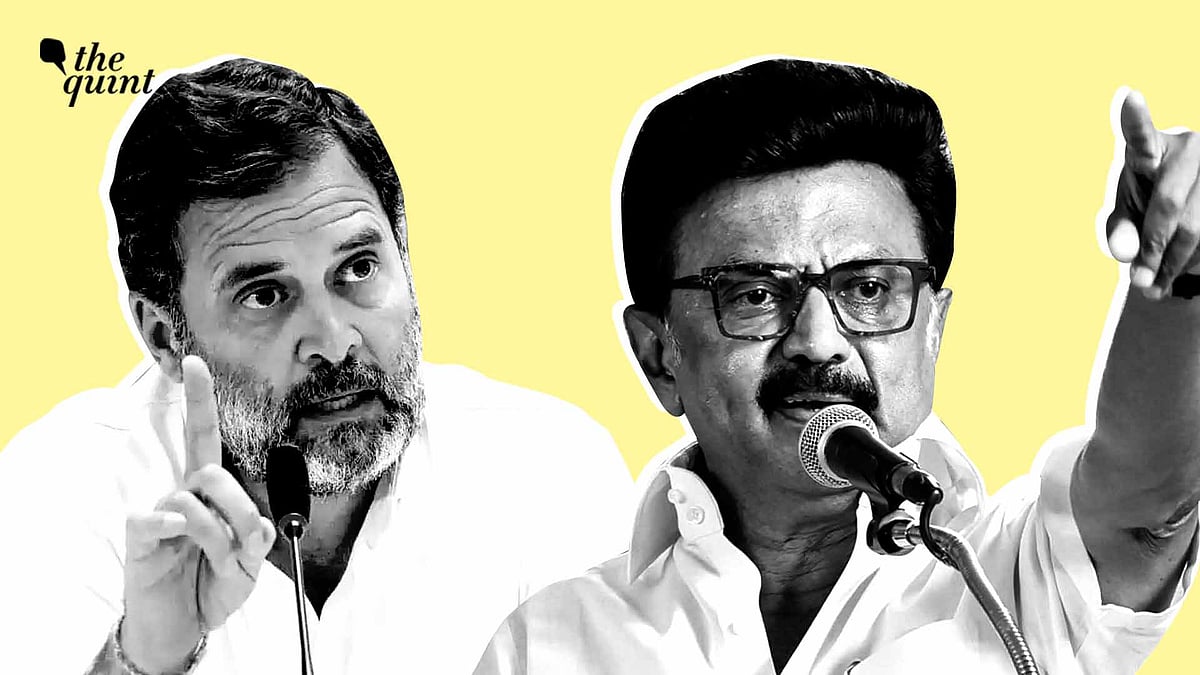
The immediate trigger is clear. After the Tamil Nadu Assembly election, the Congress parted ways with the DMK and aligned itself with Vijay’s Tamilaga Vettri Kazhagam (TVK). For the DMK, this was betrayal. The party accused the Congress of disregarding the sentiments of DMK cadres—and abandoning an ally that had stood firmly with it on important national issues.
Congress leaders attempted some damage control. Their decision to pay tribute to M Karunanidhi on his birth anniversary (3 June) was widely seen as an effort to ease tensions. But symbolic gestures cannot repair a political relationship when the underlying trust has collapsed. The DMK’s firm stance on staying away from the INDIA bloc meeting indicates that the wound runs much deeper.
The message is straightforward: the DMK believes it stood by the Opposition when it mattered, only to be discarded when the Congress saw a new political opportunity.
Did Congress Miscalculate?
The alliance with the TVK has given the Congress a place in the new political arrangement in Tamil Nadu. But politics is not only about what is gained today. It is also about what is lost tomorrow.
More than ever, it is now that the Congress requires stable and proven alliances to effectively challenge the BJP. When it alienates trusted partners in pursuit of political opportunism, it weakens the coalition on which it depends.
The TVK is still a new political force. Its long-term electoral strength remains untested. Its national political position is also unclear. Questions have arisen about the TVK’s willingness to confront the BJP at the national level. The party had an opportunity to enter Parliament through a Rajya Sabha seat to engage in national Opposition politics, but it chose not to. Critics allege it shows the party’s unwillingness to oppose the BJP openly.
Unlike the DMK, the TVK has not established a sustained record of opposing the BJP’s agenda. It has not played a significant role in national debates on federalism, secularism, or minority rights. There is a risk that the Congress may have appeared to have made a miscalculation by choosing an untested partner over a proven ally.
The Leadership Question for Rahul Gandhi
Over the last several years, Rahul Gandhi has sought to project himself as a defender of constitutional values and democratic institutions. He has repeatedly argued that Opposition unity is essential. These arguments have earned him political credibility among Opposition supporters. But leadership is not measured only by speeches. It is measured by political conduct.
The DMK’s problem is not so much that the Congress entered into a new alliance. In fact, its other partners have done the same thing. And political realignments are common in a democracy. The problem is the way it did so. From the DMK’s perspective, the Congress benefited from the alliance during the election—and then walked away in a hurry once the results were known. The other allies took their time and had the courtesy to consult the principal party.
Whether that perception is entirely fair is almost beside the point. In politics, perceptions often become political facts.
What This Means for Opposition Unity
What consequences will this DMK-Congress rupture have beyond Tamil Nadu? Simple. Regional parties across the country will be watching closely. Many are likely to ask whether the Congress remains a reliable coalition partner.
If a party as significant and loyal as the DMK can be set aside when political convenience demands it, what assurance do other allies have that they will be treated differently? Coalitions are sustained not merely by shared interests, but by trust, consistency, and mutual respect. Once these are called into question, the authority of the coalition’s principal partner begins to erode.
In other words, the DMK is not withdrawing from the anti-BJP political space. It is questioning the Congress’s leadership within that space.
That difference may shape Opposition politics in the coming months. Several important Bills are expected to come before Parliament. Opposition coordination will be crucial if these measures are to be challenged effectively. The Congress will most likely discover that managing parliamentary resistance becomes more complicated when one of its most influential allies no longer trusts it.
Of course, the DMK may not support the BJP as its ideological differences with the ruling party remain deep. But it may choose to pursue a more independent strategy. It could coordinate directly with other regional parties. It could build issue-based coalitions without relying on the Congress. It could strengthen relationships with leaders who have also expressed frustration with the Congress’s tendency to assume leadership without always earning it. Such a development would gradually weaken the Congress’s position as the central organising force of the Opposition.
A Warning for Congress’s Future
Could this eventually lead to a third front without the Congress? Although it cannot be entirely ruled out, in the immediate future, that remains unlikely. The BJP remains the principal political opponent for most Opposition parties, and a complete rupture would benefit the ruling party.
However, another possibility is emerging. Instead of a formal third front, INDIA bloc may see the rise of a more decentralised Opposition structure in which the Congress becomes only one among several important players rather than the unquestioned leader. Regional leaders would then exercise greater influence over strategy and decision-making. The DMK’s current position seems consistent with that possibility.
For many years, the Congress had occupied the natural centre of Opposition politics. The reality today is different. Regional parties have become stronger. Several possess organisational structures and voter bases that are more stable. In a way, the DMK’s boycott reflects this changing balance. It indicates that regional parties are becoming less willing to accept decisions that disregard their interests.
For years, regional parties have been skeptical of the Congress’s trust quotient. This episode may only deepen those concerns. Rahul Gandhi now faces a political test: can he persuade his allies that he values loyalty and partnership as much as power and political convenience? The answer may determine not only the Congress’s future relationship with its allies but also its claim to leadership of the Opposition.
(John J Kennedy is an educator, columnist, and political analyst based in Bengaluru. This is an opinion piece and the views expressed above are the author’s own. The Quint neither endorses nor is responsible for the same.)
- Access to all paywalled content on site
- Ad-free experience across The Quint
- Early previews of our Special Projects
Published: undefined