
Congress Sends a Big Message with 3 Deft Calls: Is an Overhaul Next?
The Congress has surprised many by its smooth transition from Siddaramaiah to DK Shivakumar in Karnataka.
advertisement
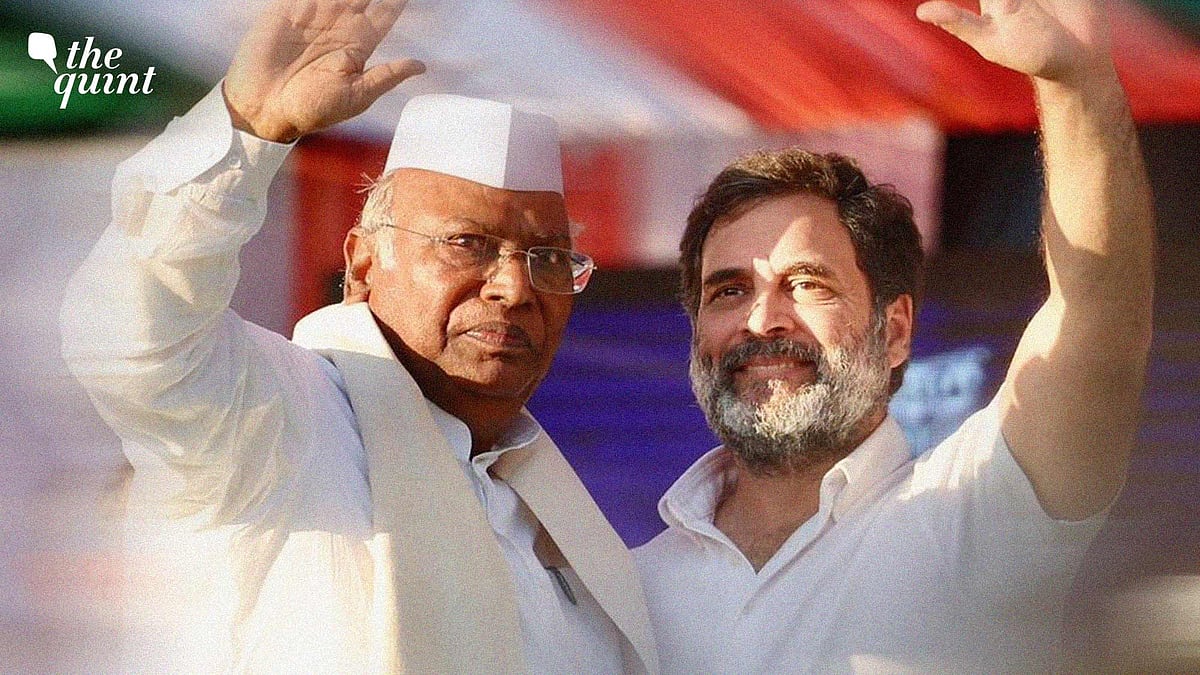
With three deft calls, Leader of the Opposition Rahul Gandhi and Congress President Mallikarjun Kharge have shaken up politics in South India and shown a new kind of decision-making. It is a departure from the party's previous track record.
These decisions are: replacing Siddaramaiah with DK Shivakumar as the Karnataka CM, choosing VD Satheesan over KC Venugopal and Ramesh Chennithala in Kerala and ditching the DMK to ally with Vijay's TVK after the Tamil Nadu Assembly election results.
Why are these three decisions significant?
What does this mean for the party's future plans?
We will try to answer these questions in this piece.
Congress Keeps its Promise in Karnataka
The seemingly smooth transition in Karnataka is a departure from the Congress' track record over the past 12 years, even though it may remind some of the 1970s and 1980s when the party was dominant at the Centre and replaced CMs regularly.
The high command is said to have made "power-sharing" promises in other states as well, but they weren't implemented. In 2018, the Congress came to power in Rajasthan, Madhya Pradesh and Chhattisgarh. In the first two states, it made younger leaders Sachin Pilot and Jyotiraditya Scindia step aside in favour of senior leaders Ashok Gehlot and Kamal Nath. In Chhattisgarh, it went with an OBC face Bhupesh Baghel ahead of TS Singh Deo.
Scindia left the party in March 2020, bringing down the Congress government in MP. However, neither Pilot nor Singh Deo got their chance in their respective states. Congress lost both states in 2023, though in Rajasthan, Gehlot did manage to increase the party's vote share despite the state's pattern of voting out incumbents
In Karnataka, it is significant that the Congress didn't let the issue fester and took a decisive call three years into Siddaramaiah's tenure as CM. It honoured Siddaramaiah with six more months as CM beyond the promised two-and-a-half year arrangement, allowing him to overtake Devaraj Urs as Karnataka's longest-serving CM.
The Karnataka transition was also in contrast to the ham-handed manner in which it replaced Captain Amarinder Singh with Charanjit Singh Channi in Punjab six months before the 2022 elections.
What Changed This Time?
Three things were different from the past.
First, the party wasn't just honouring a promise. It is also rewarding DK Shivakumar for his patience and discipline. Shivakumar didn't try to leave the party like Pilot reportedly did in 2020. He also never publicly spoke against the CM the way Singh Deo reportedly did.
Shivakumar has also stayed loyal to the party despite facing raids and even jail time, due to Enforcement Directorate cases.
Second, a majority of MLAs favoured Siddaramaiah after the 2023 elections due to his status as a mass leader heading a social coalition. However, by 2026 many of these MLAs had doubts if he would be able to lead the party to victory in 2028 when he would be over 80 years of age. As a result, the MLAs became much more amenable to a change dictated by the high command.
Third, the Congress high command presently has a little more political capital, having increased its tally from 52 to 99 in the 2024 Lok Sabha elections, winning a massive mandate in Kerala and emerging as a surprise kingmaker in Tamil Nadu in 2026. It has already been ruling another southern state, Telangana, since the winter of 2023.
This made it slightly easier for the party to enforce its will.
Rewarding Workers' Sentiment
In Kerala, the Congress' choice of VD Satheesan as CM was a way to reward the sentiment among party workers as well as the mandate at large. The high command went against its own initial instincts as well as the wishes of a majority of MLAs in favour of KC Venugopal.
In the past, the party leadership hasn't seen kindly to regional leaders staking claim to leadership through the mobilisation of party workers. However, in Kerala, the party acknowledged Satheesan's popularity and didn't make a big deal of the posters being put up by party workers in his support.
Party Over Alliance
In Tamil Nadu, the Congress ditched its close ally DMK and joined hands with Vijay's TVK after the elections. This was a rare case in which the party prioritised its own interest over old alliances.
In the run-up to the 2014 elections, a section of the party favoured aligning with Nitish Kumar in Bihar instead of Lalu Prasad's RJD. However, in the end, the party went with the latter due to Sonia Gandhi favouring loyalty in alliances.
The alliance with DMK was a Sonia Gandhi era masterstroke. In the run-up to the 2004 elections, no one expected the Congress to go with the DMK. The BJP under Atal Bihari Vajpayee believed it can formally or informally keep both the Dravidian parties on its side. Sonia Gandhi deputed Dr Manmohan Singh to negotiate with M Karunanidhi and he had sealed what has been a strong alliance (except for a brief disruption during the 2014 polls).
Switching from the DMK to TVK is Rahul Gandhi's way of regaining leverage in Tamil Nadu the way Sonia Gandhi did in 2004.
This approach may be an indication that the Congress may drive a hard bargain with the Samajwadi Party in the run-up to the Uttar Pradesh Assembly elections next year.
What Lies Ahead?
The party has clearly laid a precedent through these three moves in the South: rewarding patience and discipline, honouring workers' sentiments and party before alliance.
The question is how the party extends this nationally.
Presently, the party high command is trying to resolve factional feuds in the Punjab Congress. Its latest meeting with state leaders reportedly witnessed an argument between leader of the Opposition Partap Singh Bajwa and state unit chief Amarinder Singh Raja Warring. There is a clamour for replacing Warring as well as for declaring former CM Charanjit Channi as the de-facto CM candidate.
Punjab should have been a low hanging fruit for the Congress. Like Kerala and Telangana, the BJP is a marginal player in the state and the party's main challenger is the Aam Aadmi Party. Punjab has also been voting in favour of the Congress in the past two Lok Sabha elections.
However, the state leadership hasn't quite shown the kind of consistency that say VD Satheesan showed as Leader of Opposition Kerala from 2021 or Revanth Redddy did as Telangana Congress chief from 2021 to 2023.
Instead, the only stories to come out of the Punjab Congress have been factionalism and defections to the BJP.
Whether the Congress sets its house in order in Punjab ahead of next year's assembly elections, will be a test case for the party.
The other challenge is a larger organisational overhaul both in terms of national office bearers as well as state unit chiefs. The most immediate decision would be DK Shivakumar's replacement in Karnataka. The second most longest serving PCC chief is Govind Singh Dotasara who has been at the helm since 2020. It won't be easy to replace him since he belongs to the influential Jat community in the state.
The fate of Vincent Pala (Meghalaya PCC chief since 2021) is likely to be decided after the Shillong Lok Sabha bypoll due in the next couple of months. Then there's Warring in Punjab, who was appointed four years ago.
There may be need to overhaul AICC general secretaries as well. For instance Bhanwar Jitendra Singh has resigned as in-charge for Assam after the party's defeat in the Assembly polls. A few other general secretaries have been in their positios since even before Kharge became the party chief in October 2022.
- Access to all paywalled content on site
- Ad-free experience across The Quint
- Early previews of our Special Projects
Published: undefined