
Crocs, Snakes to Guard Rivers in Indo-Bangladesh Border. Lions on Patrol Next?
Anyone would know that crocodiles or snakes cannot be trained to identify between friends and foes, writes SK Sood.
advertisement
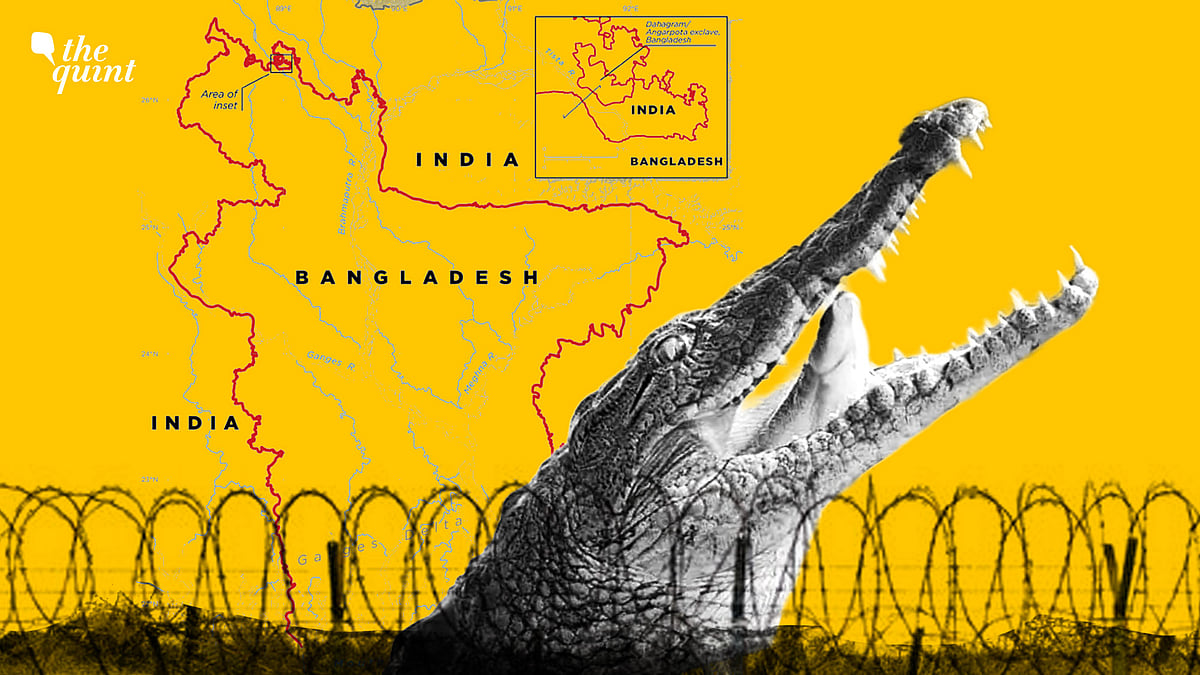
"Irony died a thousand deaths" aptly describes the recent directions by the Director General of the Border Security Force (BSF) to its lower formations—particularly along the eastern borders of India with Bangladesh—to explore the possibility of deploying crocodiles and snakes to keep the riverine stretches of border under surveillance.
The news, reported first by digital portal Northeast News, goes on to state that “the matter was considered crucial enough for the BSF top brass to discuss and deliberate upon in a meeting chaired by Director General Praveen Kumar on 9 February this year.”
Subsequent reports by other media channels have reported that this message was indeed issued. A report in The Hindu went on to note that the directions to field formations for the “use of reptiles is in line with Union Home Minister Amit Shah’s directions”.
Outsourcing Border Patrol to Wildlife?
The suggestion is similar to another outlandish idea that was floated by the then in-charge of the Western Frontiers in 2018. Fortunately, the idea was, at the time, opposed by a formation commander. The latter had grown with the organisation and was familiar with all facets of border guarding and management.
Even a layperson would identify the proposal to be outlandish. Anyone would know that crocodiles or snakes cannot be trained to identify between friends and foes.
Perhaps the idea was floated in jest and the Director General took it as a serious proposition? Furthermore, politicians who do not have a feel of the ground are often prone to float such views or "out-of-the-box" ideas, which may or may not be practical. The professionals, however, have a responsibility to project the correct picture and explain the feasibility or otherwise of that idea. The Director General directly reports to the Home Minister—and he should have presented the correct picture, explaining that the idea was not workable.
Quoting a colleague here, who said,
Jokes apart, the colleague, not unlike me, wondered how these reptiles were supposed to distinguish between intruders and our jawans. "This sounds riskier than practical. It is time to move towards tech-driven border management, drones, sensors, and AI. Not crocodiles or snake charmers. We need less gimmicks, more technology.”
If true, this incident shows that if the leader of a force does not have any exposure to the specialised domain of the force he has been assigned to lead, they are neither expected to have the professional insight or wherewithal nor the courage to explain the actual position to their political masters.
Overworked Jawans Need Tech Solutions
Instead of wasting time and energy of the entire force on this outlandish idea, the Director General should have projected the need of acquiring proper technology and equipment to facilitate better surveillance of the borders.
The BSF has been detecting tunnels transcending the border since about 1996. However, we have not yet been able to find any technological solution for the task. The patrols are still having to physically look for them or depend upon locals to stumble upon one such tunnel to inform the nearest BSF posts.
Pakistan has been using drones to send weapons and drugs to India, yet the premier border guarding force of the country has developed only limited capability to detect or intercept these objects.
The fate of the proposed extension of the Comprehensive Integrated Border Management System (CIBMS) to all borders—though said to be successful—is unclear, even after trials both on the Eastern and the Western borders. Even the induction of low cost technology to ascertain identity of persons crossing the fence for work/farming or staying in their villages located across the fence has not happened yet.
Where it has happened, it is due to the initiative of the local commanders who know the intricacy of the day-to-day border problems of the jawans and the border populations.
Border guarding is also severely hampered by frequent withdrawal of troops from borders for duties like elections, besides almost permanent deployment of troops in troubled states like Manipur.
National Security Needs Scientific Temper
It is laughable that even in the 21st century, the leaders of a professional border guarding organisation continue to have such unscientific and archaic mindsets.
This also once again highlights the travesty and irony of the CAPF (Administrative Reforms) Bill 2026, recently passed by both the Houses of Parliament.
The leaders of the force do not have any connect with operational realities—and command these critical forces simply because they belong to the bureacracy. Such leaders are not professionally equipped to project the real picture to the political executive.
In the meantime, such absurd ideas are likely to continue being floated.
(Sanjiv Krishan Sood (Retd) has served as the Additional Director General of the BSF and was also with the SPG. He tweets @sood_2. This is an opinion piece and the views expressed above are the author’s own. The Quint neither endorses nor is responsible for the same.)
- Access to all paywalled content on site
- Ad-free experience across The Quint
- Early previews of our Special Projects
Published: undefined