
Budget Cuts, Demolitions, False Narratives: Inside BJP's War on Madrasas
The campaign to stop state support for madrasas is contrary to the spirit of the Constitution, writes Harsh Mander.
advertisement
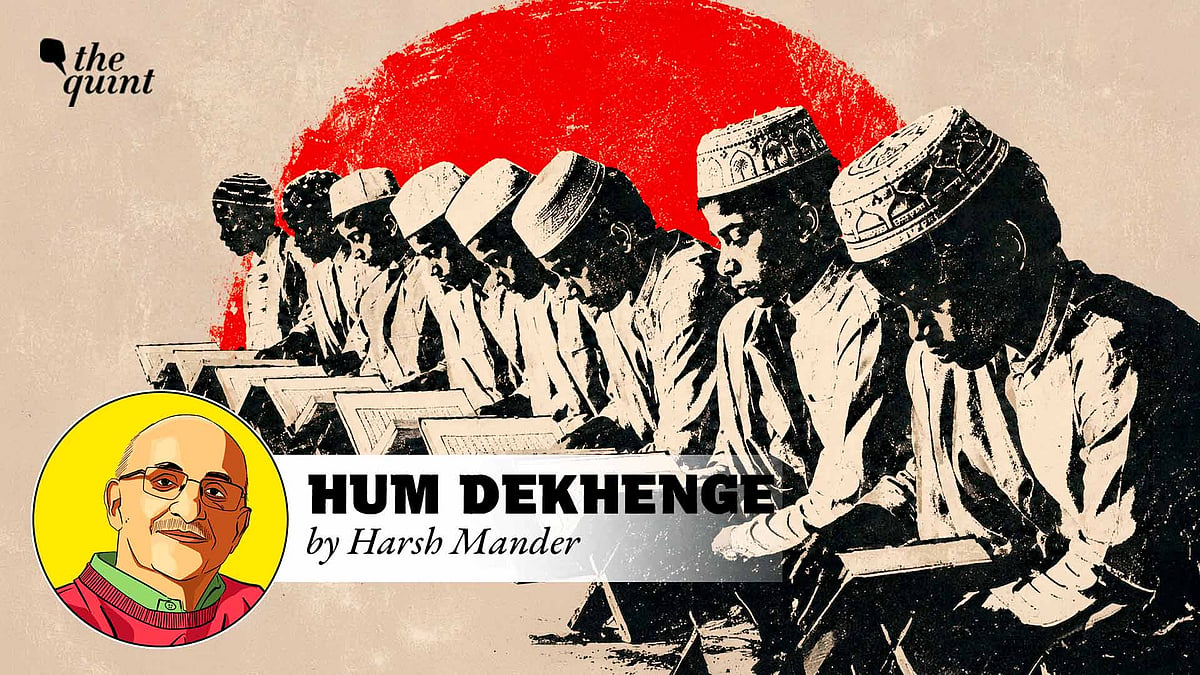
For a thousand years, madrasas have been an integral part of India’s social and cultural life. But, today, their survival itself is gravely threatened.
Not just are madrasas targeted by their cultivated demonisation—they are imperilled even more by concerted state actions by the Bharatiya Janata Party (BJP) governments to close and seal madrasas, detain madrasa students and teachers, and withdraw the meagre state support to madrasa education.
But madrasas were not just sites of religious education for Muslim children. India’s first president Rajendra Prasad studied in a madrasa. In his autobiography, Prasad fondly records his debt to “maulvi saheb”, who “initiated” him “into the alphabet”.
The rulers of the Delhi Sultanate of the Slave, Khilji, and Tughlaq dynasties patronised madrasas to spread learning. This royal patronage of madrasas continued under the Mughal emperors. Akbar, in particular, is remembered for introducing a new focus on the rational sciences, including astronomy, mathematics, medicine, natural sciences, and logic in the curriculum of madrasas.
Colonial Rule Pushed Madrasas to the Margins
The word madrasa in Arabic literally means a place to study. It derives from the word darasa, which translates into “to learn” or “to study.” Believing Muslims view madrasas as obedience to the first command from Allah— iqra, which means “read” or “seek knowledge.” In Persian, the word madrassah—meaning a place of learning—pre-dates even Islam.
With the arrival of British colonial administrators and the introduction of English-medium education, traditional Islamic education became increasingly marginalised. This resulted in madrasas returning to their original focus on religious education to remain relevant.
Madrasas were centres of revolt during the 1857 first war of Indian independence. Maulanas of most madrasas were against the British rule, supportive of the freedom movement, and opposed to the Partition. They called for total freedom even at the time when many freedom fighters restricted their demands to “home rule”.
Madrasas in Independent India
Madrasas continued to operate in independent India, funded mostly by Muslim charity or zakat and with some state funding. According to a Ministry of Minority Affairs report in 2018-19, India had 24,010 madrasas.
There are two kinds of madrasas. One are those entirely funded by donations from the Muslim community, particularly the religiously enjoined zakat. The others had some state support to supplement the community charity. Madrasas supported by the state were organised under various state madrasa boards that made grants to the madrasas.
The curriculum of the state madrasas were at par with the syllabus of different state education boards. Students enrolled in the state-run madrasas studied the regular state board syllabus, along with some religious texts.
Residential madrasas are chosen mostly by impoverished Muslim parents because they ensure free education, food, and clothes for their children. Tabassum Barnagarwala of Scroll.in visited Bihar’s poorest district Araria to understand why parents send children to madrasas sometimes often hundreds of miles away in other states. She reports that “behind the exodus is crushing poverty and the hope of a better life for the next generation”.
As many as 52.07 percent of the district’s population survives below the poverty line, dependent mainly on farm labour and migration. Monsoon rains often devastate the fields that then suffer long dry spells. The parents are either school dropouts or had never been to a school; the district’s literacy rate is 53.5 percent. They send their children to faraway madrasas not just for the education that they were denied, but also in the hope that they have a better chance of survival.
Muslim majority settlements are usually underserved by sufficient numbers of well-functioning public schools. Private schools are unaffordable for impoverished parents. For them, the madrasa is the only resort for ensuring that their children are not left unlettered. And the food and lodging that residential madrasas provide often gives the child better material conditions than in their own homes.
Demonising Madrasas as Terror Hubs
The Modi years have been marked by concerted attempts to taint with stigma, suspicion, persecution and criminalisation all evidence of Muslim identity and community life. Dress, prayer, shrines, waqf, food, language, livelihoods, habitats, personal laws, relationships with people of different faiths, civic, and political participation: each of these are relentlessly pilloried. The popular common sense is moulded to denigrate and denounce these as un-Indian, repellent and threatening, worthy of public ostracism and state repression.
The most pernicious charge fuelled both by Hindutva organisations and BJP leaders, including BJP chief ministers, is that madrasas are schools of Islamist radicalisation. This false narrative has contributed to justify both state and civilian attacks on these institutions although these have been part of the Indian cultural and educational landscape for a thousand years.
During the Atal Bihari Vajpayee regime, a campaign was ignited against madrasas claiming these were “anti-national” breeding grounds for terror. When LK Advani was the home minister, he ordered an inquiry into the linkages of madrasa education to extremism and terrorism. Despite the ideological inclinations of the ruling establishment, the police could not come up with any concrete evidence of any such linkages. Therefore, the inquiry was quietly shelved.
Sadly, even sections of the Left were also not exempt from such prejudices. The Marxist Bengal Chief Minister, Budhhadeb Bhattacharya, also dubbed unauthorised madrasas to be dens of anti-national activities by Islamic fundamentalists. He had later to tone down his remarks under pressure from his party.
The ‘Terror Hub’ Narrative Gains Political Currency
But such discourse became commonplace in India after 2014. Union minister Giriraj Singh repeatedly describes madrasas and even mosques as a grave security threat to the country “particularly grave in the areas bordering Nepal and Bangladesh.”
The Uttar Pradesh Waqf Board chairperson, a political leader of Muslim identity, stirred the pot by alleging that madrasas are producing terrorists. Priyank Kanoongo, chairperson of the National Commission for Protection of Child Rights (NCPCR), is a dedicated campaigner of allegations that madrasas teach terror. He claims that madrasas neglect secular principles, and radicalise students by enrolling Hindu and other non-Muslim children and exposing them to Islamic education.
In an appalling incident in Jharkhand, the police egged on by local villagers thrashed a 12-year-old madrasa student, declaring that all skull-cap wearers are terrorists. Villagers demolished a madrasa in an alluvial river island in Goalpara district of Assam claiming it is the site of “jihadi activities”. The students and parents were devastated. This was their only chance of any kind of education: the high school was too far, and the madrasa also provided free food and lodging.
During Ram Navami on 1 April 2023 in Biharsharif, a Bajrang Dal mob of around 150 men went on a rampage, looting and setting Muslim properties on fire. Among their targets was the historic Azizia Madrasa. Established in 1910, this was an icon of Muslim culture and knowledge. The mobsters burnt down the library with 4,500 books of philosophy, science, and Islamic jurisprudence, including 250 precious handwritten manuscripts.
There were two reasons that the Bajrang Dal gave for the destruction of this prestigious centre of learning, knowledge and religion. The first was to avenge the alleged burning down of the Nalanda University by Bakhtiyar Khilji in 1197. And the second was the unsupported claim that the Azizia Madrasa was a den of terrorism.
Similarly, after a blast in the Rameshwaram Cafe, the VHP Karnataka Dakshina Prantha called upon the National Investigation Agency (NIA) to raid mosques and madrasas which it claimed have become "safe havens for terrorists".
The Asphyxiation of Madrasas in the Modi Years
In this overall social and political climate of prejudice and hostility targeting Muslims, increasingly weighed down by officially fostered prejudice, the Union and BJP state governments have drastically reduced budgetary support, sealed, closed, and demolished madrasas.
The NCPCR asked the state governments and union territories to stop funding madrasas and madrasa boards. It also recommended that madrasa boards be discontinued and shut down. The Union government accordingly slashed madrasa funding to almost zero, a dramatic reduction from earlier allocations, following the NCPCR's recommendation to shift madrasa students to formal schools.
In 2023-24, funding for education schemes for madrasas and minorities was slashed by 93 percent, dropping to just Rs 10 crore. In 2024-25, it was further reduced to a mere Rs 2 crore. The 2025 Union Budget showed that the Education Scheme for Madrasas and Minorities has been effectively discontinued, with a 99.5 percent reduction from its paltry budget of Rs 2 crore to Rs 0.01 crore. For the first time, the FY2026–27 Union Budget made no provision whatsoever for the scheme, underscoring the continued absence of meaningful financial support from the Central government.
Madrasas that run only on community charity donations are usually unable to afford to hire teachers for secular subjects. Even the religious teachers are often not paid their very meagre salaries for months. The result is that without state support madrasas are left with no option except to offer just religious teaching and not modern subjects. These leave students unskilled and unfit for employment outside as imams in mosques.
The BJP governments are targeting these with closure of what are listed as “unrecognised” madrasas. Many madrasas are “unrecognised” only because since 2015, the government has not accorded recognition to any madrasa. A madrasa administrator said,
Uttar Pradesh Chief Minister Yogi Adityanath is prominent among the baiters of madrasas among chief ministers. His government conducted a survey of madrasas operating in the state, to assess and gather information about the operations, source of funding, mode of education, resources available and facilities. The stated aim was the “betterment for the madrasas”.
The government formed a three-member high-level special investigations team (SIT), led significantly by the Additional Director General, Anti-Terrorism Squad (my italics), to investigate overseas funds received by all 16,000 recognised, privately funded and state-aided madrasas in the state. The choice of a body mandated to investigate terror to investigate religious schools is revealing. The SIT was asked to check if foreign funds were used for any illegal activities, including terrorism and religious conversion.
The investigation found around 25,213 madrasas in the state. There were 16,462 recognized by the government, but only 560 aided by the government. The survey also listed 8,500 unrecognised madrasas in Uttar Pradesh. The government sealed or demolished many of these madrasas, disrupting the education of thousands of impoverished children.
The Crackdown Moves From Rhetoric to Closures
The higher judiciary also played its part. Its lethal strike on madrasas was when the Allahabad High Court struck down the Uttar Pradesh Board of Madarsa Education Act, 2004 governing madrasas in UP, ruling that it violates India's constitutional secularism. It ruled that the Act violates the principles of secularism enshrined under the Constitution, and that it is against the fundamental right to equality under Article 14 and the right to free and compulsory primary education under Article 21A. It ordered that students be moved to conventional schools.
The next blow was to stop the payment of a small stipend to 21,000 graduate teachers who were recruited to teach “modern subjects” in madrasas. (Incidentally, 6,000 of these teachers were of Hindu identity). This effectively rendered these 21,000 madrasa teachers jobless. There are reports of them falling back on plying rickshaws or manual labour in order to survive.
Other BJP governments followed a similar trajectory. Madhya Pradesh had a total of 2,689 madrasas in 2021. The state government ordered the closure of 1,012 among these over the three years until 2024. The registration of another 577 madrasas were kept in abeyance. The Uttarakhand government sealed over 170 madrasas for non-registration, and announced that it will end all financial assistance to 500 registered madrasas.
The assault on madrasas is most comprehensive in Assam. Chief Minister Himanta Biswa Sarma often declares his intention unambiguously. He said he would shut all government-funded madassas because he will not permit religious teaching with public money. But his ban extended to all madrasas. “I intend to close all madrasas because we do not want madrasas. We want schools, colleges and universities.”
He dubbed madrasas as “terror hubs” and his government ordered the demolition of many madrasas. These demolitions were accompanied by high-profile arrests of individuals charged with connections to terrorist organisations like the Al-Qaeda and Ansarullah Bangla Team.
To accomplish this, he introduced a law in 2020 by which all state-run madrasas were to be converted into “regular schools” that impart “general education”. The law to abolish two madrasa education-related Acts—one in 1995 and the other in 2018. The conversion of state-funded madrasas into what are called Middle English general schools under the supervision of the State Directorate of Elementary Education is accomplished. In 2024, he announced that his government was trying to negotiate with private madrasas—madrasas run on private donations and receive no government funding—for their closure as well and conversion to general schools.
What the State Should Do Instead
There are many lessons that the state can profitably learn from the experience and challenges of madrasas in India today.
Madrasas point to the still substantially unmet responsibility of the state to lift families that are socially disadvantaged by caste, religion, ethnicity and geography from the desperate levels of poverty that choke up the pathways available to them to secure a decent education for their children.
That governments need to greatly expand primary and secondary government schools in pockets of high concentration of Muslims.
Far from policies to block off state support for modernisation of madrasas, these need to be expanded significantly. The state and the community need to join hands to ensure that every madrasa becomes a site both for religious teaching and for studies in science, mathematics, history and literature.
The government should more effectively create linkages at every level of madrasa education with the systems for mainstream education.
Madrasas fulfil this felt need in the community, because of which large numbers of Muslim boys and girls who study in mainstream schools attend madrasas for religious education. If parents and children wish for children to be schooled in the scriptures and teachings of Islam, they are guaranteed the fundamental right to do this. The hostility of the BJP governments to madrasas is the outcome of the RSS hostility to Islam, its institutions, and its teachings.
Beyond religious teaching, the madrasa fills gaps in existing state provisioning of primary and secondary education. In more than three-quarters of a century, the public education systems have still failed to reach many very impoverished Muslim families living in Muslim-majority areas that are poorly served by good-quality government schools.
In this sense, madrasas do not seek to compete with, even less supplant mainstream public education. On the contrary, they complement it by reaching to places and children that mainstream public education still substantially excludes.
I am grateful for research support from Omair Khan and Syed Rubeel Haider Zaidi.
(The author is a social activist, writer, and researcher who started the Karwan-e-Mohabbat campaign in solidarity with the victims of communal or religiously motivated violence. This is an opinion piece and the views expressed are the author’s own. The Quint neither endorses nor is responsible for them.)
- Access to all paywalled content on site
- Ad-free experience across The Quint
- Early previews of our Special Projects
Published: undefined